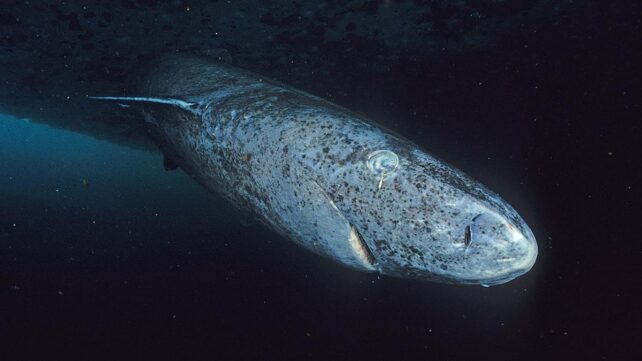
A new analysis of the eyes of some of the longest-lived animals on Earth could provide molecular clues about long-lasting vision.
Scientists had long assumed that Greenland sharks (Somniosus microcephalus) have, at best, exceedingly poor vision. They spend most of their centuries-long lives in the dim depths of the ocean, often sporting parasites attached to their corneas.
A team of researchers from the US, Switzerland, and Denmark has now found that Greenland sharks can see – and retain a functional visual system for quite a long time.
This finding suggests that some aspect of the remarkable DNA repair toolkit linked to the sharks' exceptional longevity may help keep their retinas unusually sprightly… although it's unclear if this will have implications for human eye health.
Related: The Genome of The Greenland Shark Reveals The Secrets to Its Longevity

The research was conducted on the eyes of Greenland sharks caught and euthanized between 2020 and 2024 under a research permit issued by the territory's government. These sharks all had estimated ages of more than a century, with the oldest estimated at more than 130 years.
Greenland sharks spend most of their time in deep waters, up to 1,200 meters (3,940 feet) below the surface, although they can dive deeper. At these depths, there's very little light; starting at 100 meters, the amount that can penetrate the water column drops off steeply. Below about 1,000 meters, there's effectively no sunlight at all.
This, combined with the prevalence of ocular parasites, led many scientists to conclude that these fish could live with little to no visual acuity. The team's molecular, genomic, and tissue-structure examination of the Greenland sharks' eyes has proven otherwise.
Vertebrate retinas typically have rods and cones – types of light-sensing cells. Rods are optimized for vision in low-light conditions, while cones support color vision in brighter conditions. The retina of the Greenland shark has no cones at all – an adaptation found in a handful of animals that spend the majority of their time in low-light conditions.
The researchers also tested their rhodopsin, a highly light-sensitive protein in rod cells that is essential for low-light vision. The sensitivity of rhodopsin in Greenland sharks peaks at around 458 nanometers – the blue wavelength at which the faint light that reaches the sharks' habitat is strongest.

The shark retinas the researchers studied were healthy, with no signs of degeneration, even at ages over 100 years, although the DNA repair mechanism that might maintain them is yet to be explored. Corneal measurements show that these structures continue to transmit most of the incoming light, even when a parasite is attached.
Taken together, the results suggest that Greenland sharks are exceptionally well adapted for permanent night vision in the dark depths of the ocean where they live.
Related: The Weirdest Eyes in The Animal Kingdom See a World We Can't Imagine
"Our findings support the presence of a preserved and functional visual system in the adult Greenland shark, which seems well-adapted to extreme low-light conditions," the researchers write in their paper.
"The Greenland shark provides a striking example of long-term preservation of retinal integrity, supported at both molecular and histological levels, and highlights the extraordinary potential for neuronal maintenance in extreme longevity."
The research has been published in Nature Communications.