
We've heard that the world's wealthiest 10 percent are disproportionately responsible for environmental damage.
Now, scientists have estimated just how much, in cold hard cash, those damages are worth.
It's difficult to put a price on the environment, and some scientists even argue it's beside the point: that nature has intrinsic value, beyond the services it provides to us.
But in some situations, it helps to try to put it in economic terms: especially when those are the terms the world's wealthiest are used to dealing in.
That's what environmental scientists Inge Schrijver, Rutger Hoekstra, and Paul Behrens, all from Leiden University in the Netherlands, have done.
The world's top 10 percent of consumers, they calculate, owe society trillions for their environmental impact.
That's a pertinent finding when, for instance, Elon Musk has just been named the world's first trillionaire.
"We aim to highlight the differentiated responsibility of society's top decile and illustrate this with the potential revenue if they would pay their environmental bill," Schrijver and team explain in a new peer-reviewed paper.
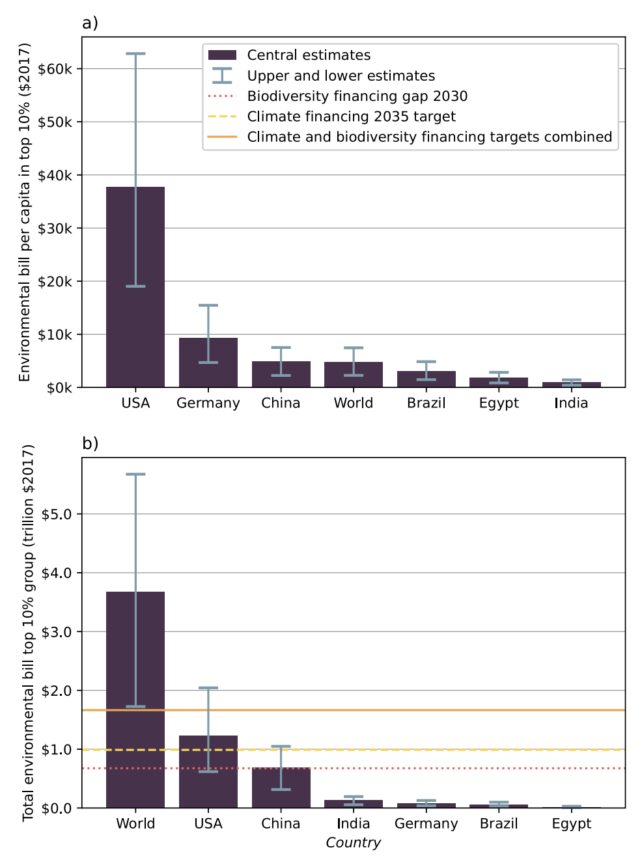
"We find annual damages owed by the global 10 percent to be $1.7–$5.7 trillion, equivalent to $2.3k–$7.5k per person (in 2017 US dollars)."
"This surpasses international climate and biodiversity financing gaps."
In other words, environmental taxes targeted at this group could help pay for the large-scale transitions needed to keep our societies safe from environmental collapse, and improve the lives of lower-income households in the process.
For instance, they found that even conservative estimates for the top decile in the US and China could each cover a $675 billion gap in biodiversity protection funding by 2030.
The mid-level estimates for the US's top 10 are more than enough to cover the $993 billion needed each year to meet targets set at COP30 by 2035.
To calculate this enormous debt, the team started with the consumption-based 'footprints' of the world's wealthiest 10 percent, in 2017 (unfortunately, that's the most recent available data for these footprints – almost ten years out of date).
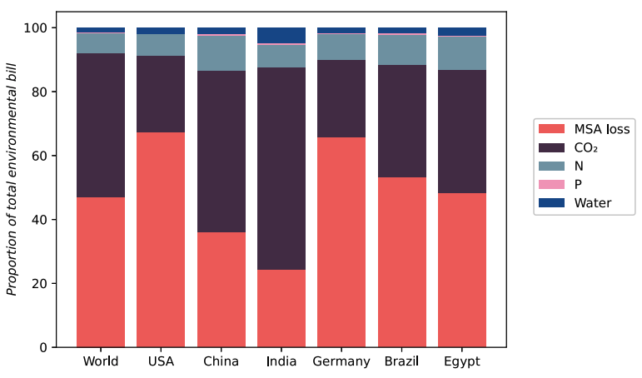
This provided estimates of how much carbon dioxide is emitted, how much biodiversity is lost, and how much nitrogen, phosphorus, and freshwater are displaced by this top decile of consumers.
Then, they referred to the Environmental Prices Handbook 2024 to assign monetary values to those forms of environmental damage, reflecting how much value is lost to human society as a result. They converted the values into 2017 US dollars to match the footprint data.
The results varied widely between countries.
 Schrijver and team found that the two biggest contributors to the wealthiest 10 percent's global 'damage bill' are biodiversity loss, making up 47–56 percent of the total, and climate change, which accounts for 36–45 percent of the total.
The top 10 percent of US consumers, who make up the largest share of the global top decile, were assigned bills ranging from $19k to $63k, which is just 6–20 percent of their income, or 0.8–3 percent of their wealth.
These individuals consistently had the highest 'debt' in a global sense, according to the study's estimates.
By comparison, in India the top 10 percent had bills ranging from $410 to $1.4k, which is about 0.8–2.8 percent of their incomes, or 0.2–0.5 percent of their wealth.
"The difference in the bill between countries reflects the inequalities in consumption and emissions," the researchers write.
In practice, environmental taxation may not be a cure-all for the serious global disasters we face when it comes to climate change and biodiversity loss.
But, as Schrijver and team say, the money has to come from somewhere: this could be an important part of shifting to more sustainable models of consumption.
Related: Almost 30% of Us Face 5x More Heat-Drought Extremes by End of Century
"These costs highlight the mitigation responsibility of the top 10 percent and illustrate the potential revenue of environmental taxes if the polluter-pays principle is adopted," Schrijver and team conclude.
The research is published in Communications Sustainability.