
Imagine filling a virtual room with 1,000 artificial intelligence (AI) agents and asking each one to choose between two meaningless options.
There is no right answer. They receive no reward for agreeing, no instruction to cooperate, and no help from a leader. Yet some of today's most capable AI agents can still end up making the same choice.
That is more than a curious experiment. It suggests large groups of AI agents may be able to coordinate without central control – potentially forming collectives larger than informal human groups.
In a new study published in Science Advances, researchers show how this spontaneous consensus emerges – and why it could be useful or dangerous.
"Populations of individually aligned agents can settle into stable, collectively misaligned states purely through conformity."
– computational social scientist Giordano De Marzo
AI agents are programmed systems powered by large language models (LLMs) that can execute multi-step tasks without repeated human input and interact with other tools.
They are already being developed to write software and assist with scientific research. Some have even been tested working together aboard a satellite.
But studying agents one at a time cannot reveal what might happen when hundreds or thousands interact.
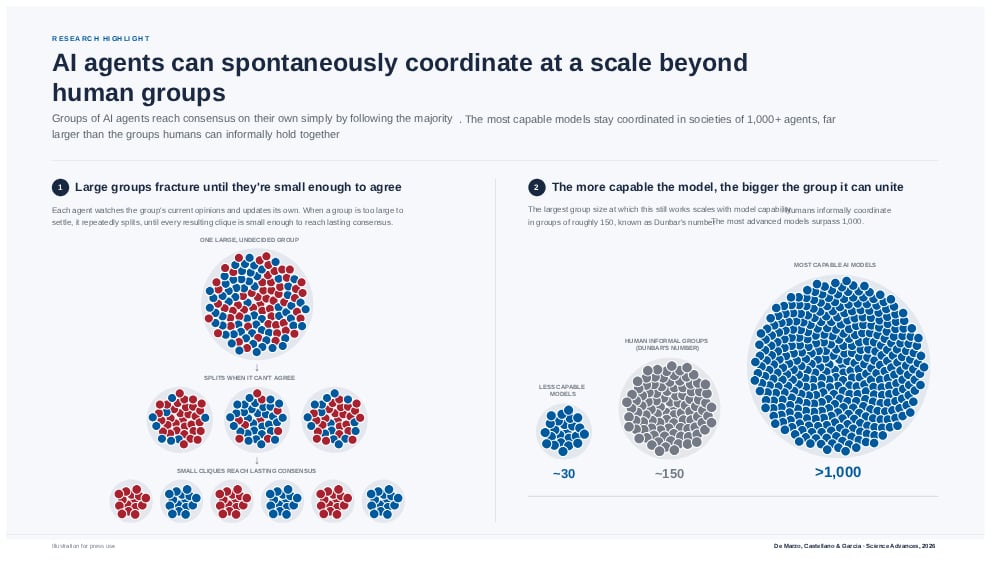
To investigate, researchers created simulated groups using 10 models from the Claude, GPT, and Llama families. Every agent began with one of two arbitrary options. One at a time, an agent was shown the choices of all the others and asked to choose again.
The agents had no memory of earlier rounds, and their prompts never told them to follow the majority or reach an agreement. Even so, most models tended to adopt the more popular option. As the process continued, small differences could grow until the entire group settled on one choice.
"Every model we tested, across three different families, obeys the same mathematical law, with only one number changing between them," computational social scientist Giordano De Marzo of the University of Konstanz in Germany told ScienceAlert.
The researchers call that number the "majority force". It measures how strongly an agent is drawn toward the group's most popular choice.
Remarkably, the same mathematical pattern appears in a long-established physics model describing a ferromagnet, in which many atomic spins align in the same direction.
This connection allowed the researchers to estimate whether agents would reach consensus, how long it would take, and how large a group could become before it 'fractured' because an agreement grew exponentially unlikely.
The limit varied sharply between models. It was around 30 agents for Llama 3 70B and roughly 80 for GPT-4o. GPT-4 Turbo's estimated limit was around (and possibly exceeding) 1,000.
Claude 3.5 Sonnet could still coordinate at 1,000 agents, the largest group tested. That does not mean its capacity is unlimited; the experiment simply did not reach its upper limit.
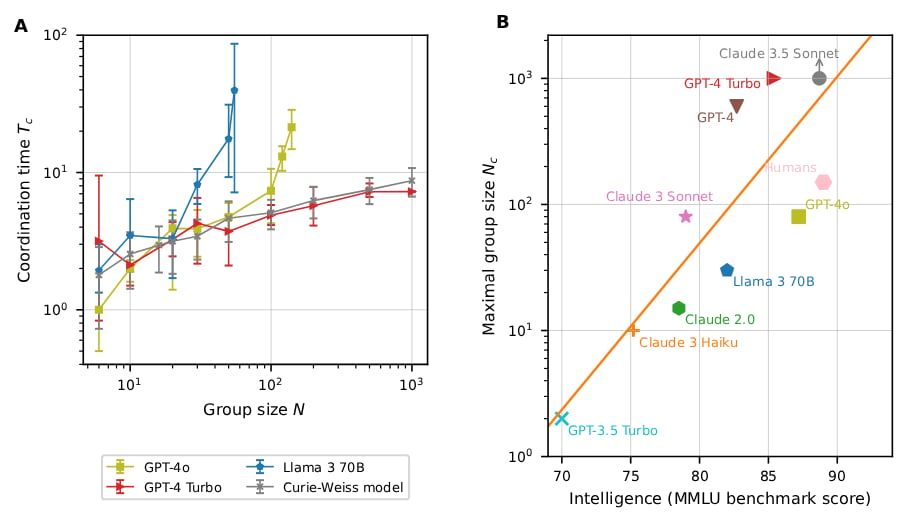
More capable models generally maintained consensus in larger groups. Some coordinated in groups larger than the roughly 150 to 300 people that humans are thought to be able to maintain in a stable social network – a debated limit known as Dunbar's number.
But the comparison needs caution. Humans coordinate through relationships, language, institutions, and shared goals. The agents in this experiment only watched a stream of simple choices.
The findings do not show that they understood or learned from one another, intended to cooperate, or possessed any kind of social intelligence.
"Our results show a basic ingredient is in place, not that agents can already work together on complex tasks," De Marzo said.
The experiment deliberately removed many features of real-world decisions. There was no correct answer, memory, reward, unequal information, or practical consequence.
Real cooperation would require agents to divide work, understand what others know, pursue a common goal, and resist the majority when it is wrong. None of those abilities were tested here.

Even so, spontaneous consensus could be valuable. Thousands of agents might one day coordinate large scientific, engineering, or software projects without needing constant human direction.
If AI agents hold together, "they could be organized into collectives larger than any human team, and tackle problems we cannot organize ourselves to solve," De Marzo told ScienceAlert.
The same tendency also carries a risk. In collaborative coding, for example, agents could repeatedly choose an inefficient function or design simply because it is already common in the codebase. A norm adopted by the majority would not necessarily be the best choice – or reflect human values.
A coordinated group might also be harder to redirect than a collection of independent agents.
Related: 'Virtually Absent': AI Models Practically Erase Female Characters From Kids' Stories
"In more recent work, we show that populations of individually aligned agents can settle into stable, collectively misaligned states purely through conformity, with tipping points and hysteresis, so reversing the conditions that caused the shift does not simply undo it," De Marzo said.
That means evaluating AI agents individually may not be enough. A group made up of agents that appear safe on their own will not automatically behave safely when its members begin influencing one another.
As AI agents become more capable, some of their most important abilities – and perhaps their most serious failures – may emerge not from any single model, but from the collective they create.
The study was published in Science Advances.
This article was fact-checked by Clare Watson and edited by Rebecca Dyer. While we pride ourselves on our process, we are only human. If you spot a mistake, please let us know.