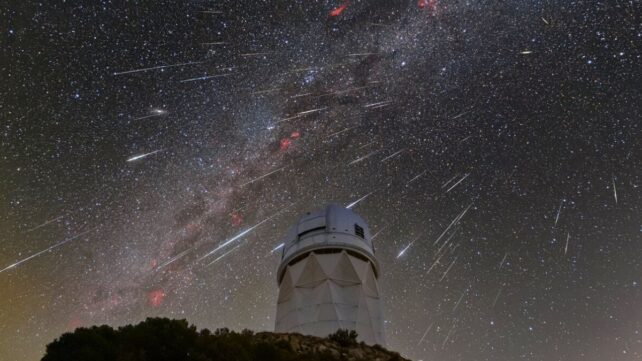
December has arrived, and with it the year's peak meteor season for the northern hemisphere.
It's during this time that two major meteor showers occur back-to-back, with the Geminids peaking in mid-December, and the Quadrantids hitting their full stride in early January.
This year, the Geminid peak falls on the evening of Saturday 13 December, and early morning Sunday 14 December. Viewers could see up to 150 meteors per hour, with the greatest concentration at around 08:00 UTC (3:00 am EST).
Related: There's Something Special About Meteors That Collide With Earth
"Although the Perseids, which arrive every August, are better known, the Geminids usually put on a better show," says Sky & Telescope Editor in Chief Diana Hannikainen. "Just make sure to bundle up!"
The Geminids are special for a few reasons, of which their proliferation is just one. Their parent body is a strange object called 3200 Phaethon, a chunk of space rock that has properties of both asteroids and comets.
As it zooms around the Sun on an elliptical orbit that intersects that of Earth, 3200 Phaethon sheds a trail of debris. When Earth passes through that debris trail, chunks of shed rock-comet fall into the atmosphere, heating as they go to turn into bright sparks screaming down the sky.
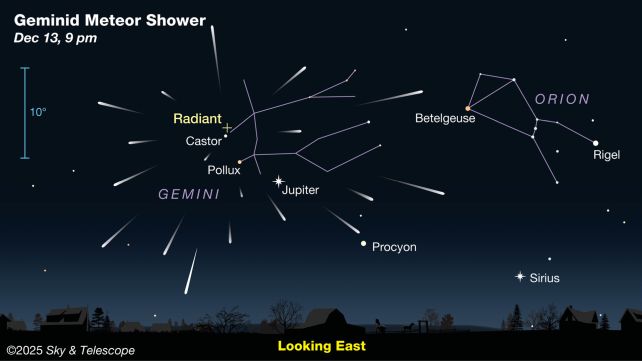
These Geminids are so-named because they appear to fall from a point in the sky close to the constellation Gemini, just above the star Castor.
They're notable for their brightness and their intense hues. They fall relatively slowly, which means they don't tend to leave bright trails, but they are rewarding to watch and photograph.
This year, the Moon will be in its waning crescent phase, about 26 percent full during the peak of the Geminids, which means its glare should not hinder the visibility of bright meteors.
You should also be able to get a good show by watching the sky on the nights either side of the peak – clear skies pending.

The Quadrantids peak on the night of 2 January 2026 coincides with a full Moon, so the Geminids might be your best chance for a meteor experience before the Lyrids arrive in April 2026.
You need no special equipment to see them, so get out there and have a blast.