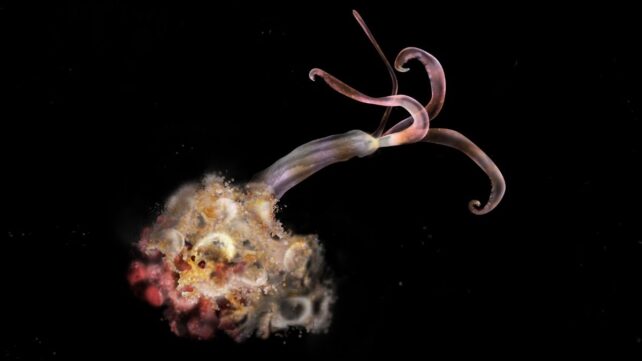
Fallen whale carcasses offer islands of nutrition within an otherwise sparse seafloor, and with help from bone-eating zombie worms, they can sustain an entire ecosystem for decades.
But in recent years, scientists have found the zombie worms (genus Osedax) are missing in action off the coast of British Columbia, at a site nearly 900 meters (3,000 feet) deep in the Pacific Ocean.
Under normal circumstances, the worm larvae float freely in the water column, waiting for the chance to settle on a freshly fallen whale skeleton or some other bones. There, they quickly mature into adult worms and begin secreting an acid from their 'roots' to bore through the hard cortical exterior of the bone.
Related: A Dead Whale at The Bottom of The Ocean Is Now a Thriving Home of Life
Each zombie worm hosts a colony of symbiotic bacteria within its body, which helps it digest otherwise-inedible fats and proteins (especially collagen) from the bones.
This slow-motion feeding frenzy unlocks delicious nutrients for other deep-sea creatures, increasing the diversity and complexity of the whale fall ecosystem. These microhabitats, when they form, create "stepping-stones" for species to disperse hundreds of kilometers through the ocean.

It's troubling, then, that when scientists placed humpback whale bones on the deep seafloor of British Columbia, not a single zombie worm turned up on their cameras, across all 10 years of monitoring.
The team who conducted the study, led by benthic ecologist Fabio De Leo of the University of Victoria, suspect the worms' absence may be explained by insufficient oxygen.
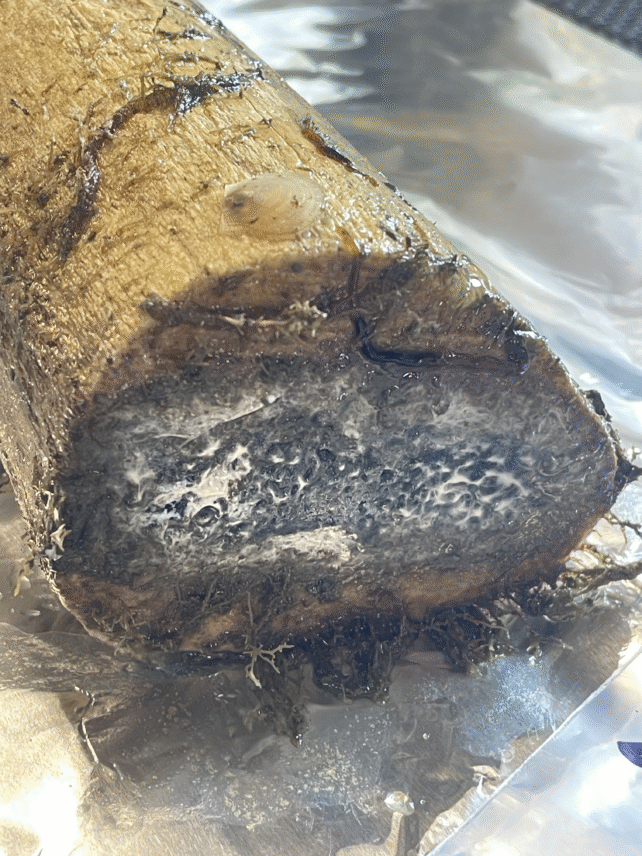
The Barkley Canyon (where the whale bones were placed and monitored) is naturally low in oxygen, but areas of the deep sea with these asphyxiating conditions – known as oxygen minimum zones (OMZ) or 'dead zones' – are expanding under climate change.
"Basically, we're talking about potential species loss," says De Leo.
If fewer zombie worms nourish seafloor communities, then the 'island' habitats they create may become few and far between, and "you could start losing a diversity of Osedax species across regional spatial scales," De Leo says.

"It looks like the OMZ expansion, which is a consequence of ocean warming, will be bad news for these amazing whale-fall and wood-fall ecosystems along the northeast Pacific Margin," says University of Hawai'i oceanographer Craig Smith, who co-led the experiment with De Leo.
Smith and De Leo have been monitoring another whale fall at the Clayoquot Slope off Vancouver Island that should soon offer further insight into the potential loss of zombie worms from our oceans.
The initial study was published in Frontiers in Marine Science in 2024.