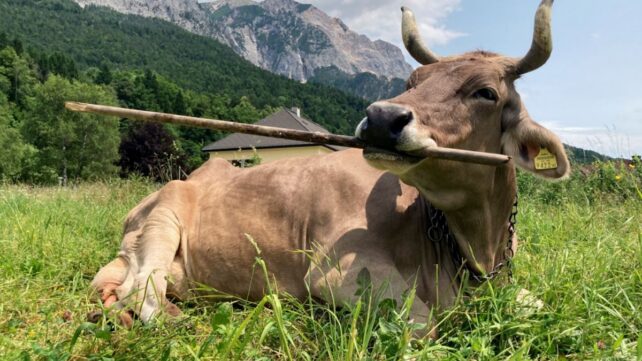
Cows can now be counted among the animals shown to use tools deliberately – and to adapt them to different tasks.
In a series of controlled experiments, a Swiss Brown cow (Bos taurus) named Veronika has demonstrated her tool-use proficiency, revealing a level of behavioral adaptability rarely documented in non-primates.
"The findings highlight how assumptions about livestock intelligence may reflect gaps in observation rather than genuine cognitive limits," says cognitive biologist Alice Auersperg of the University of Veterinary Medicine Vienna in Austria.
Related: Scientists Have Trained Bumblebees to Understand a Form of Morse Code
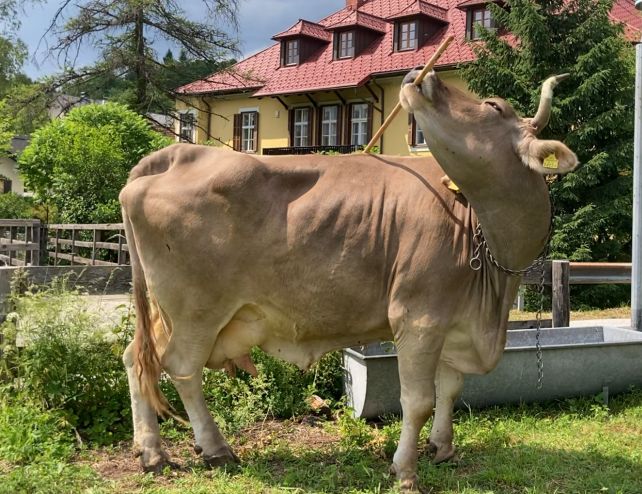
The intentional, flexible use of tools has long been considered a hallmark of cognitive ability. For much of modern science, humans considered themselves the only animals capable of doing so – a mark of hubris later deservedly curtailed by discoveries that many non-primates, from crows to orcas to insects, can also use tools.
For anyone who's ever spent any time around cows, it's probably not a huge surprise that there's quite a bit going on behind those dewy, limpid eyes. Still, relatively little is known about how they manipulate objects to meet their own needs.
Veronika is a pet cow and member of the family of Austrian farmer and baker Witgar Wiegele. Wiegele is certainly not surprised by Veronika's antics; he's been watching her pick up and use sticks to reach stubborn, itchy spots for more than a decade.
But when Auersperg and her university colleague, Antonio Osuna-Mascaró, saw a video of this behavior, they were intrigued.
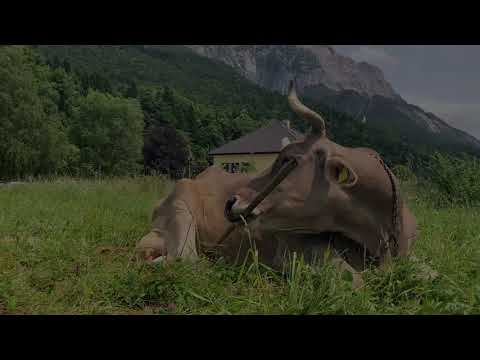
"When I saw the footage, it was immediately clear that this was not accidental," Auersperg says. "This was a meaningful example of tool use in a species that is rarely considered from a cognitive perspective."
So, the researchers traveled to meet this remarkable cow and designed an experimental regime to see just how sophisticated her use of tools could be.
The test was simple. Veronika was offered an asymmetrical object, where each end clearly had a different function – in this case, a deck broom with stiff bristles on one end and a handle on the other.
The researchers predicted that Veronika would use the bristles of the broom in a consistent way to perform a function – scratch hard-to-reach, itchy spots. This behavior would signal intentionality: Veronika would have identified what the broom could do for her and then used it for that purpose repeatedly.
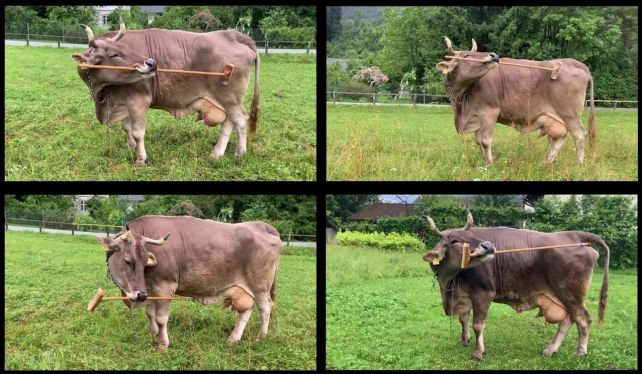
Over a series of seven sessions, each consisting of 10 trials (for a total of 70), the two scientists presented Veronika the broom in a range of random orientations.
The cow picked up the broom and used it to scratch a hard-to-reach itch 76 times, but she didn't just meet the predictions – she blew right past them like a cow with something to prove.
She did indeed use the brush end of the broom for scratching, but she also used the handle end. And which end she chose depended on the sensitivity of the target skin. The thick hide of her back and flanks got the bristles; the thinner skin of her belly, udder, and backside got the handle.
Moreover, how she used the broom was context-sensitive, too. She used broader, less controlled strokes for the brush, but more tightly controlled, targeted motion for the handle.

"Because she is using the tool on her own body, this represents an egocentric form of tool use, which is generally considered less complex than tool use directed at external objects," Osuna-Mascaró says.
"At the same time, she faces clear physical constraints, as she must manipulate tools with her mouth. What is striking is how she compensates for these limitations, anticipating the outcome of her actions and adjusting her grip and movements accordingly."
The ability to use different characteristics of a tool to perform different functions is known as multipurpose tool use, and it's rare in the wild. The researchers say that – outside of humans – only chimpanzees have been consistently recorded doing it. But that doesn't mean other animals can't.
The researchers believe that Veronika's circumstances may have contributed to her skills. She's around 13 years old; most cows living around humans don't live that long, primarily interact with other cows in rigidly controlled environments, are rarely closely observed, and aren't offered a range of items to play with.
"We suspect this ability may be more widespread than currently documented," Osuna-Mascaró says. "We invite readers who have observed cows or bulls using sticks or other handheld objects for purposeful actions to contact us."
The research has been published in Current Biology.