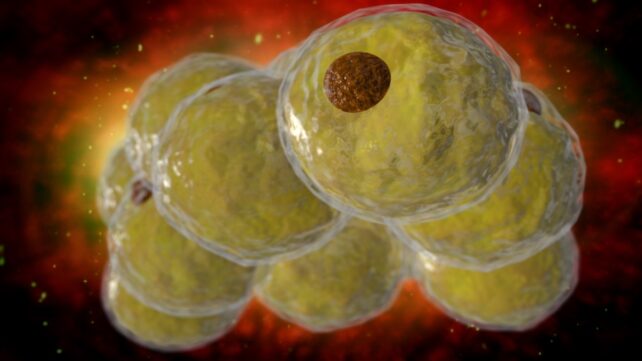
Understanding how cells become fat cells is a crucial part of tackling conditions like obesity and type 2 diabetes – and a new study just gave us some important clues into how we might prevent them from turning into fat cells.
A team from the Korea Advanced Institute of Science and Technology took a closer look at the PPARγ protein, "a master regulator" of fat cell formation.
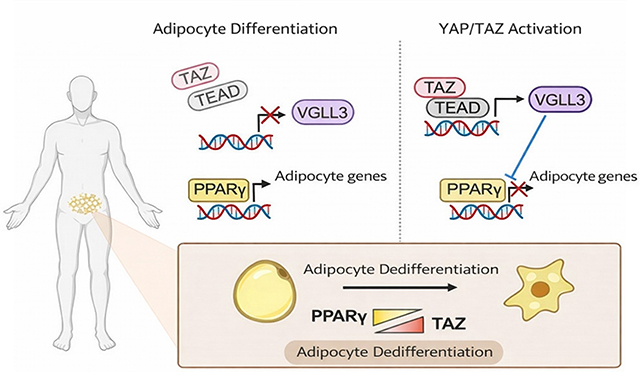
When PPARγ is active, it turns on a network of genes that push a cell to become – and stay – a fat cell, known as an adipocyte.
Related: One Simple Diet Change Helps Older Adults Lose Fat And Boost Metabolism
In an analysis of mouse cells and mouse models, the researchers discovered that PPARγ's fat-making instructions can be blocked by a specific epigenetic switch – one that controls how genes behave without altering DNA.
"This study is the first to establish that adipocyte differentiation is precisely controlled at the epigenetic level, beyond simple gene regulation," says molecular biologist Dae-Sik Lim.
Central to this are two proteins called YAP and TAZ, which are part of the Hippo signaling pathway. The Hippo pathway is fundamental in controlling how big our organs grow, essentially by deciding whether cells should divide, die, or become a specific type, such as fat cells.
Previously, scientists knew YAP and TAZ somehow interfered with fat cell formation, but it was unclear how. The research takes us another layer deeper into this biological mechanism, like opening the hood of a car to see exactly how its engine runs.
"Our comprehensive genomic analyses provide mechanistic insights into how the Hippo-YAP/TAZ pathway controls metabolic cell fate through epigenetic reprogramming," write the researchers in their published paper.
YAP and TAZ were shown to enable a chemical chain reaction that disables the fat-cell-activation genes that PPARγ tries to switch on.
So if PPARγ is pushing a cell toward becoming a fat cell, YAP and TAZ can override that instruction and keep the cell in a less specialized state. But typically, YAP and TAZ activity is tightly regulated by the Hippo pathway, which acts like their brakes.
The researchers tested what happens when the Hippo signaling pathway is switched off in mice (effectively releasing the brakes on YAP and TAZ). With the 'brakes' released, YAP and TAZ became hyperactive – and existing fat cells took a step backward along their developmental path.
Rather than reverting fully to stem cells, these fat cells lost many of their defining fat-cell features and behaved more like precursor cells.

The end result of the research is a much better idea of how fat cell production can be ramped up or pulled back, albeit only in mice for now.
Having too much fat on our bodies, or storing it in the wrong places, is associated with a wide range of health problems. And once fat cells form, they are difficult to eliminate; when we lose weight, fat cells tend to shrink, rather than disappear completely.
Related: Exercise Can Actually Make Your Brain Look Younger, MRI Scans Reveal
Understanding how PPARγ does (or doesn't) work in coaxing cells into being fat cells could one day offer new ways to treat metabolic disease. The discoveries here might give us a way to target fat buildup more precisely, though a lot more research will be needed to find effective, safe ways to do so.
"[The study] has laid an important foundation for a more sophisticated understanding of the mechanisms behind adipocyte identity changes and, in the long term, for developing personalized treatment strategies for patients with metabolic diseases," says Lim.
The research has been published in Science Advances.