A worrying health pattern for some of the Gen X and Millennial crowd has been highlighted by a new study: people born between 1970 and 1985 are experiencing worse mortality rates than the generations before them, across multiple causes.
The international team of researchers analyzed cause-of-death records over more than 40 years, between 1979 and 2023, to examine changes in life expectancy and the underlying reasons that could be shaping it.
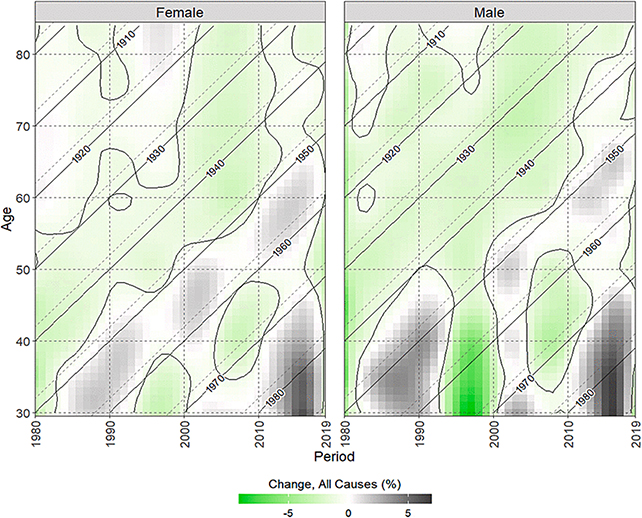
What stands out is that being born in the 1950s – the middle of the Baby Boomer generation – marks a turning point: from steadily decreasing mortality rates and better health outcomes compared with earlier groups, to the opposite.
"We see concerning trends for those born from around 1970 to 1985 – the late Gen Xers and elder Millennials," says social epidemiologist Leah Abrams, from Tufts University in the US.
"These cohorts are trending worse than their predecessors in all-cause mortality; deaths from cardiovascular disease and cancer, especially colon cancer; and external causes."
Patterns among these three main causes of mortality are likely to be connected, the researchers suggest. External causes include drug overdoses, traffic accidents, homicides, and suicides. They also argue that rising economic and social inequalities may be fundamentally affecting US life expectancy trends.
The study links the increasing number of cancer deaths, particularly colon cancer, to growing problems with obesity and unhealthy diets.
As for the "stagnating declines" in cardiovascular deaths, this is trickier to explain. However, it's worth noting that both cancer treatments and drugs of abuse (our other main causes) can be detrimental to heart health. It's a complex picture.
The researchers also discuss the growing impact of stress in modern life, driven by social and economic conditions and other factors. We know that stress can affect cancer risk, cardiovascular disease, and substance abuse.
"The increase in deaths among those born from 1970 to 1985 is cause for concern because cancer and cardiovascular disease tend to be relatively rare in individuals who are in their 30s and 40s," says Abrams.
"So if these cohorts are showing worse mortality trends already, what's going to happen when they're in their 60s if nothing gets turned around? That's one of the looming implications of these findings."
While overall life expectancy in the US has improved slightly in the last couple of years, that could change as these patterns among younger generations start to show up in the data.

It may be that, as a species, we're reaching our peak in how long we can live, and that we'll only see slight rises and falls from now on.
"However, continued life expectancy improvements among high-performing populations and the divergence of the United States from other high-income countries suggest that human-made factors are limiting US life expectancy improvement," Abrams and team write in their published paper.
The researchers have some ideas as to how these trends can be turned around.
Tackling the rise of conditions such as diabetes, hypertension, and obesity is likely to have a positive effect, while lowering the risk of colon cancer in younger people (perhaps through diet improvements) would potentially make a notable difference to the numbers.
There's also a clear need to address the drivers of substance use and suicide, issues which the COVID pandemic exacerbated, as job security and social structures were put under threat.
Related: Each Stressful Person in Your Life May Age You by Months, Study Finds
The researchers do point to some good news: the way that tobacco control measures led to a significant drop in deaths from cancer and cardiovascular disease. These public health wins are possible and can turn around the outlook for future generations.
"Prior evidence, combined with our findings, shows that we really need to think holistically if we are to improve US life expectancy," says Abrams.
"Reducing social inequalities and improving resources for socioeconomically disadvantaged groups could help lessen stress and its harmful effects on health, improve dietary behavior, and reduce substance use."
The research has been published in PNAS.