
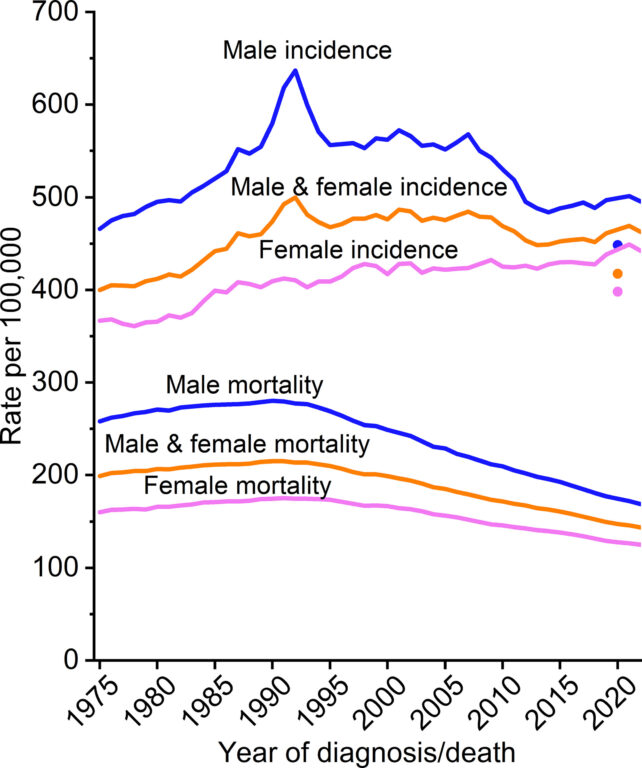
Cancer may be an inevitability of cell division and, therefore, life. But in the US, great progress has been made fighting this dreaded disease, achieving a milestone five-year survival rate of 70 percent for cancer cases diagnosed between 2015 and 2021.
The most significant survival gains were in cases of advanced or fatal cancer.
Earlier detection, improved screening and treatments, and reductions in smoking prevalence have helped avert 4.8 million cancer deaths in the US between 1991 and 2023, giving 3,256,800 men and 1,555,300 women a new lease on life.
These findings, by researchers at the American Cancer Society (ACS), were recently published in Cancer Statistics 2026.
Related: 10-Minute Bursts of Exercise Can Trigger Anti-Cancer Signals in The Body
"Seven in 10 people now survive their cancer five years or more, up from only half in the mid-70s," says cancer epidemiologist and first author Rebecca Siegel.
"This stunning victory is largely the result of decades of cancer research that provided clinicians with the tools to treat the disease more effectively, turning many cancers from a death sentence into a chronic disease."
The 2026 report marks the 75th year that ACS has disseminated cancer survival data to help improve public awareness and health efforts.
It comprises the most current, population-based incidence and mortality rates through 2022 and 2023, respectively. This data is always a few years behind the current year due to the time required to collect, compile, verify, and disseminate data.
Cancer is the second-leading cause of death in the US, behind heart disease, but overall five-year survival rates have now reached their highest levels, increasing from 49 percent for diagnoses during the 1970s to 70 percent for diagnoses during 2015-2021.
Furthermore, the greatest gains in survival rates were observed for cancers that have spread to other parts of the body, with rates more than doubling from 17 percent in the mid-1990s to 35 percent during 2015-2021.
Survival rates varied among cancer types.
"Contemporary survival is highest for cancers of the thyroid (98 percent), prostate (98 percent), testis (95 percent), and melanoma (95 percent), and lowest for cancers of the lung (28 percent), liver (22 percent), esophagus (22 percent), and pancreas (13 percent)," the researchers report.
Incidence and mortality rates also varied based on factors like socioeconomic, racial, and ethnic disparities. Native American people had the highest cancer death rates. For example, their mortality rates for cancers of the kidney, liver, stomach, and uterine cervix are about double those of White people.

Additionally, geographic trends hinged on state and local health policies and on the affordability of health insurance. As a result, cancer deaths varied from 122 to 128 per 100,000 in Utah, Hawaii, New York, and Colorado, to 178 to 180 deaths per 100,000 in West Virginia, Mississippi, and Kentucky.
Prevention practices also differed, with HPV (human papillomavirus) vaccination rates for boys and girls, aged 13-17, ranging from 38 percent in Mississippi to 84 percent in Rhode Island.
Nationwide, cancer mortality in children has decreased by more than two-thirds, from six per 100,000 in 1970 to two per 100,000 in 2023.
Adolescent mortality has also decreased significantly over the same period, from 7 per 100,000 to 3 per 100,000. A large portion of this decrease is due to improved leukemia survival rates resulting from optimized treatment regimens.
Related: Tiny Bubbles Help Cancer Invade New Organs – And May Be Key to Stopping It
Temporal trends also play a role. Clinicians may soon see an uptick in advanced cancer diagnoses due to the COVID-related lapse in detection. For instance, the decrease in colorectal cancer screening during the pandemic may lead to as many as 7,000 excess deaths by 2040. However, a recent rebound in screening, driven by increased stool testing, may mitigate this projected mortality.
The report forecasts future incidence and mortality. In 2026, more than 2,100,000 new cancer cases (about 5,800 per day) and nearly 630,000 deaths (about 1,720 per day) are predicted in the United States.
Lung cancer is projected to account for the highest mortality, causing more deaths than the second-ranking colorectal cancer and third-ranking pancreatic cancer combined.
Finally, even though survival rates have increased, continued progress is threatened by numerous considerations, including rising incidence rates for common cancers like those of the breast, prostate, and pancreas.
Related: A Hidden Warning Sign Discovered in The Gut May Increase Cancer Risk
"Threats to cancer research funding and significant impact to access to health insurance could reverse this progress and stall future breakthroughs," says Shane Jacobson, CEO of the ACS.
"We can't stop now. There is still much work to be done."
This research is published in CA: A Cancer Journal for Clinicians.