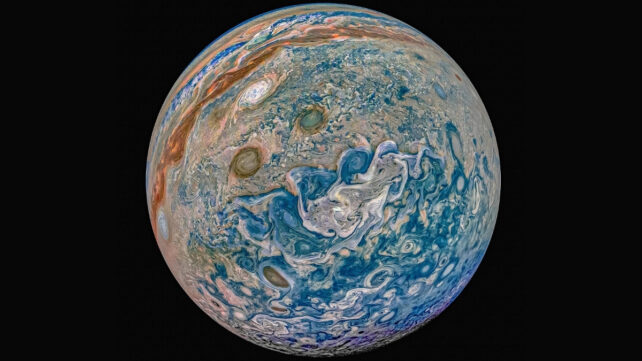
The biggest planet in our Solar System just got a little smaller. Okay, not physically, but our measurements of Jupiter just got more precise, and it turns out there's slightly less of the giant than we thought.
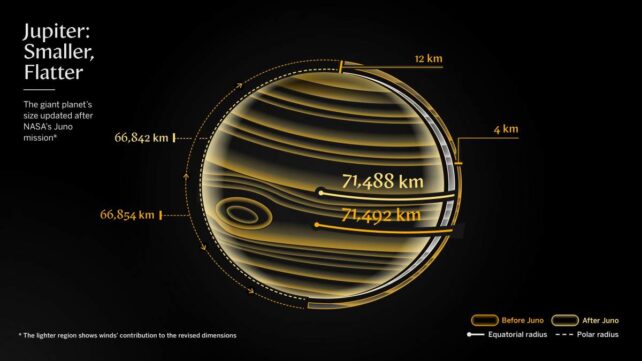
According to the new data, Jupiter's radius measures 71,488 kilometers (44,421 miles) at its equator, and the planet rises 66,842 kilometers from its center to its north pole. That makes it 4 kilometers narrower each side at the equator, and 12 kilometers 'flatter' at each pole, than previous measurements suggested.
It's not a major adjustment, obviously, but it actually does make a difference to our models.
"These few kilometers matter," says Eli Galanti, planetary scientist at the Weizmann Institute of Science in Israel.
"Shifting the radius by just a little lets our models of Jupiter's interior fit both the gravity data and atmospheric measurements much better."
Our previous estimates of Jupiter's size and shape rested on measurements made by NASA's Voyager and Pioneer missions in the 1970s, using a method called radio occultation (RO). Basically, as the probes beamed their communications back to Earth from the far side of Jupiter, the gassy giant's atmosphere refracted some of the signal. Measurements of the extent of that refraction can then be used to calculate the planet's size.
Astronomers only had six of these RO measurements to work with – until now.
In 2021, NASA shifted Jupiter probe Juno into a new orbit that, for the first time, took it behind the planet, from our point of view here on Earth. This gave scientists the opportunity for regular RO measurements, boosted with new data-processing techniques.

"We tracked how the radio signals bend as they pass through Jupiter's atmosphere, which allowed us to translate this information into detailed maps of Jupiter's temperature and density, producing the clearest picture yet of the giant planet's size and shape," says Maria Smirnova, planetary scientist at the Weizmann Institute.
Related: Jupiter Was Twice Its Current Ginormous Size, Scientists Discover
Powerful winds are also known to whip around the gas giant, and previous estimates of Jupiter's size had to ignore their influence. But since other recent studies have measured them, Galanti and colleagues could include that data in their new calculations.
A difference of 4 or 12 kilometers might not sound like much, but pinning down the measurements more precisely can teach us plenty about gas giants here and in other planetary systems.
The research was published in the journal Nature Astronomy.