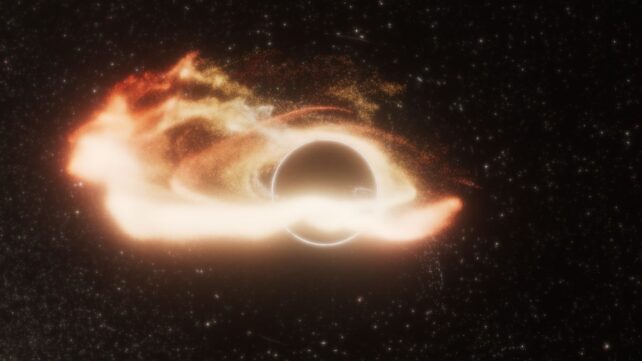
A burst of X-rays from 8 billion years ago may be the first clear evidence of a white dwarf torn apart by a black hole.
The study, coordinated by Dongyue Li and Wenda Zhang of the Chinese Academy of Sciences, describes the event as "unprecedented". The analysis suggests the sudden flare – among the brightest X-ray bursts ever observed – is best explained by the tidal disruption of a white dwarf by one of the most elusive objects in the cosmos: an intermediate-mass black hole.
"Our computational simulations show that the combination of the tidal forces of an intermediate-mass black hole, combined with the extreme density of a white dwarf, can produce jet energies and evolutionary timescales that are highly consistent with the observational data," says co-first author and astrophysicist Jinhong Chen of the University of Hong Kong.
White dwarfs are among the densest known objects in the Universe, outstripped only by neutron stars and black holes. They form when stars up to about eight times the mass of the Sun reach the end of their lives and shed their outer layers, leaving behind a compact core roughly the size of Earth but containing up to 1.4 times the Sun's mass.
White dwarfs are so compact that only black holes within a narrow mass range can tear them apart in a visible way in a tidal disruption event. Stellar-mass black holes would be expected to generate shorter-lived and less energetic flares, while most supermassive black holes would swallow a white dwarf whole before it could be disrupted.

Intermediate-mass black holes, with masses in the range of hundreds to tens of thousands of Suns, sit in the narrow sweet spot. But no flares had been recorded that astronomers could confidently link to an encounter between a white dwarf and an intermediate black hole.
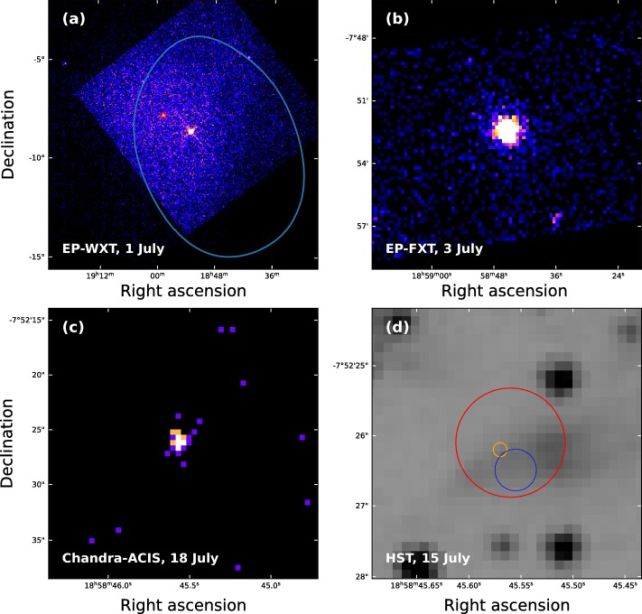
That changed when the Einstein Probe recorded a blazing X-ray flare from a distant galaxy in July 2025. The event, named EP250702a, rose to a powerful peak before fading, as multiple instruments tracked its evolution. About a day after the X-rays were spotted, NASA's Fermi Gamma-Ray Space Telescope recorded a gamma-ray burst.
"This early X-ray signal is crucial," Li says. "It tells us this was not an ordinary gamma-ray burst."
Over about 20 days, the signal changed rapidly, fading from its peak brightness by more than a hundred thousand, and transforming from hard to soft X-rays. Moreover, it took place at the outskirts of its galaxy – a region where older stars are common, rather than the young, massive stars that explode as supernovae.
Related: We Just Found One of The Rarest Stars in The Galaxy
By carefully studying data across the electromagnetic spectrum from the EP250702a, and comparing it with possible mechanisms, the researchers found that one explanation for what they had observed stood out above the others.
"The white dwarf-intermediate-mass black hole model can most naturally explain its rapid evolution and extreme energy output," says astronomer Lixin Dai of the University of Hong Kong.
If confirmed, the flare may represent the first clear sighting of a white dwarf being torn apart in this way – and a new way of catching elusive intermediate-mass black holes in the act.
The research has been published in Science Bulletin.