Researchers in China have found a potential new biomarker of Parkinson's disease hiding in human hair.
When the team analyzed the hair of 60 patients with Parkinson's and compared the results with those of healthy, age-matched controls, they found a distinct difference.
According to a pre-proof paper, hair samples from patients with Parkinson's disease showed significantly lower levels of iron and copper, along with higher levels of manganese and arsenic.
The authors of the study, led by biologist Ming Li of Hebei University, think their discovery has "high diagnostic potential for Parkinson's disease."
A non-invasive but reliable way to diagnose Parkinson's disease has so far proved a challenge. Some recent blood-based biomarkers look promising, but human hair is a unique new target with features that blood doesn't have.
Our hair is known to accumulate heavy metals from our diet or our surrounding environment, and unlike saliva, sweat, blood, urine, or feces, it can capture a longer historical record of health.
The true cause of Parkinson's is a mystery, but previous studies have linked the disease to disrupted gut bacteria and unhealthy diets, like those heavy in ultraprocessed foods. Evidence also suggests this neurodegenerative disease is closely related to environmental pollutants, like pesticides.
If something is going awry in any of these departments, our hair could spill the tea.
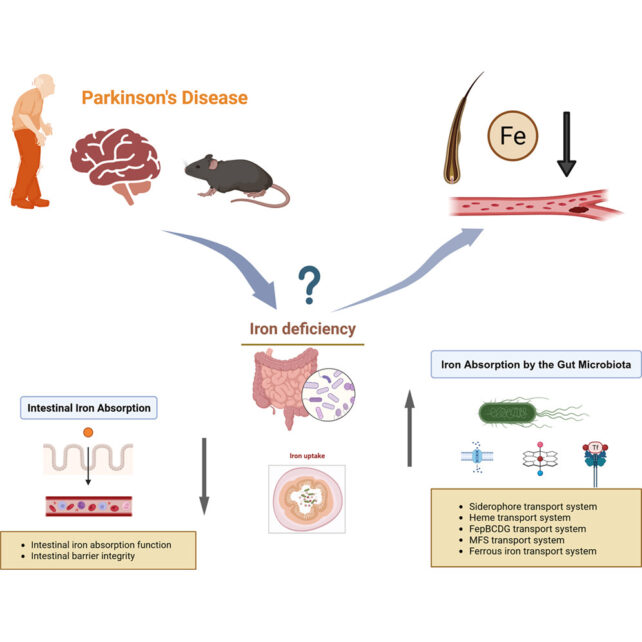
In further experiments involving mouse models, Li and colleagues also found lower levels of iron in hair, and this change was closely connected to dysfunction in the gut.
The intestinal barrier in the mice with a Parkinson's-like disease appeared impaired. Their genes involved in iron absorption were downregulated, and they showed increased activity in genes involved in microbial iron acquisition, possibly leading to broad iron deficiency across the body.
In human patients with Parkinson's, changes in gut bacteria emerge years before diagnosis. Like other neurological diseases, Parkinson's seems to be based on close communication between the gut and the brain. Perhaps our hair has been 'listening in' and recording what they hear.
The iron deficiency in the hair of human Parkinson's patients and mouse models was the most consistent and noticeable change.
The research team thinks the link between the gut microbiome and iron metabolism genes is a "foundational proof-of-concept that these systems are linked in the context of Parkinson's disease-like pathology.
Elevated arsenic in the hair is also worth exploring further, as this could be caused by environmental exposure. The study is small, but those with Parkinson's reported eating more animal offal and shellfish, which are more likely to contain arsenic.

"Taking all these results together, we suggest that the drop of iron levels in the hair could be associated with the gastrointestinal dysfunction in PD patients, as shown in many other studies," the authors conclude, "and also the imbalance of the gut microbiota, which exhibited enhanced iron uptake capacity."
The findings support a 2025 study that reviewed the available literature and found evidence of iron dysregulation in the brain, blood, and gut of Parkinson's patients.
Related: Parkinson's May Emerge From a Deeper Brain Network Than We Thought
Further research is now needed to verify this pattern among larger cohorts, and to test the mechanisms uniting iron deficiency and Parkinson's disease.
Who knows, maybe down the road a snip of hair is all that will be needed to identify this systemic disruption.
The study was published in iScience.