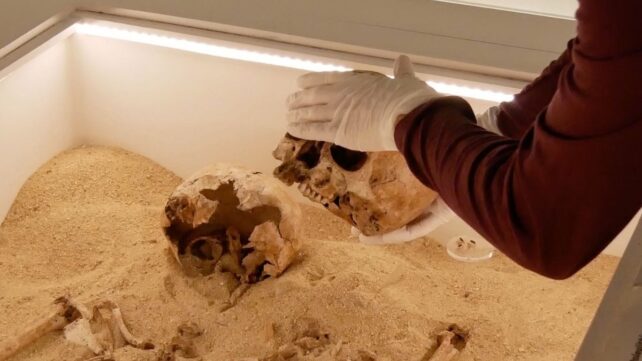
More than 12,000 years ago, two closely-related women – a mother and her daughter, perhaps – were buried in an eternal embrace.
This Ice Age pair of hunter-gatherers were both shorter than average for their population – one of them markedly so – and now we finally know why.
A team of researchers from Europe re-examined the bodies – which were first discovered in the Grotta del Romito in southern Italy during a dig in 1963 – using modern genetic techniques.
This enabled the team to identify specific mutations carried in the genes of these long-gone humans, using ancient DNA recovered from the left inner ear of each person.
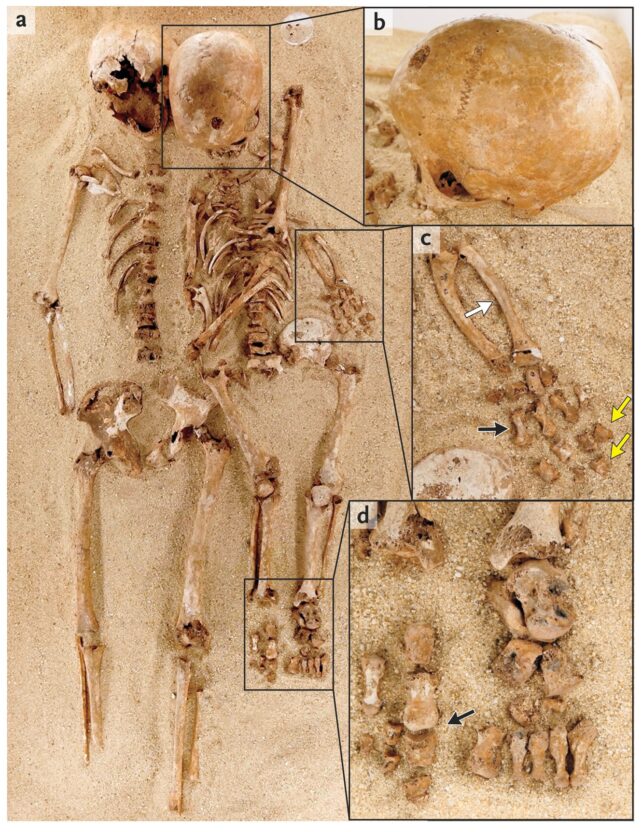
The new analysis revealed the pair were female, first-degree relatives – likely, a mother and daughter.
It also allowed the team to diagnose the younger of the pair with acromesomelic dysplasia, Maroteaux type (AMDM), a rare genetic disorder affecting the growth of bones. This is the earliest evidence of the disorder ever found.
AMDM is caused by mutations in the NPR2 gene, which codes for a protein involved in skeletal growth. Without two functioning copies of that gene, the protein isn't produced, resulting in the physical qualities associated with AMDM.
"Identifying both individuals as female and closely related turns this burial into a familial genetic case," says the study's first author, anthropologist Daniel Fernandes of the University of Coimbra in Portugal.
"The older woman's milder short stature likely reflects a heterozygous mutation, showing how the same gene affected members of a prehistoric family differently."
A heterozygous mutation means the woman only had one non-functional NPR2 gene, which still affects bone growth, though not to the same extent as in AMDM.
If this woman is the girl's mother, then the father would have also carried at least one copy of the NPR2 variant, which is how the girl ended up with two copies: one from each parent.

Living in hunter-gatherer society, the girl would have had a difficult time traversing the distances and terrain typical of her people.
The way her bones developed limited her range of movement at the elbows and hands, which also would have made daily activities more difficult. For instance, people with AMDM often have increasing difficulty fully extending their arms, or rotating them. But it appears that in life, as in death, her family was by her side.
Related: Fossilized Bone of Neanderthal With 'Down Syndrome' Challenges Ideas of Prehistoric Care
"She survived… until late adolescence with a diet and nutritional stress similar to that of other Romito persons, which suggests that the challenges she faced were met by the provision of care in her family group," Fernandes and team write.
This adds to growing evidence that humans have been taking care of each other long before civilization existed. Why the two died together is unclear, but in death, their embrace is a tableau of family love that reaches far across time.
"Rare genetic diseases are not a modern phenomenon but have been present throughout human history," says Adrian Daly of Liège University Hospital Centre in Belgium.
"Understanding their history may help recognizing such conditions today."
This research was published in The New England Journal of Medicine.