A thorough reexamination of scientific data has revealed that the rate of sea-level rise is accelerating, and the primary driver might not be what you think.
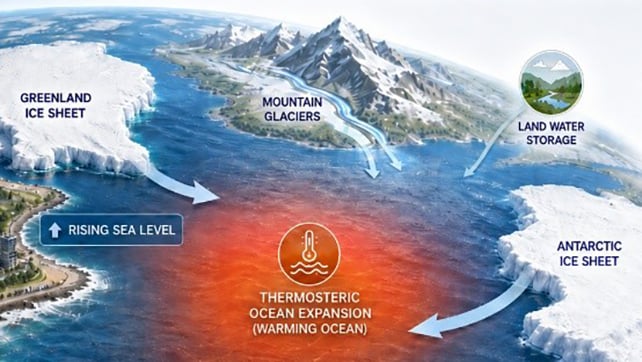
While melting glaciers and shrinking ice sheets are commonly understood to contribute to sea levels creeping higher, the slow and steady expansion of our oceans often goes unseen.
Yet this phenomenon is the main cause leading to higher sea levels around the world, research shows.
As water in the ocean gets warmer, it expands in space – a process known as thermal expansion – meaning seawater occupies more volume.
This expansion of water is the primary cause of sea-level rise, researchers say in a new study.
The analysis, from an international team of scientists, helps resolve some of the discrepancies seen in previous sea-level studies, where the main contributors – including melting ice and warming oceans – didn't quite add up to the sea-level rise we're seeing.
"For years, there has been a frustrating gap between how much the oceans were observed to be rising and how much we could explain from the individual causes," says mechanical engineer John Abraham, from the University of St. Thomas in the US.
"This work shows that, with better instruments, processes, and smarter analysis, this knowledge gap can be closed. We can [now] explain sea level rise with greater confidence."
This is known as balancing the global mean sea level (GMSL) budget.
Checking the numbers add up is a way of verifying the data scientists have collected, and making sure we're not missing anything in our understanding of what drives sea-level rise.
This helps improve projections from climate models simulating the impacts of rising seas over time and around the world – so we can do something about it.
The researchers split their analysis into three sections: a long-term view of the years 1960 to 2023 (covered by tide gauges and satellites), 1993 to 2023 (the satellite image era), and 2005 to 2023 (the years when scientists have used ocean-monitoring buoys known as Argo floats).
Since 1960, the data shows, global mean sea levels have risen by an average rate of 2.06 millimeters (0.08 inches) per year.
However, the rise is accelerating: Between 2005 and 2023, they went up by 3.94 millimeters (0.16 inches) per year – about twice the average rate.
In terms of contributing factors, the expansion of warming oceans is responsible for 43 percent of that rise, the researchers found.
Melting mountain glaciers account for 27 percent, the Greenland Ice Sheet 15 percent, and the Antarctic Ice Sheet 12 percent. The remaining 3 percent is down to changes in land water storage.
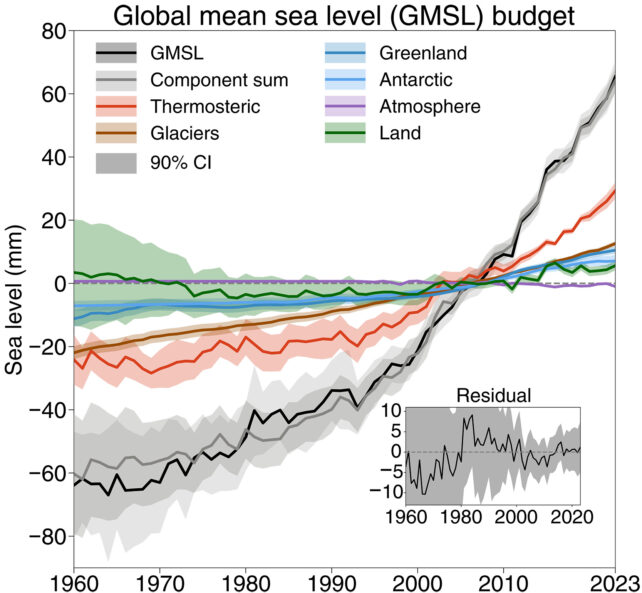
The researchers credit advances in data collection technology and analysis methods for being able to properly balance the GMSL. For example, higher-resolution satellite imagery has improved estimates of the extent of glacier melt worldwide.
"Although previous studies closed the GMSL budget, their results diverge owing to different dataset choices," write the researchers in their published paper.
"The up-to-date community estimates reconcile differences among multiple estimate methods, mitigate the random errors induced by a single source, and reduce the differences from the dataset choice."
These are trends that are going to continue for a considerable amount of time, the researchers warn. Even if we cut emissions quickly, the world's oceans will continue to heat up for at least half a century, modeling shows.

The researchers want to see further work done in gathering more data on land water storage (that includes reservoirs and irrigation systems), and in figuring out regional differences in sea level rises.
It all feeds into a more informed view of how dangerous rising oceans might be, especially for the most vulnerable populations. Millions of lives and livelihoods are thought to be under threat within the coming decades.
And the long-term effects will impact everyone on Earth, whether or not they live near the ocean. Sea-level rise will disrupt food networks, commercial links, and population distributions.
Some level of damage is now inevitable, but the extent is not yet determined.
Clamping down on emissions to limit global warming will make a difference, and a full understanding of the scale of the problem is essential to limit the impacts.
Related: Earth's Population Has Surpassed The Planet's Capacity, Study Suggests
"Accelerating sea level rise poses substantial hazards to low-lying coastal regions," write the researchers.
"Understanding the causes of sea level rise is indispensable for projections of future sea level changes and supports climate adaptation and mitigation efforts."
The research has been published in Science Advances.