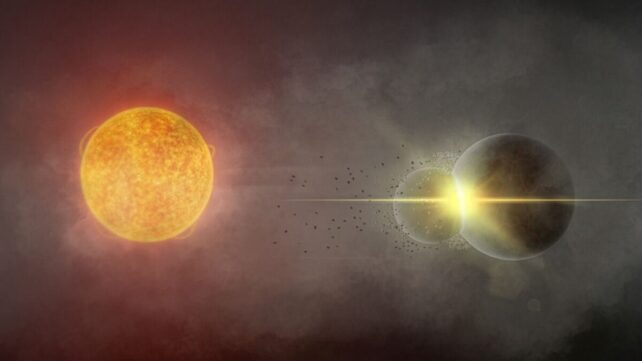
A distant star whose light suddenly flickered like a guttering candle has led astronomers to a spectacular find.
According to an analysis of the strange changes in a Sun-like star named Gaia-GIC-1, located around 11,600 light-years away, its strange behavior can best be explained by two baby planets colliding in its immediate vicinity.
"It's incredible that various telescopes caught this impact in real time," says astronomer Anastasios Tzanidakis of the University of Washington.
"There are only a few other planetary collisions of any kind on record, and none that bear so many similarities to the impact that created the Earth and Moon. If we can observe more moments like this elsewhere in the galaxy, it will teach us lots about the formation of our world."
Planetary systems, particularly in their nascent years, can be extremely chaotic environments. Clumps of dust grow into the seeds of planets – planetesimals – wherever conditions such as density and gravity allow, regardless of what else is flying around the young star.
This can lead to frequent collisions, as scientists believe happened in our own Solar System. In addition to later eras of heavy bombardment, when countless asteroids struck the young planets, something the size of Mars is thought to have collided with Earth, spraying debris into orbit that went on to form the Moon.
Evidence of this process occurring around other stars is difficult to come by. Planetary collisions happen on relatively small scales and unfold quickly, leaving behind only short-lived (in the scheme of the Universe) clouds of dust that are hard to detect from across the galaxy.

However, with recent large-scale surveys such as Gaia, astronomers are now monitoring huge swaths of the sky at once, repeatedly measuring the brightness, colors, and positions of enormous numbers of stars to catch any changes in their behavior.
For Gaia-GIC-1, changes were first recorded nearly a decade ago. It wasn't until Tzanidakis was sifting through older data that he noticed something odd.
"The star's light output was nice and flat, but starting in 2016, it had these three dips in brightness. And then, right around 2021, it went completely bonkers," he explains.
"I can't emphasize enough that stars like our Sun don't do that. So when we saw this one, we were like, 'Hello, what's going on here?'"
Gaia-GIC-1 is an F-type star, a bit like the Sun, but larger and hotter. It's about 1.7 times the Sun's radius and about 1.3 times its mass, hanging out near the southern constellation of Puppis, in the outer regions of the Milky Way's disk.
Its precise age eludes measurement, but it looks relatively stable, sitting solidly on the main sequence. That means it has entered stellar adulthood, powered by hydrogen fusion in its core. F-type stars are pretty stolid – they're not characterized by the wild activity seen in red dwarf stars, for example, nor do they exhibit the strange fluctuations seen in stars at the end of their lifespans, like Betelgeuse.

So it was somewhat puzzling to see such stark changes in brightness in Gaia-GIC-1, whose light ultimately dimmed by as much as a whopping 25 percent, in a pattern that had never been observed before.
Astronomer James Davenport of the University of Washington suggested looking at the star in a different light – and that's where the plot started to thicken.
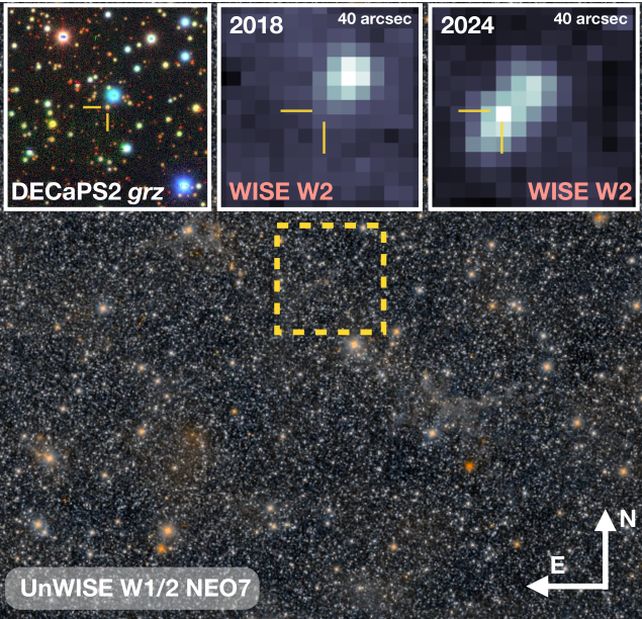
"The infrared light curve was the complete opposite of the visible light," Tzanidakis says.
"As the visible light began to flicker and dim, the infrared light spiked. Which could mean that the material blocking the star is hot – so hot that it's glowing in the infrared."
The observation suggested a cloud of dust with a mass comparable to a large asteroid, approaching half the mass of the dwarf planet Ceres, heated to around 900 kelvins. According to the researchers' modeling, there's one type of event that can fit all those parameters.
A collision between planetesimals can produce the observed mass and heat, and even match the odd brightness fluctuations, including the initial dimming and the later chaos. If two planetesimals are veering closer and closer to each other, they could undergo a series of grazing impacts before the final messy collision.
That collision, the researchers found, would have taken place at a distance of about one astronomical unit from the host star – about the same as the distance between Earth and the Sun. This could make it a vital clue about the formative years of our own Solar System, our home world, and even life upon it.
Related: Our Moon Is Curiously Lopsided, And a Massive Impact Could Be to Blame
"How rare is the event that created the Earth and Moon? That question is fundamental to astrobiology," Davenport says.
"It seems like the Moon is one of the magical ingredients that makes the Earth a good place for life. It can help shield Earth from some asteroids, it produces ocean tides and weather that allow chemistry and biology to mix globally, and it may even play a role in driving tectonic plate activity.
"Right now, we don't know how common these dynamics are. But if we catch more of these collisions, we'll start to figure it out."
The research has been published in The Astrophysical Journal Letters.