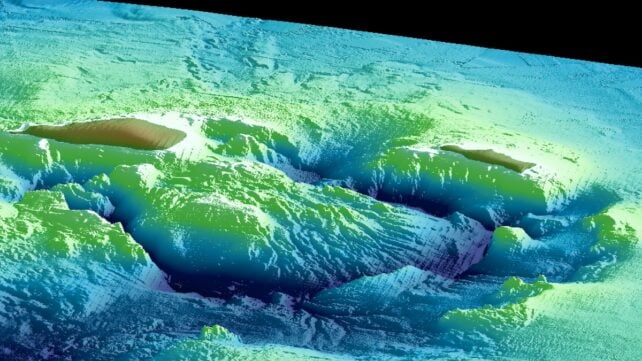
About 7,300 years ago, a volcano off Japan's Kyushu island unleashed what remains the largest known eruption of the Holocene, our current geological epoch.
In a new study, researchers reveal how this volcano's enormous magma chamber is now slowly refilling, potentially shedding light on the eruption cycles of it and similar volcanoes – and thus supporting humanity's ongoing efforts to predict future eruptions earlier and more precisely.
The Kikai Caldera volcano ejected about 160 cubic kilometers (38 cubic miles) of dense rock equivalent during its Akahoya eruption 7,300 years ago, more than 11 times the volume expelled by Novarupta in 1912 and 32 times that of Pinatubo in 1991.
The violent blast spewed material across 4,500 square kilometers, an area many times larger than London, and sent pyroclastic flows up to 150 km (93 miles) from the epicenter. Tephra fell across swaths of Japan and the Korean peninsula.
The volcano hasn't done anything nearly so dramatic since, but it is still active, producing a scattered array of minor eruptions in recent decades.
Previous research has found evidence of new volcanic activity beneath the Kikai Caldera, pointing to the formation of a lava dome and raising concerns about its potential to erupt again.
Despite scant evidence and the absence of written records, the Akahoya eruption is believed to have devastated the Jōmon people, who inhabited what is now Japan between about 14,000 BC and 300 BC.
Much has changed during the last seven millennia, and given the region's current population density, another eruption – even a relatively modest one – could be far more devastating.
In addition to Kikai, famous calderas (the giant, shallow craters left behind) include North America's Yellowstone, where the last caldera-forming eruption was around 640,000 years ago, and Indonesia's Toba, which produced the largest volcanic eruption in recorded history around 74,000 years ago.

These powerful volcanoes are known to reawaken and erupt after long interludes, although the mechanics behind these long-term cycles remain largely mysterious, hindering our ability to predict their next cataclysmic outburst.
"We must understand how such large quantities of magma can accumulate to understand how giant caldera eruptions occur," says co-author Seama Nobukazu, a geophysicist at Kobe University in Japan.
The Kikai Caldera is now mostly submerged beneath the ocean, limiting access but also preserving remnants of past eruptions and aiding modern studies of them.
"The underwater location allows us to implement systematic, large-scale surveys," Seama says.
Seama and colleagues from Kobe University and the Japan Agency for Marine-Earth Science and Technology deployed research boats to examine the area, using an air-gun array and several dozen ocean-bottom seismometers.
The researchers generated seismic pulses with air guns and then used seismometers to measure how the pulses traveled through the Earth's crust, revealing valuable information about what lies beneath.
This exposed a large magma chamber that seems to have supplied Akahoya.
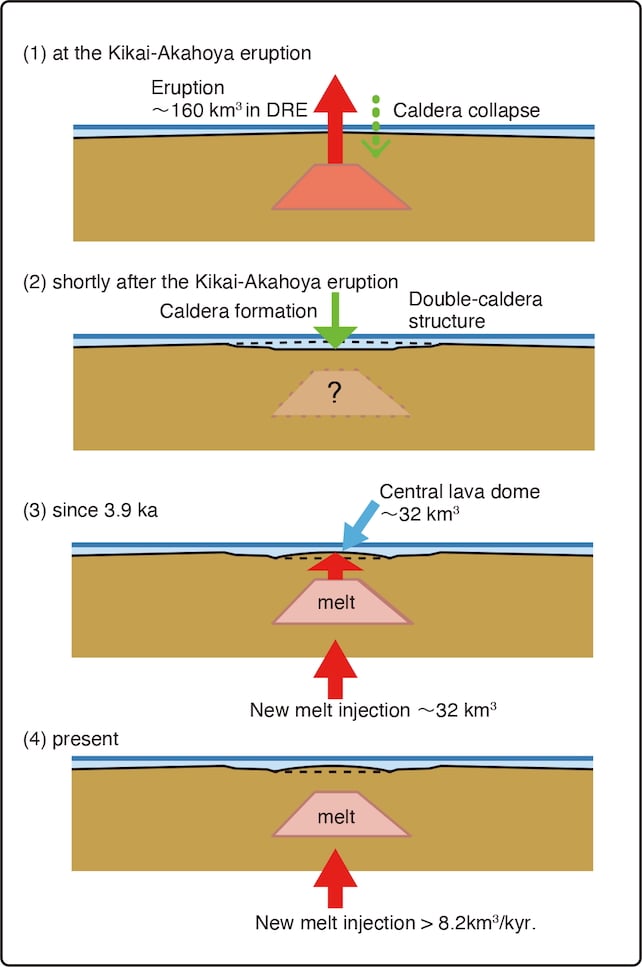
"Due to its extent and location it is clear that this is in fact the same magma reservoir as in the previous eruption," Seama says.
The magma inside doesn't appear to be leftovers, though; chemical analyses suggest its composition differs from Akahoya material. Previous studies also indicate that a new lava dome has been forming in the caldera over the last 3,900 years.
"This means that the magma that is now present in the magma reservoir under the lava dome is likely newly injected magma," Seama says.
Based on these findings, the researchers propose a new general model for the refilling of magma chambers beneath giant calderas, offering insights into Kikai and other volcanoes worldwide.
"This magma re-injection model is consistent with the existence of large shallow magma reservoirs beneath other giant calderas like Yellowstone and Toba," Seama says.
Related: Melting Glaciers Could Reawaken Hundreds of Earth's Volcanoes
"We want to refine the methods that have proved to be so useful in this study to more deeply understand the re-injection processes," Seama adds. "Our ultimate goal is to become better able to monitor the crucial indicators of future giant eruptions."
The study was published in Communications Earth & Environment.