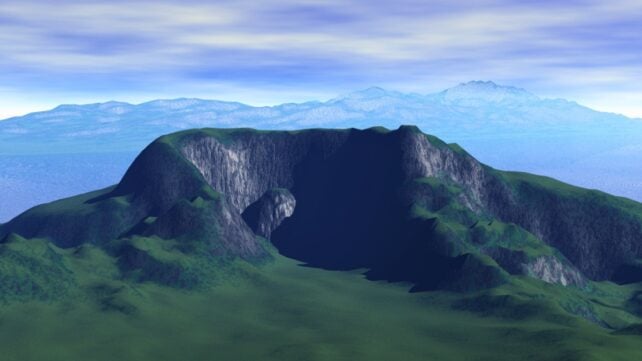
'Extinct' volcanoes that haven't erupted for tens of thousands of years may not actually be inactive, but silently accumulating huge reservoirs of magma to fuel future outbursts.
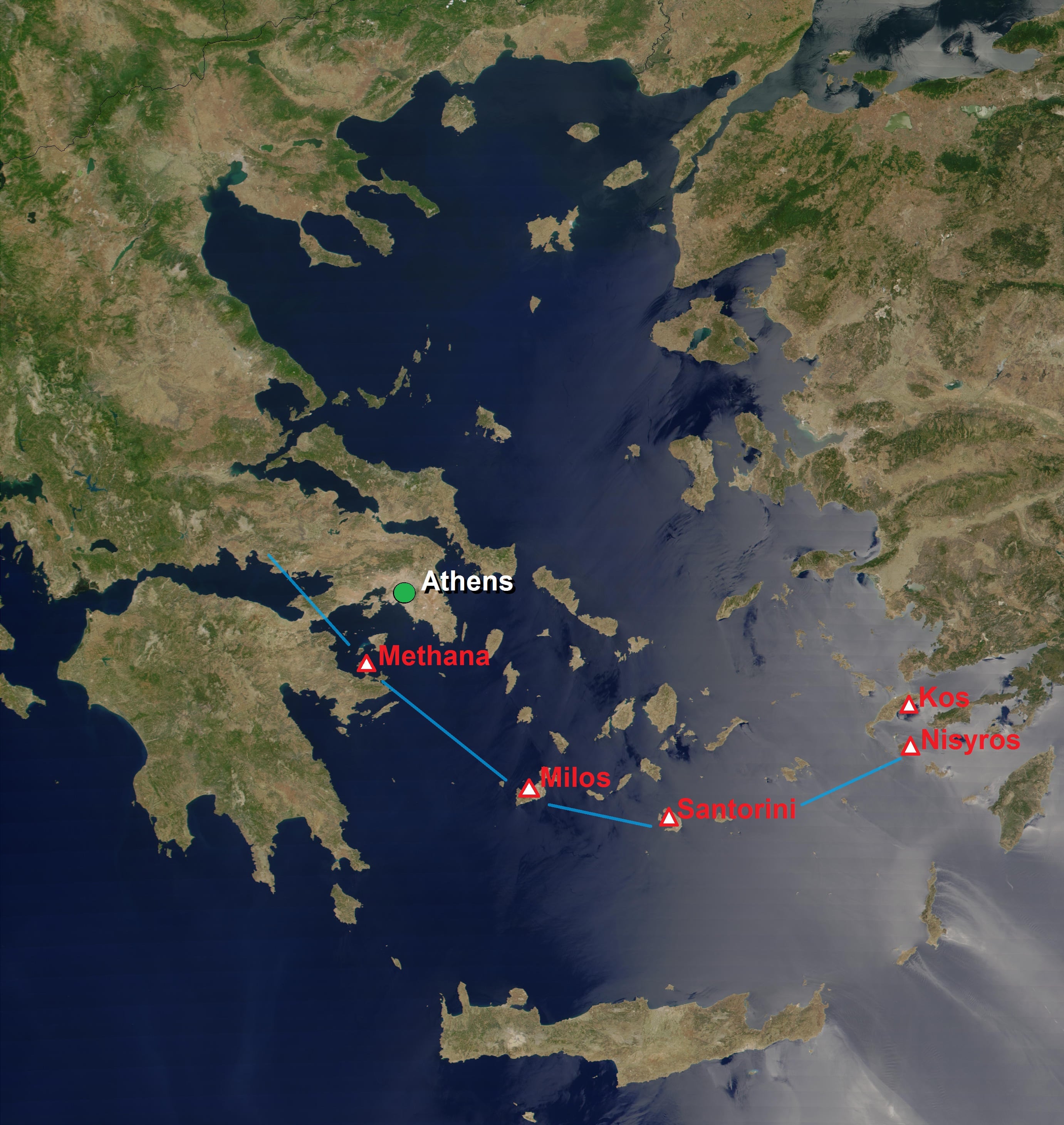
This worrying revelation comes from a team of volcanologists at ETH Zurich in Switzerland, who mapped the geological history of the Methana volcano near Athens, Greece, across 700,000 years.
They discovered a "bloom" of tiny zircon crystals coinciding with Methana's longest dormant period, which lasted more than 100,000 years, indicating that massive amounts of magma were still brewing.
Such a deceptively long, false dormancy is problematic because volcanic hazard forecasts are based on the assumption that some volcanoes may become extinct after approximately 10,000 years of inactivity.
To reassess the relationship between eruptive activity and magma accumulation, the researchers analyzed rock samples from 31 locations across the volcano, all associated with Methana's ancient eruptions – a hot-and-cold history spanning more than half a million years.
"What we learned is that volcanoes can 'breathe' underground for millennia without ever breaking the surface," says ETH Zurich volcanologist Olivier Bachmann, the study's senior author.
Methana is the westernmost component of the South Aegean Volcanic Arc, a region of volcanic hotspots generated by plate tectonics that cuts across the Greek islands. This arc also includes the Thera volcano, thought to have devastated the Minoan civilization on Santorini around 3,600 years ago.

This work adds evidence that quiescence can prove deadly – an idea that has been tragically apparent in the many human settlements destroyed by the ashes, lava, and toxic gases released from sleeping-but-dangerous volcanoes.
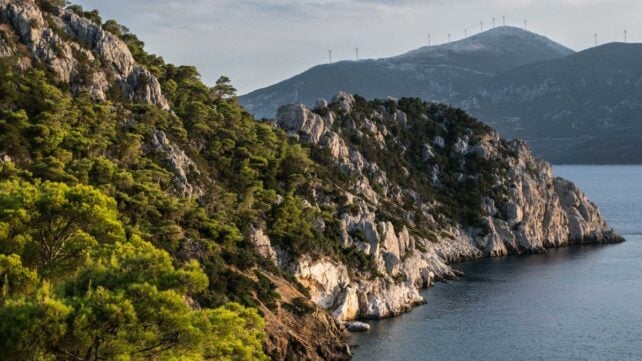
The still-active Methana itself has generated more than 31 eruptions, including three explosive events, over the past hundreds of thousands of years. Although its chronology is poorly understood, the youngest eruption was witnessed circa 2,250 years ago and recorded by the Greek historian Strabo.
To delve further back into geological time, the researchers analyzed crystals from the Methana rock samples and calculated their ages using the radioactive decay rates of elements such as uranium.
Tiny zircon crystals are especially informative. Zircons form in magmatic environments and act as natural time capsules, revealing when and where they were born – and preserving Earth's history for more than 4 billion years.
"We can think of zircon crystals as tiny flight recorders," says Bachmann.
"By dating more than 1,250 of them across 700,000 years of volcanic history, we've reconstructed the volcano's inner life with a precision and statistical power that simply wasn't possible a decade ago."
The reconstruction revealed that snoozing volcanoes may be silently awake. In fact, the peak of Methana's zircon formation occurred during an exceptionally lengthy quiet spell lasting from around 280,000 to 170,000 years ago.
Curiously, this peak – a strong signal of magma production, which provides the perfect conditions for zircon formation – occurred despite no volcanic life-signs at the surface.
This paradox is due to the geological forces that shaped Methana's roots. Beneath the volcano, one tectonic plate is sliding below another, in an Earth-sculpting process called subduction.
Like a conveyor belt, the sliding plate carries substantial amounts of sea-floor sediments and water into the Earth's interior. That water hydrates the mantle, supercharging magma production.

But water saturation also triggers crystallization within the magma, making it thicker and more immobile. This thickened magma slows itself down as it ascends, the team's modeling showed, meaning those billowing magma supplies stall at lower depths and lead to fewer eruptions.
"We actually believe that many subduction zone volcanoes might be periodically fed by particularly wet primitive magma, something that the scientific community has not yet fully recognized," explains lead author Răzvan-Gabriel Popa, a volcanologist at ETH Zurich.
"Methana is a great example where we have seen this effect clearly, but the impact of our findings can be generalized and widespread."
As a result, this work provides new evidence that extended dormancy may not indicate safety, which could prompt hazard authorities to reassess volcanoes classed as 'extinct'.
Related: A Quiet Region of Italy Is Hiding a Vast Reservoir of Magma
By monitoring gas emissions, ground deformation, volcano-tectonic earthquakes, and gravity anomalies, global hazard authorities may be able to determine which long-slumbering volcanoes are quietly reawakening, the researchers suggest.
"This highlights the importance of monitoring dormant volcanoes, even in the absence of recent eruptions," the team concludes.
This research was published in Science Advances.