
A blood pressure drug has the potential to combat one of the most common, difficult-to-treat bacterial infections, according to a new study.
A team of researchers, led by scientists at the Houston Methodist Research Institute in Texas, has shown that the drug Candesartan cilexetil could help stop a kind of antibiotic-resistant bacteria called methicillin-resistant Staphylococcus aureus, or MRSA.
In lab and animal studies, the medicine disrupted the bacteria's cell membrane, interfering with cellular function and ultimately killing the bacteria.
The drug, also called CC, is inexpensive and already widely used to treat high blood pressure and heart failure, making it an especially attractive option if its effectiveness against MRSA is confirmed in human trials.
"I think that CC is one of the most exciting agents that we have found," Eleftherios Mylonakis, the study's senior author, told ScienceAlert.
Mylonakis is an infectious disease specialist at Houston Methodist Academic Institute and says MRSA is one of the most common resistant pathogens he sees.
MRSA can cause skin, lung, or even bloodstream infections and results in more than 70,000 severe infections and 9,000 deaths in the US every year, according to estimates from the Centers for Disease Control and Prevention.
Antibiotic-resistant microbes such as MRSA are a rising public health threat, directly responsible for more than 1.27 million global deaths in 2019.
But despite the increasing pressure, attempts to develop new drugs aren't keeping pace with the problem. That's in part because antibiotics aren't very profitable and companies don't have a strong financial incentive to develop them, Mylonakis said.
"The market is completely upside down," Mylonakis said.
"The better the antibiotic, we try not to use it, because we worry it will develop resistance."
Mylonakis and his team are on the hunt for promising new candidates.
In earlier work, they used worms infected with MRSA to screen more than 80,000 compounds. Only a handful of the drugs helped the worms successfully fight off the infection, and Candesartan cilexetil was one of them.

To further probe Candesartan cilexetil's potential, the team analyzed its interaction with MRSA with simulations and advanced imaging techniques.
They also analyzed the genetic material, small molecules and lipids involved and tested how well the drug worked on MRSA in the lab when combined with different antibiotics.
"We started building one by one, block by block," Houston Methodist microbiologist Nagendran Tharmalingam, first author of the study, told ScienceAlert.
"We found how this drug is causing membrane injury."
The membrane is a critical part of the cell, providing structure and acting as a gatekeeper to the cell's insides.
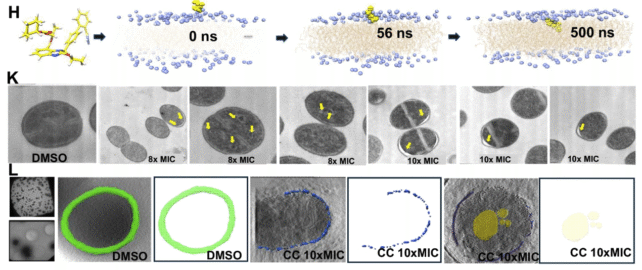
By latching onto, penetrating, and disrupting the MRSA cell membrane, the drug weakened and killed the bacteria. Imaging studies showed the drug punctured holes in the bacteria's membrane, through which the cell's innards leaked.
The team also found that Candesartan cilexetil can help fight off persistent MRSA bacteria that can hide dormant in the body and later reemerge.
What's more, combining Candesartan cilexetil with existing antibiotics, such as gentamicin, created a stronger response at lower doses than each drug alone.
In mouse models, Candesartan cilexetil significantly reduced the bacterial burden, providing more evidence that the drug could hold promise for fighting MRSA in humans.
Related: This Tiny Wildflower Could Be a Secret Weapon Against Superbugs
The team is developing similar drugs, chemically tweaking Candesartan cilexetil to make new compounds that are more effective and potentially have fewer side effects, Tharmalingam said.
They are hoping to work with a pharmaceutical or biotech company to further test Candesartan cilexetil and similar compounds in human trials, with positive responses so far.
"We are trying to get this from benchside to bedside," Tharmalingam said.
The research was published in Nature Communications.