The hominin family tree is more like a complicated, tangled bramble.
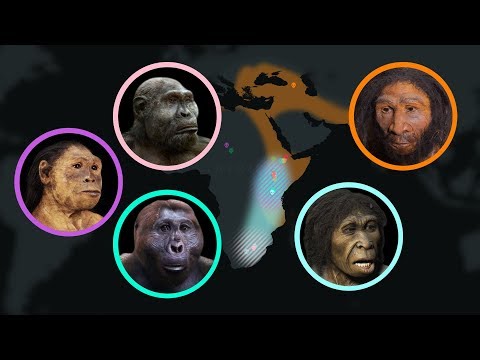
Homo sapiens is the only member of the genus left today, but in millennia past, the world was inhabited by multiple related Homo species – including the Neanderthals, Homo erectus, and Homo habilis, and traces of a mysterious group known as the Denisovans.
In recent years, evidence has emerged that these populations did not live in isolation. Multiple overlapping human groups roamed Eurasia, occasionally fighting, trading – and even interbreeding.
Now, new evidence has emerged of this complex history. From three sites across China, archaeologists have identified proteins in six H. erectus teeth that contain a genetic variant also seen in Denisovans, hinting at genetic mixing between the groups.
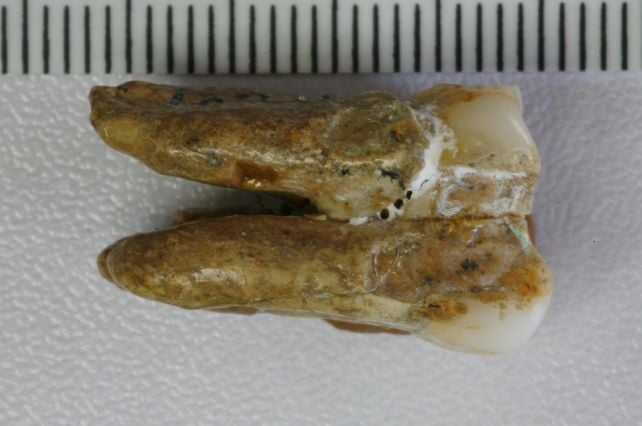
Because organic material degrades so efficiently over time, peering into our ancient past is difficult. Teeth are a particularly valuable resource. The hard enamel retains proteins that can be linked to DNA variations inherited across generations.
When scientists do succeed in decoding this information, there are often surprises waiting.
Humans mixed with Neanderthals. Neanderthals mixed with Denisovans. Denisovans mixed with humans. Human DNA even shows genetic traces of long-lost, unidentified 'ghost' hominids.
But the Denisovans remain deeply mysterious. Scientists have found only a few fragmented remains – teeth, a jawbone, and shards of other bones – that are not consistent with humans or Neanderthals, but do seem to have things in common with each other.
We don't know whether the Denisovans consisted of just one group or were a collection of related groups. We don't know how far they dispersed, or how long they were around, or when they disappeared.
They have no formal classification, description, or species name. The little evidence recovered suggests that they were closely related to the Neanderthals and shared an ancestor in common with both Neanderthals and modern humans.
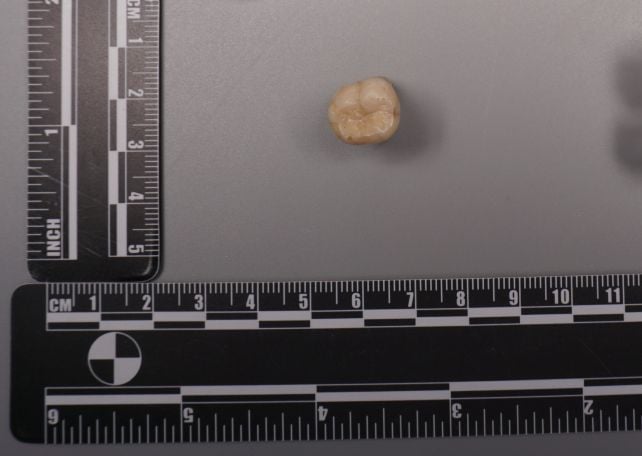
The new evidence about this mysterious group comes from six H. erectus teeth from three archaeological sites across China – Zhoukoudian near Beijing, Hexian in Anhui Province, and Sunjiadong in Henan Province.
H. erectus predates modern humans, but belongs to the broader human lineage from which H. sapiens emerged.
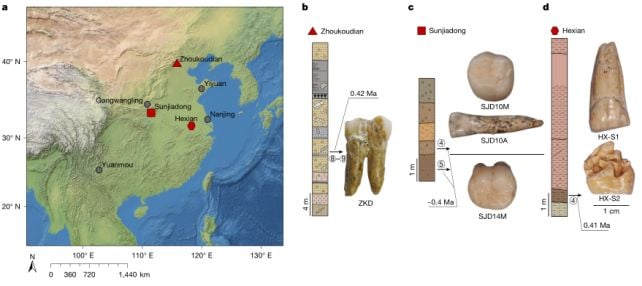
The teeth the researchers studied are around 400,000 years old – far too old for DNA to have survived under most normal conditions. However, DNA encodes genes, which make proteins, and tooth enamel is tough enough to retain proteins for a very, very long time.
By carefully extracting and analyzing proteins in the enamel of these ancient teeth, a team of scientists led by paleoanthropologist Qiaomei Fu of the Institute of Vertebrate Paleontology and Paleoanthropology in China identified inherited genetic variants preserved in the proteins.
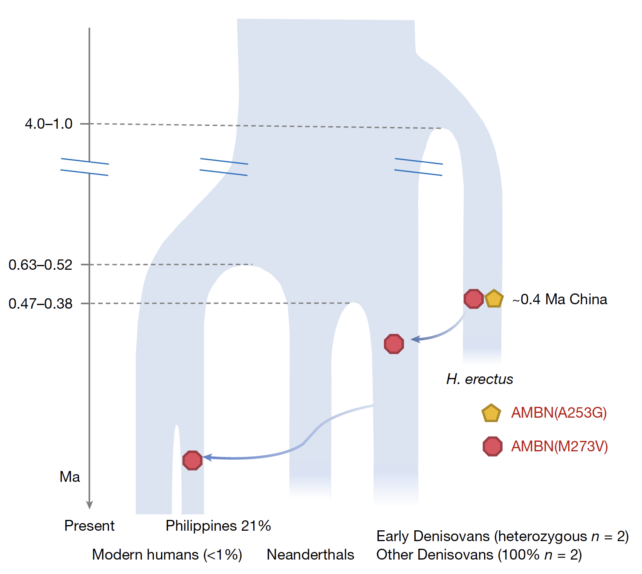
Those proteins, from all six teeth, contained two unusual inherited variants of the enamel protein ameloblastin.
One variant appears to be unique to these Chinese H. erectus individuals – it's never been seen before in any other known hominin, and may indicate a distinct lineage of East Asian H. erectus.
The other had previously been identified in Denisovans – suggesting populations related to the two groups may have interacted somewhere in their history.
It's difficult to determine how widespread Denisovan populations really were because the fossil record is extremely sparse, but the evidence we have suggests they coexisted with H. erectus in East Asia for a time.
Because the variant appeared in all six H. erectus teeth studied across multiple Chinese sites, the researchers argue it most likely originated in populations related to H. erectus before later appearing in Denisovans.
"Their shared habitats create opportunities for interactions," the researchers write in their published paper.
These findings don't solve the mystery of the Denisovans. Instead, they add to a growing body of evidence that the course of human evolution was deeply messy in a way that Charles Darwin could never have imagined.
Rather than one neat evolutionary lineage, the picture being constructed is one of multiple groups repeatedly overlapping, interacting, and sharing genetic material over hundreds of thousands of years.
The results also add weight to the idea that the Denisovans at least roamed far enough to intermix with other groups and were more genetically diverse than once thought.

And there's one more tantalizing possibility. Scientists have never been able to isolate a full H. erectus genome; the samples are just too old and degraded.
Related: Moroccan Cave Fossils Capture a Crossroads in Modern Human Evolution
This new study suggests that genetic information from populations related to H. erectus may have entered the Denisovan genome; from there, parts of it may have entered the human genome.
The second protein variant, the one already known from Denisovans, was also found in some modern humans.
Other recent studies have similarly uncovered traces of Denisovan DNA in modern human genomes, adding to our own genetic diversity.
So it's exciting to think that with increasingly sophisticated tools and analysis techniques, scientists are bringing us closer to untangling some of the most twisted parts of ancient human history.
In time, with more specimens and samples, we may even work out who the 'ghosts' in our genomes are.
"Further research on H. erectus, including molecular data across different periods and regions, will help to clarify their microevolution, population diversity, and interactions with Denisovans," the team concludes.
The findings have been published in Nature.