
We know that weight loss drugs such as Wegovy can have negative as well as positive impacts on the body.
But people who take these medications may face a hidden side effect unrelated to nausea, digestion, or the number on the scale: social stigma.
A new study suggests that people who lose weight with GLP-1 drugs get judged more harshly than those who lose weight through diet and exercise. There's news that may not surprise you.
But that wasn't the most concerning finding.
In fact, the new research revealed that the judgment that comes with using weight loss drugs could be worse in some cases than the judgment people get for not losing weight at all.
That could potentially put people off from starting or maintaining a course of medication, the study authors warn.
"We expected there might be some stigma around using a GLP-1," says first author and social psychology researcher Erin Standen, from Rice University.
"But what surprised us was the extent of it."

Standen and colleagues from the Mayo Clinic and the University of California, Los Angeles recruited 1,313 US-based adults through two randomized online experiments, asking them to rate various character traits of a fictional 38-year-old after reading about their weight history.
The participants were randomly assigned different stories to compare their perceptions of others.
The stories varied based on the method of weight loss (either with a GLP-1 drug or through diet and exercise) and whether the lost weight was kept off, with some fictional characters also described as not having lost weight at all.
Characters using GLP-1 to lose weight were judged more harshly on most measures.
Compared with those who lost weight using diet and exercise, GLP-1 users were perceived by study participants as lazier, less healthy, less disciplined, and less appealing to spend time with – measured by participants' willingness to affiliate with them.
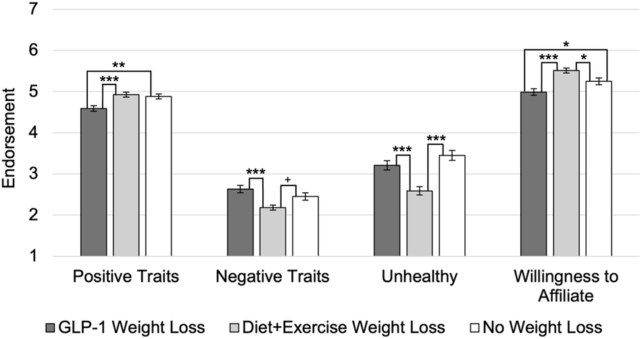
When rating GLP-1 users and those with no weight loss, participants scored them similarly on negative traits, but the GLP-1 users received lower scores on positive traits, including honesty and generosity.
The characters who hadn't lost weight were also rated as more appealing to spend time with than the GLP-1 users.
"The GLP-1 users were socially penalized not just compared to someone who lost weight through diet and exercise," says Standen.
"They were also rated more harshly than someone who didn't lose weight in the first place."
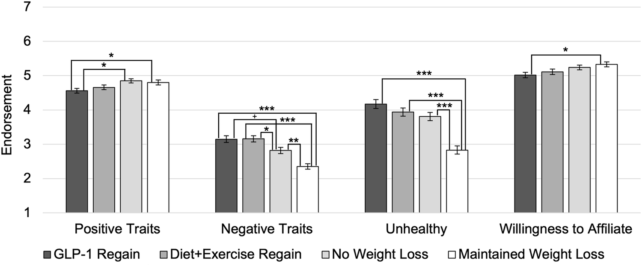
In another experiment, participants judged regaining weight after a course of GLP-1 drugs about the same as regaining weight lost through diet and exercise.
Both groups were rated more negatively than characters who maintained their weight loss.
"What we're seeing is that people may face judgment at multiple points," Standen says.
"They may be judged for their weight and for how they choose to manage it."
This is quite a limited study in that we're talking about short bios of people who don't exist and aren't personally known to the participants, but the findings could still be useful.
Research on GLP-1 drugs (named after the glucagon-like peptide-1 hormone that helps regulate blood sugar) has shown that once someone stops taking these medications, the extra weight tends to come back quickly.
That's a problem when it comes to helping people stay at a weight that's healthy for them, and which can reduce the risk of physical and mental problems related to obesity, such as premature death, cardiovascular diseases, several kinds of cancer, and depression.

The researchers behind this new study are keen to change the narrative around the idea that GLP-1 drugs represent an "easy way out" for those struggling with obesity or being overweight.
The opinions of other people do matter here.
"If people feel judged for the choices they're making about their health, that can influence what they're willing to do," explains Standen.
"It can affect whether they seek care, whether they talk openly with providers, and how they manage their health overall."
Related: Immune Cells 'Remember' Obesity Long After Weight Loss, Study Finds
For those living with obesity, effective treatment can be life-changing, and the study's findings may be useful for public health messaging.
"This is a moment where these treatments are really entering the mainstream, so understanding the social side of that is critical," Standen says.
The research has been published in the International Journal of Obesity.