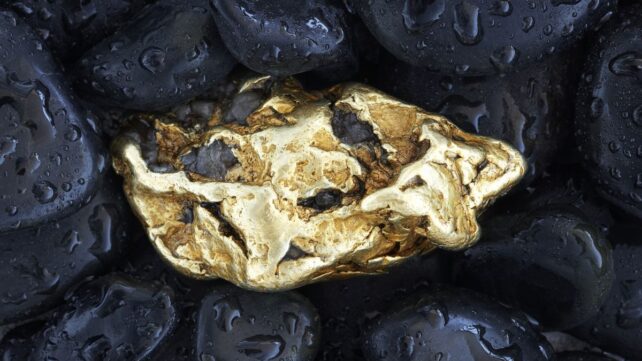
There are several good reasons gold is one of the most valuable metals on Earth.
Not least of those is its glistening shine. Unlike many other metals, gold is extremely resistant to rust, tarnish, and corrosion – it will gleam as brightly yellow thousands of years from now as it does today.
This property is known as chemical nobility, which means the element has low reactivity.
Gold is the most noble of all known metals – it doesn't react readily with substances like the oxygen that bonds with atoms on the surface layers of other metals to form rust or tarnish.
Now, computational chemists Santu Biswas and Matthew M. Montemore of Tulane University in the US have discovered why.
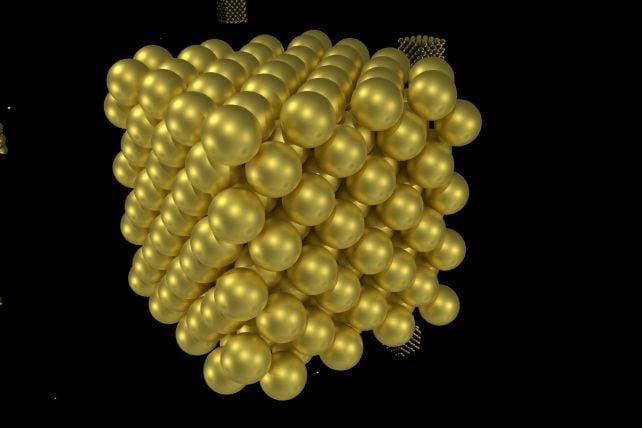
According to their research, the arrangement of atoms on the surface of gold forms a pattern so tightly packed that the dioxygen molecule that would otherwise interact with it cannot break apart easily enough to trigger oxidation.
Loosen that pattern up a bit, and gold could become dramatically more vulnerable to rust – but that could actually be a good thing.
In chemistry, oxygen activation is an important step that allows other reactions to take place. For example, to convert carbon monoxide into carbon dioxide, you need a free, reactive oxygen atom available that can attach to the CO to make it CO2.
To do this, scientists can 'activate' dioxygen using a metal surface that helps split the molecule into two highly reactive oxygen atoms.

Gold would be an especially desirable catalyst for this reaction because it's so inert – that is, it doesn't react strongly with other atoms or molecules.
Some oxygen activation catalysts are much more reactive, which can generate undesirable byproducts, or the catalyst itself binds too strongly with oxygen and corrodes over time.
You might think gold would be a poor candidate for this sort of work, but in the 1980s, scientists made a shocking discovery.
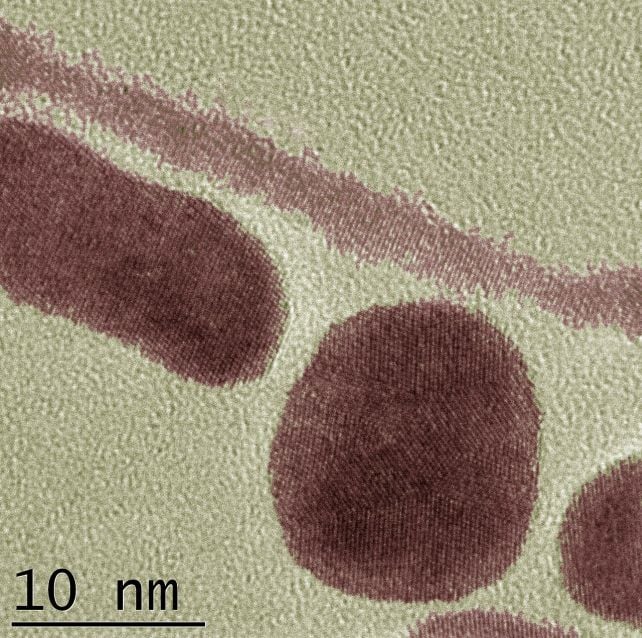
Although bulk gold is unsuited for oxygen catalysis, nanoparticles of gold are surprisingly effective at activating oxygen.
That discovery raised a big question.
If gold resists oxygen so strongly, how are these tiny particles able to drive oxidation reactions at all?
The new research suggests that the answer may lie in the way atoms are arranged on gold's surface.
Biswas and Montemore used computer simulations to study what happens when oxygen molecules come into contact with nanoscopic gold surfaces with different arrangements of atoms.
In particular, they studied two different kinds of patterns: "reconstructed" surfaces, where the atoms settle into the tightly packed hexagonal arrangement gold naturally prefers; and "unreconstructed" surfaces, which form looser square-like patterns.
The difference between the two surface types was dramatic.
On the reconstructed surfaces, the interaction played out exactly as expected. The oxygen molecule was unable to easily split apart into two oxygen atoms, as has been observed in real scenarios involving bulk gold.
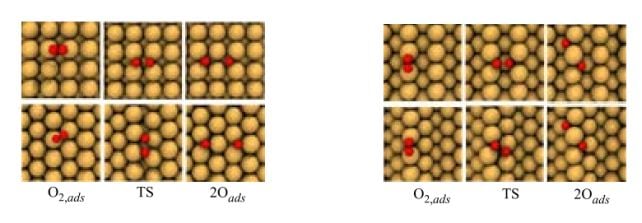
On the unreconstructed surfaces, the scenario couldn't have been more different. The oxygen molecules split apart quite easily.
The simulations suggest this is because, on the tightly packed hexagonal surface, the oxygen molecules could not find enough space to break apart easily.
The square patterns have a looser geometry with that space built in, and the oxygen molecules can much more readily find enough purchase to split.
How much more readily? Many orders of magnitude, the researchers found. Oxygen dissociation occurred billions to trillions of times more readily on the unreconstructed surfaces than on the reconstructed ones.
This may help explain why tiny gold nanoparticles behave so differently from bulk gold. Small particles may not fully develop the tightly packed reconstructed surfaces seen in larger pieces of gold, leaving more reactive square-like regions exposed.

The tight arrangement of surface atoms on bulk gold is not necessarily designed to resist oxidation; it's just the most stable configuration for the metal. The corrosion resistance is just a cool side effect of that.
Related: A Vast Source of Natural Hydrogen Is Hiding in Ancient Canadian Rocks
The new findings could help scientists engineer gold catalysts that balance corrosion resistance with efficient oxygen activation.
"This provides new understanding as to why gold is so inert toward dioxygen and suggests that creating surfaces with square or rectangular structures may significantly improve catalytic activity for oxidation reactions on gold," the researchers write.
"Our results provide a new strategy for designing gold-based catalysts that minimize reconstruction or stabilize squarelike motifs to enhance dioxygen activation."
The findings have been published in Physical Review Letters.