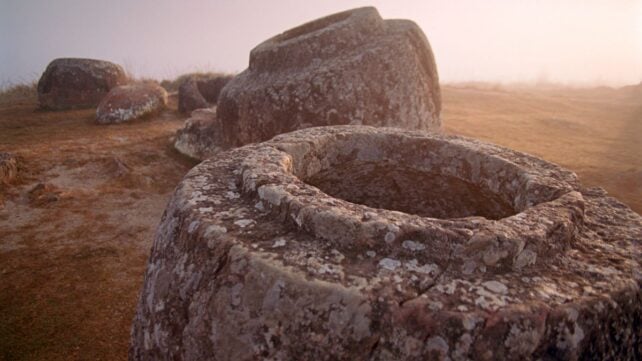
In the middle of Laos, an ancient mystery bulges from the sweeping plains and intermittent forests of the Xiangkhoang Plateau.
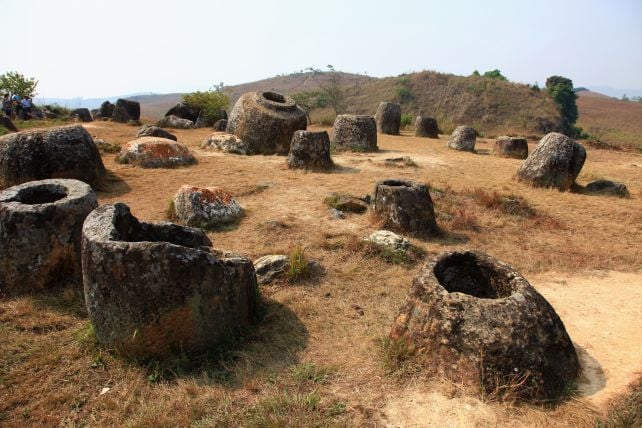
There, numbering in the thousands, vast stone jars – many empty and open to the sky – punctuate the landscape, their original purpose lost in the fog of time.
For many years, scientists have debated their use, often unable to get closer to the jars due to the 80 million undetonated cluster bombs that still lie scattered across the plain, dropped by the US during the 1960s Laotian Civil War.
Now, the excavation of a single giant jar has given us an answer.
Inside, archaeologists have found a densely packed jumble of human bones, from an estimated 37 individuals. What's more, they were not all placed inside at the same time – the remains suggest the jar was used multiple times over a 270-year period, between 890 and 1160 CE.
"The number of individuals also suggests the jars were owned by family or extended family groups," says archaeologist Nicholas Skopal of James Cook University in Australia.
"They likely served as places where ancestral rites were performed over generations."
Although many theories about the jars' function have been floated, including that they were used for food storage, the piecemeal evidence retrieved to date indicates that the giant jars were used for funerary purposes.
Several of the coffers – which range in size from 1 to 3 meters (3.3 to 9.8 feet) and were hewn from various types of stone – have been found to contain human remains, some of which also show possible signs of cremation.
"Archaeologists generally agree they were used in mortuary rituals, but we don't know how they were exactly used, who made them, or how old they are," Skopal explains.
His team's excavation of one particular large jar, with a base around 2 meters in diameter, has yielded some vital clues.
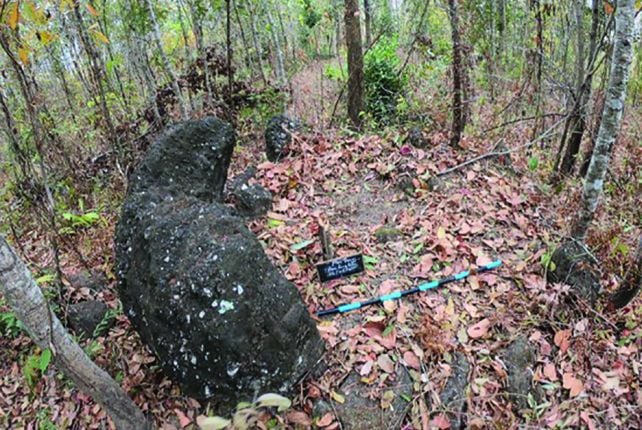
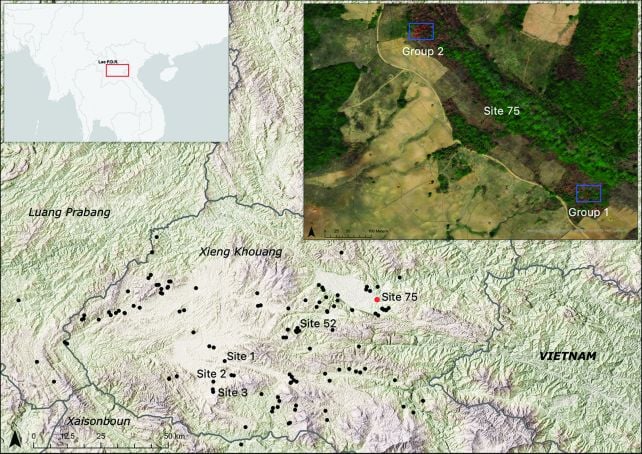
It took three field seasons, from 2022 to 2024, to completely excavate the monument known as "Jar 1" at Site 75 of the Plain of Jars. This particular stone container, carved from conglomerate stone, was in poor condition, partially buried with only its crumbling sides protruding from the swallowing earth.
During the first field season, the site disgorged its first tantalizing hints of the jar's contents: a few fragmentary pieces of human remains and possible grave goods.
By the time excavations were complete, the researchers had uncovered a large number of human bones, densely packed at the base of the jar.
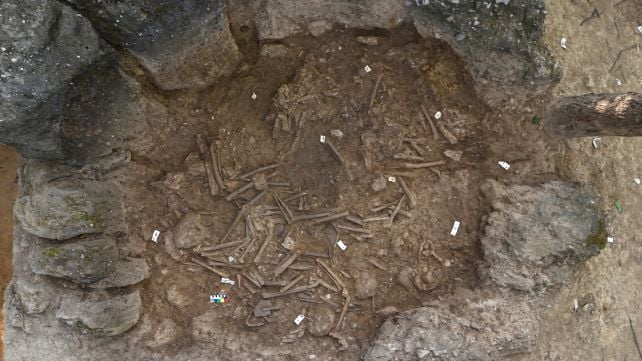
Analysis suggested that some 37 individuals had been placed therein, with radiocarbon dating revealing the period of their interment.
However, the researchers' analysis also suggested that the jar was not the first place that the remains had been placed after death, and may not have been intended as their final resting place.
"We determined that it was an example of secondary interment during the 9th and 12th centuries CE, in which human remains were deposited after an initial period of decomposition elsewhere," Skopal says.
The researchers hypothesized that the smaller stone jars may have been where the initial decomposition took place, after which the remains were moved to a larger one. This may have been intended as a temporary resting place before the bones were moved to a third location.
This could explain why so many of the jars are now empty – but the researchers urge caution with this speculation, since similar stone jars are widely distributed across Laos, and mortuary practices likely varied significantly.
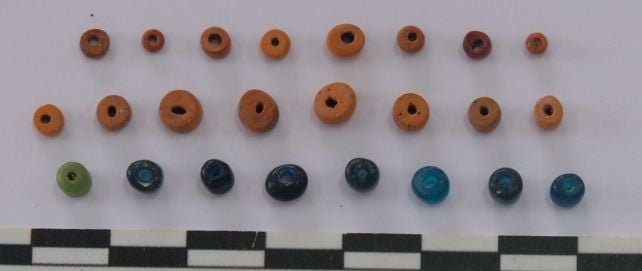
Bones weren't the only items in the jar. The researchers also found 20 glass beads, five stone slabs, pottery shards, a small bell, and an iron knife.
Several of the pottery pieces could be put together like a puzzle, revealing that they were once a round pot. The knife and bell are similar to items found at other sites in burial contexts, suggesting they are important grave goods.

Meanwhile, the glass beads revealed a bit more about the people who may have used these jars. An analysis of their composition showed the beads are made of materials originating from South India and Mesopotamia – hinting at previously unknown trade connections between Laos and these regions.
Related: Strange, Giant Stone Jars Created by a Mysterious People Were Just Found in India
The researchers are now working to analyze the bones to try to discover who they belonged to, how they lived, and how they were related to each other. This will tell us whether the site does indeed represent a multi-generational grave.
"The preservation encountered here offers an exceptional window into past mortuary practices, and indicates that many comparable sites may still exist, awaiting discovery," Skopal says.
"Continued investigation of these landscapes has the potential to fundamentally transform our understanding of the cultural and social dynamics that shaped the region."
The findings have been published in Antiquity.