The human population is growing larger and older, which means cancer cases and deaths are increasing, too.
Based on the current trends, there will be 35.3 million cases of cancer diagnosed annually by 2050, and 18.5 million deaths.
For every 10 people diagnosed with cancer, seven will be in low- and middle-income countries, where survival rates are much lower.
This is way beyond the current capacity of global healthcare systems.
According to a new report commissioned by The Lancet Oncology, the cancer workforce will be running 100 million people short by 2050.
Most of those projected shortages are in nursing, and diagnostic roles such as radiologists and pathologists.
The research was led by radiologist Hedvig Hricak of the Memorial Sloan Kettering Cancer Center in the US, and oncologist Patrick Loehrer of Indiana University Melvin and Bren Simon Comprehensive Cancer Center.
"Our global initiative brings a clear warning: without urgent action to address critical workforce shortages, we risk a cancer crisis unlike anything we've seen before," says Hricak.
"We call for immediate, country-specific strategies, smarter workforce use, task-shifting and AI/digital health adoption, alongside future-ready education and strong, sustainable financing through public–private partnerships."
To get a sense of what lies ahead, the team created models of current and future scenarios based on 17 common types of cancer, and 18 types of cancer workforce personnel.
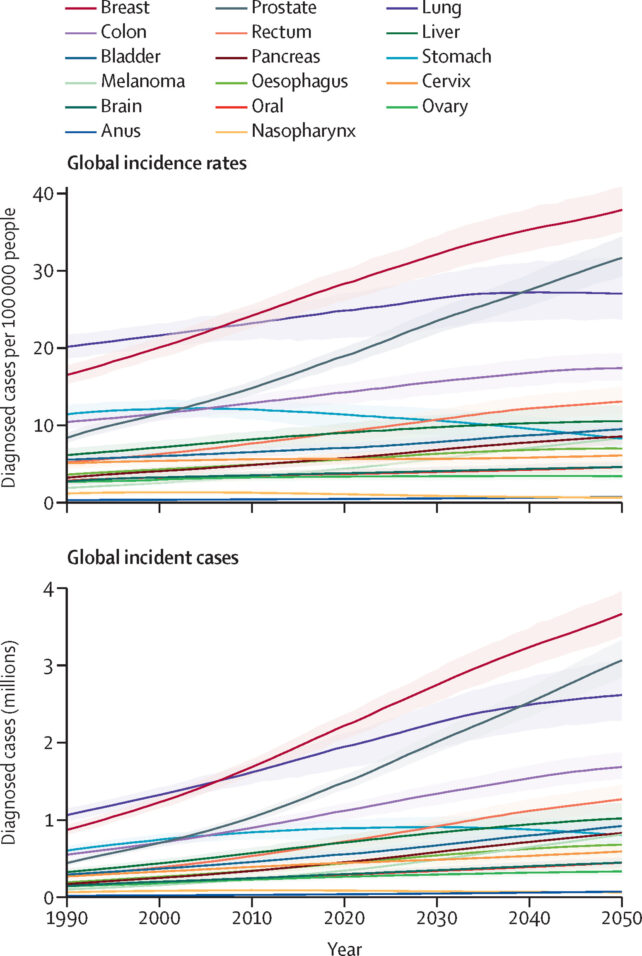
They expect diagnosed incidence rates of these cancer types to increase globally, particularly in low- and middle-income countries, due to aging populations, changing risk factors, and the increasing size of the human population overall.
And it looks like we're on track to have nowhere near enough healthcare staff to deal with it.
By 2050, the global cancer workforce will fall short by about 100 million staff needed to cope with these rising cancer rates, the report states.
It suggests we need to do something, fast, to fill the need for 65 million more nurses and 16 million more diagnostic specialists.
There's also expected to be a global gap of 10 million in demand for specialized medical doctors, with at least 10 years of training; a gap of 6 million in advanced clinical specialists with 6 to 10 years of training; and a shortage of 15 million technical and allied health professionals with 3 to 5 years of training.
These shortages are particularly concerning in Africa and Asia, which are predicted to have the lowest five-year net cancer survival rates globally in 2050. The report estimates those survival rates at just 34 percent in Africa and 39 percent in Asia.
"Crucially, we estimate that one in three cancers go undiagnosed worldwide, with more than 60 percent of cancers remaining undiagnosed in parts of Africa," Hricak and team report.
"Rather than cancer type or biological factors, the most important determinant of cancer survival for many patients is therefore the country in which they receive diagnosis and treatment."
By comparison, in high-income areas like North America and Oceania, survival rates are expected to reach 60 percent.

If the global community can somehow scale up the workforce – and ensure these workers are positioned where they're most needed – it could avert 170 million cancer deaths between 2030 and 2050, the report says.
They propose a suite of strategies to address the crisis. A global cancer workforce registry – which currently doesn't exist – would help inform training, hiring, and resource allocation.
Partnerships between workforce sectors and nations could aid in training, research, diagnostics, therapeutics, and equipment.
They also urge for more investment in digital and artificial intelligence solutions.
In economic terms, the team says these strategies could deliver US$120 trillion of benefits between 2030 and 2050. That's a $4 return on every dollar invested in addressing the problem.
Related: Almost 50% of Preventable Cancers Linked to Just Two Lifestyle Habits
"Make no mistake; this is a wake-up call, no matter where you are in the world," said Mark Lawler, co-author and oncologist at Queen's University Belfast in the UK, at the commission's launch event.
"What we've uncovered is shocking – how can we reconcile a 15 million increase in cancer cases diagnosed with a 100 million decrease in cancer staffing? The data unfortunately do not lie. We can't wait until 2050 to see if our projections are correct – we must act now."
The research was published in The Lancet Oncology.