
Strength training may help you live longer, according to a large new study – though the data shows that changes in mortality risk depend on how much time you invest in it.
Putting in 90–119 minutes per week was the sweet spot identified by the study, associated with a 13 percent reduction in the likelihood of dying from any cause over a period of up to 30 years.
More was not necessarily better; no further reduction in mortality risk was shown in the stats for 120 minutes or more per week.
Researchers led by a team from the Harvard T.H. Chan School of Public Health analyzed data from 147,374 people across three long-running prospective cohorts: the Health Professionals Follow-up Study, the Nurses' Health Study, and the Nurses' Health Study II.
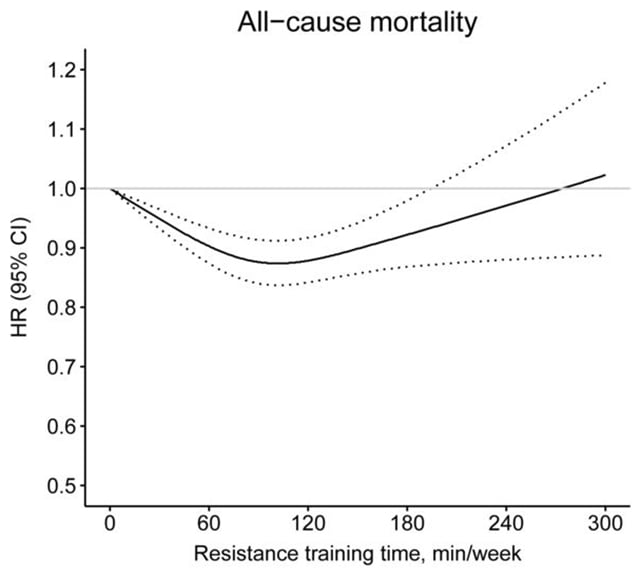
Aerobic exercise mattered too. The lowest mortality risk was observed among people who combined regular strength training with substantial aerobic activity.
The study team says the findings answer some important questions specifically about strength (resistance) training.
"The mortality benefits of aerobic physical activity are well established," write the researchers in their published paper.
"However, the role of resistance training in reducing all-cause and cause-specific mortality, its dose-response relationship, and its joint effects with aerobic activity remain less clear."
The participants in the study were all health professionals: 74 percent met the recommended 150 minutes per week of moderate aerobic exercise (such as running or playing squash), and 46 percent engaged in some form of regular strength training (such as squats or weightlifting).
Besides the reduction in all-cause mortality risk, those clocking up between 90 and 119 minutes of strength training were also 19 percent less likely to die of cardiovascular disease and 27 percent less likely to die from neurological disease (such as Alzheimer's).
Aerobic exercise was measured in MET (metabolic equivalent of task) hours, a measure of how much energy an activity uses relative to sitting still.
Your energy expenditure while sitting (at rest) is defined as 1 MET, and other activities are then calculated relative to that baseline.
For example, 150 minutes of moderate aerobic exercise is the equivalent of 7.5 MET hours – meaning it burns 7.5 times more energy than when resting.

This type of exercise was shown to be even more beneficial in terms of living a longer life, fitting in with earlier research.
Those who logged at least 45 MET-hours of aerobic activity a week had a 42–47 percent lower risk of dying, regardless of how much strength training they did.
For combined aerobic exercise and strength training, the largest reduction in mortality risk was seen in people doing 30–44 MET-hours of aerobic exercise per week plus 60–119 minutes of strength training.
That combination was linked to a 45 percent lower risk of death.
"Our joint analysis of resistance and aerobic activity showed the lowest mortality risk among participants who engaged in both, consistent with previous studies," write the researchers.
"Importantly, we observed that while either sufficient aerobic or resistance training alone reduced mortality risk, aerobic activity conferred greater benefit."

The study cannot prove that exercise directly caused people to live longer. It was observational, meaning it looked for patterns in people's existing habits and health outcomes.
The participants also self-reported their exercise habits, so there may be some fuzziness in the records.
However, the sheer number of people included here and the vast amount of data gathered over decades make the study a useful reference for the benefits of strength training.
Around one to two hours may be enough to see meaningful benefits, and blending strength training with aerobic training seems to be the best way of making sure you live longer – alongside a host of other factors.
The researchers are keen to extend their analysis to look at how exercise types might influence quality of life as well as healthspan: how long people remain healthy, mobile, and independent.
Related: Even Mild Strength Training Now Can Save Your Mobility Later
"Our findings on different dose-response relationships between long-term resistance training with all-cause and cause-specific mortality suggest that different amounts of resistance training may be needed to optimize benefits across outcomes," write the researchers.
The research has been published in The British Journal of Sports Medicine.