It's called California's Big One for a reason.
For more than a century, tectonic pressure has steadily and silently been building within the San Andreas fault line and the nearby San Jacinto fault line.
Now, a new computer model designed by researchers from the US and Europe suggests that tectonic pressures in this area are "unusually high".
"Our results show that stress levels on multiple fault segments are now at or above the highest values seen in the past millennium," says lead author Liliane Burkhard, a geophysicist from the University of Bern, Switzerland.
"Right now, with stress at historically high levels across the region and more than 160 years elapsed since the last major rupture, the system is in a critically loaded state."
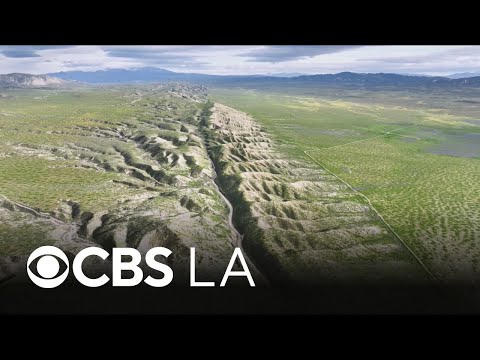
Elevated pressure doesn't guarantee an earthquake in the near future, but it has scientists like Burkhard concerned.
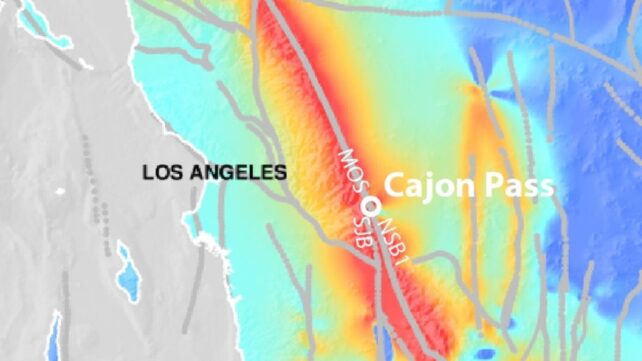
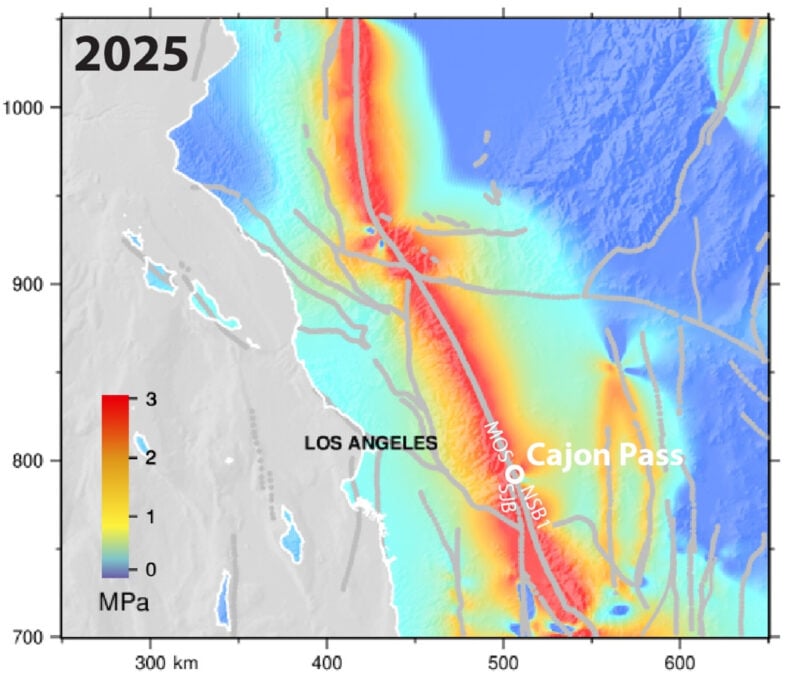
The San Andreas and San Jacinto fault lines meet at Cajon Pass, just northeast of Los Angeles. Together, these two fault systems are responsible for 90 percent of the tectonic slipping that occurs between the North American plate and the Pacific plate in Southern California.
That's creating an immense amount of pressure – estimated to be 2.8 MPa on the Mojave South segment and 3.6 MPa on the San Jacinto Bernardino segment.
In the past 160 years, both of these fault lines have been scarily silent.
If something doesn't give, geophysicists fear an imminent, large earthquake that could cause major damage to Southern California.
That includes densely populated areas like Los Angeles County, Ventura County, Orange County, San Diego County, the Palm Springs–Indio metropolitan area, and even as far south as Tijuana.
It's a disaster waiting to happen, but when it will happen is the pressing question.
"This is not a prediction of when an earthquake will happen," Burkhard says.
"However, studies like this are important contributions to national and global earthquake hazard research in that we are using rigorous, quantitative science to better understand the risk facing millions of people."
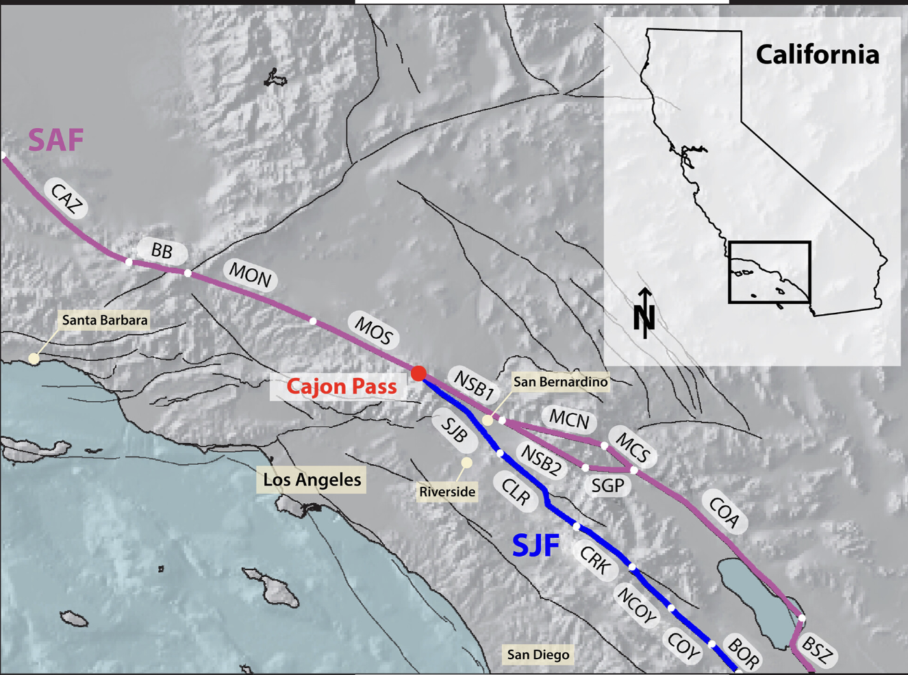
The point where the two fault lines meet is called Cajon Pass, home to highways, railways, and energy corridors that serve the greater Los Angeles metropolitan area.
What happens here, between the San Gabriel and San Bernardino Mountains, could foretell the future of the region.
Scientists think of it like an "earthquake gate". If it opens during a 'slip' event, it could include both fault line systems, causing a larger and more complex disaster.
To investigate further, Burkhard and colleagues joined up with researchers from Northern Arizona University, the University of Bern, the US Geological Survey, and the University of California, San Diego.

They designed a physics-based computer model to better understand the history of fault lines in the region, and how we got to where we are today.
The international team fed 1,000 years of earthquake history data from the region into their model, and then ran simulations.
In some past earthquakes in this region, the 'gate' appeared to be closed, which meant ruptures stopped at Cajon Pass and were contained to one fault line. In other scenarios, it was open. When it was open, there was a joint rupture that typically resulted in a larger and more complex earthquake.
"The conditions that determine whether the 'earthquake gate' at Cajon Pass opens or stays closed appear to be related to how closely the stress levels on the two fault systems are aligned with each other at the time of rupture," explains Burkhard.
Related: Mysterious Earthquakes Strike Like Clockwork – We May Finally Know Why
Of course, these computer models aren't perfect reflections of reality.
However, they help provide information that can be critical for hazard assessments, infrastructure planning, and emergency preparedness, says Burkhard.
At this point, that's really all we can do. Gather as much information on the region as we can, so we are best prepared when the fault lines rupture.
"What we can say is that the system is critically stressed, and that physics-based models like this one give us a clearer picture of the range of scenarios we should be prepared for," concludes Burkhard.
The study is published in the Journal of Geophysical Research: Solid Earth.