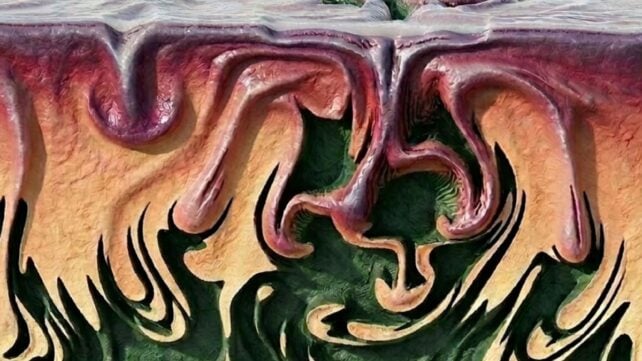
The planet Earth we live on today bears very few traces of its infancy.
The 500 million years between Earth's formation around 4.5 billion years ago and 4 billion years ago – the Hadean eon – is almost a geological black hole.
Very little survives from that time. A handful of ancient rocks and scattered zircon crystals preserve rare glimpses of newborn Earth, but most of the planet's earliest crust has vanished.
Some researchers have put forth that the reason for this is Earth's efficient crustal recycling system, plate tectonics.
But according to a team led by geologist Tim Johnson of Curtin University in Australia, that early crust may never have been able to settle into anything stable.
The reason? An intense period of asteroid bombardment that pummeled Earth for hundreds of millions of years.
"Those impacts carried enormous amounts of energy, and that energy had to go somewhere," Johnson says in a statement.
"The extra heat from impacts would have kept much of the early crust weak and partially molten, making it difficult for rocks to survive."
You may be wondering: If Earth's first attempts at scabbing over are lost from the geological record, how can we possibly know what asteroids were doing during the Hadean?
The answer is both farther and closer than you might think: the Moon.
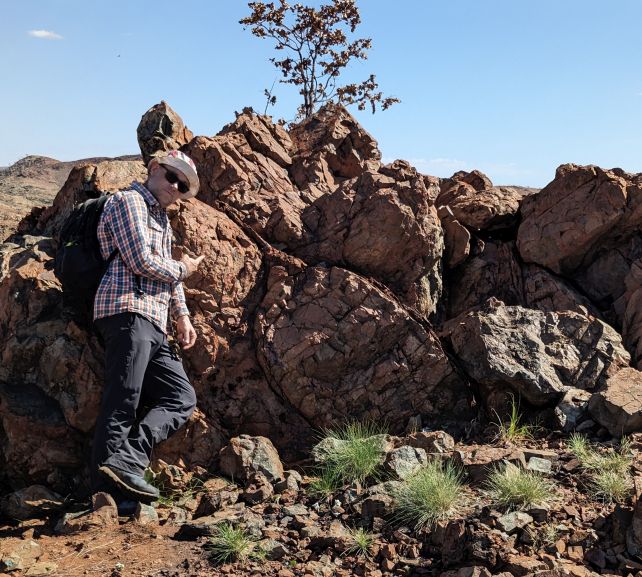
"If you want to see what was happening to the early Earth, it's right there staring back at you," Johnson told ScienceAlert. "I have even been lucky enough to look at thin slices of samples of the Moon under the microscope. Unsurprisingly, they have all been smashed to smithereens."
In fact, the Moon, Mercury, Mars, asteroids, and chunks of meteorites found scattered across the globe preserve quite a detailed record of the inner Solar System's impact history.
"To imagine that Earth was somehow spared the bombardment is, in my view, bordering on lunacy."
"In terms of the energy, specifically that delivered by impact, these bodies tell a similar tale," Johnson said.
"To imagine that Earth was somehow spared the bombardment is, in my view, bordering on lunacy. Of course, how any particular body reacts to an impact is a more complicated story, in which water and gravity are major players."
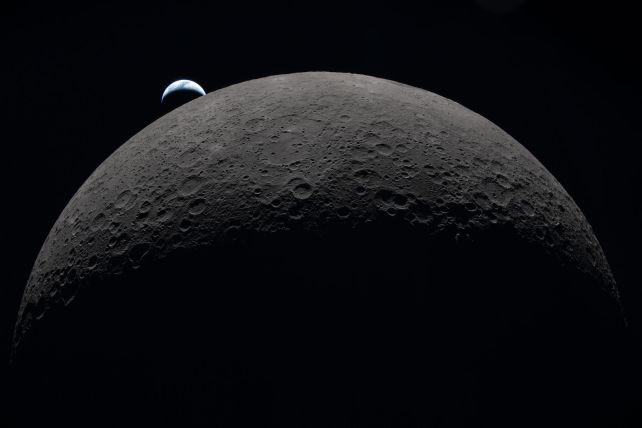
The Moon is a scarred jumble of billions of years of impact history, and previous work had used this lunar history to reconstruct the number, size, and timing of the Hadean bombardment on early Earth.
Some of those earlier studies, which included work by co-lead author and planetary geophysicist Craig O'Neill of the Queensland University of Technology, suggested that repeated impacts may have helped erase much of Earth's earliest rock record.
Johnson, O'Neill, and their colleagues took the next step.
Instead of asking how many asteroids struck the young Earth, they asked what all that impact energy would have done to the planet itself.
According to reconstructions of the Hadean impact history, early Earth was absolutely hammered by asteroids.
The kinetic energy they carried had to go somewhere. Some excavated craters, some blasted rock into the air and even into space, and some became an immense shock wave that rippled through Earth's crust and mantle.
As it decayed, that shock wave dissipated as heat – lots of it.
The effects of large impacts can linger long after the collision itself; previous research has shown that a single impact can leave behind a hot hydrothermal environment that persists for tens of thousands of years.
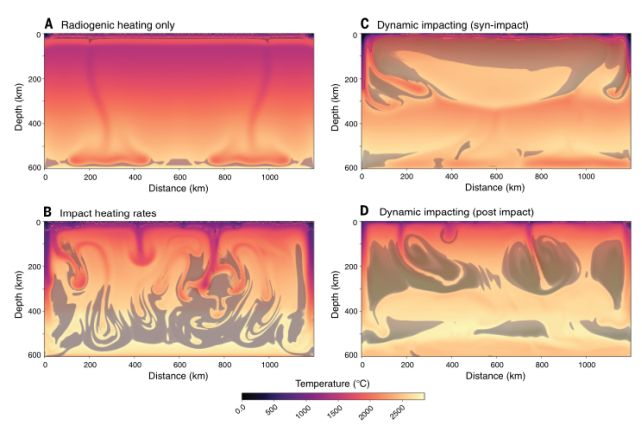
"On the early Earth, much of that energy would have been transferred into Earth's mantle, the thick layer immediately beneath the crust, as heat," O'Neill says in a statement.
"That would have caused mantle beneath and around the impact site to rise and melt, producing large volumes of magma."
According to the team's modeling, the heat from all those impacts may have rivaled – or even exceeded – Earth's internal heat budget for much of the Hadean.
"Although big impacts were much, much more common than today in terms of geological time, they would have been exceptionally rare on the timespan of a human life," Johnson told ScienceAlert.
"Between impacts, the Hadean world would have been mostly covered in a greenish-brown iron-rich ocean and an orange anoxic atmosphere. At sites above earlier impacts, one might expect some large volcanoes poking up above the water spewing lava and gas, not unlike Iceland or Hawaii. At least that's what is in my head."
With this injection of heat, rock just a few kilometers beneath the surface may have remained partially molten, making it difficult for the crust to stiffen into long-lived tectonic plates or stable continents.
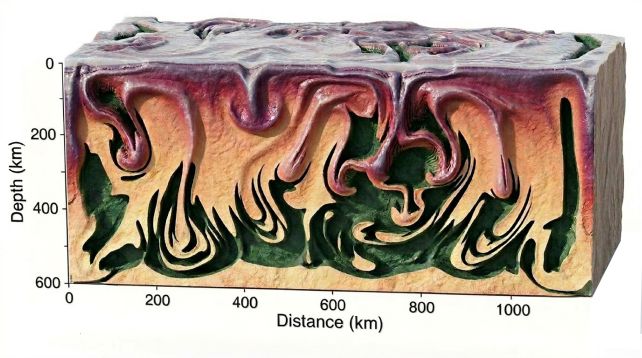
Which means that, instead of forming a stable crust, any crusty bits that did form were almost immediately remelted and recycled, rapidly dispersing back into our planet's toasty maw.
When conditions were right, the eventual stabilization of the crust could have then helped set the stage for plate tectonics – a feature of our world that scientists believe is a crucial component of our planet's habitability.
"Once everything died down in the early Archean, the crust could cool and thicken. It needed to get thick and rigid before plates could begin to form, and that may have happened from the mid-Archean onwards," Johnson explained.
"Once you form a rigid and thick crust and upper mantle (lithosphere), you then need a mechanism to break it. I would argue impacts might explain that as well, but such ideas will annoy many early Earth academics, most of whom prefer (mostly exclusively) internal drivers."

Because the idea challenges current models of our planet's evolution, it's likely to take some time to validate – a process that Johnson says is more likely to be a slower accumulation of evidence than a single smoking gun.
Related: A Surprising Mathematical Pattern Was Found Hiding in Earth's History
However, it does offer a tidy explanation for a number of outstanding questions about the Hadean Earth.
"If the Earth is 4.5 billion years old, why don't we find continental rocks from the first half-billion years of that history? One might also ask why the best-preserved cratons are round. Or how you form huge unconformities on a planet covered by water," Johnson told ScienceAlert.
"Impacts provide a plausible explanation for so many conundrums in Earth science, and not just in the early Earth. As early Earth geologists, we need to take our detailed observations of the Moon more seriously. If not, what was the point of going there?"
The research has been published in Science.