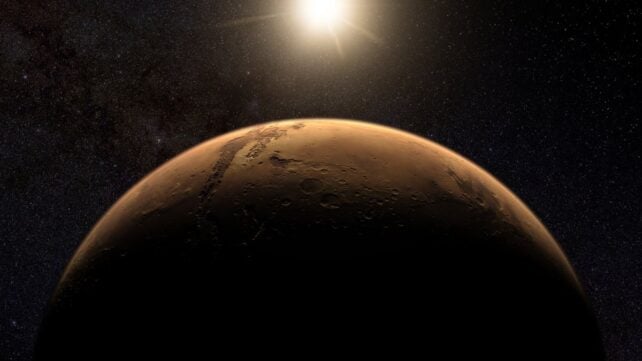
For decades, our picture of Mars was of a dead desert world.
Its magnetic field exists only in sparse patches. Its lakes and rivers have long dried up. Surface volcanic activity sputtered to a halt long ago. And its crust is just one whole unbroken shell – unlike Earth's system of shifting tectonic plates.
Scientists have interpreted this shell as a "stagnant lid," believing any deep magmatic activity would have been relatively simple and localized – very different from Earth's vast, long-lived network of molten-rock plumbing.
Now, however, seismic rumbles recorded deep in the belly of Mars suggest otherwise.
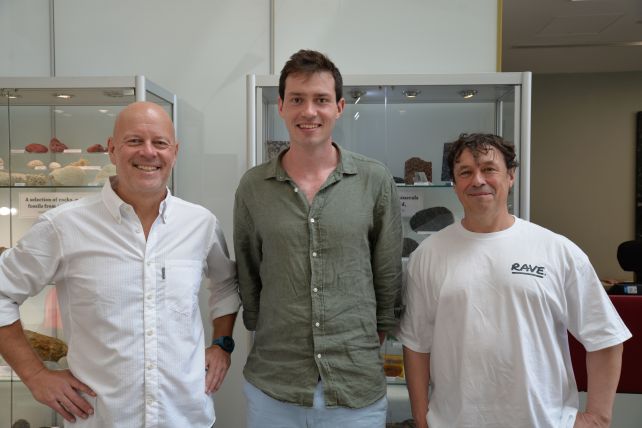
"Traditionally, complex silica-rich crust was thought to require plate tectonics and subduction-driven magmatic differentiation," University of Bristol seismologist Tobermory Mackay-Champion, who was at the University of Oxford during the study, told ScienceAlert.
"Our study suggests instead that Mars can build complex crust through long-lived transcrustal magmatic systems, where mantle-derived magma is stored, differentiated, mixed, and assimilated within the crust.
"That means plate recycling is not the only route to making evolved crust on hot rocky planets."

The differences between Earth and Mars have long been used to interrogate the distinction between a world that is habitable and one that isn't.
The planetary crusts of each world have played quite a large role in those analyses.
Earth has mobile tectonic plates, which in turn generate complex volcanism and continents. Mars doesn't have tectonic plates; its volcanism should, therefore, be relatively simple.
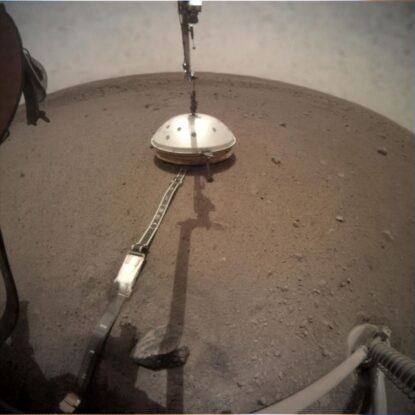
But then NASA's InSight lander was sent to Mars to sit on the surface and monitor the interior for signs of activity. Scientists were not sure what level of activity it might record, but the seismic monitoring station revealed a planet surprisingly alive.
In just over four years, it recorded 1,319 quakes.
"Habitability may be achievable in a wider range of planetary settings than we once assumed."
Here's the thing about quakes. Seismic waves change shape based on the composition of what they are traveling through. This means that they can be used to perform something like a planet-sized ultrasound to figure out what's inside.
And Mackay-Champion and his colleagues were piqued when something in that picture didn't quite add up.
"We noticed that the seismic wave speeds in the Martian lower crust were much higher than expected for a simple crustal structure," he explained.
"That mismatch suggested that the lower crust was compositionally unusual and worth investigating in more detail."
Previous studies had identified this boundary, but its origin remained unclear. Mackay-Champion and team asked the question: What if it marks the point at which two different rock layers meet?
The scenario is easy to picture. In a huge, underground reservoir of magma, heavier minerals sink to the bottom, while lighter minerals rise to the top.
Eventually, the denser crystals accumulate at the bottom, while the remaining melt becomes richer in silica.
Using thermodynamic modeling and statistical tools, the researchers tested how seismic propagation would unfold across hundreds of different combinations of rock layers.
The only scenario that consistently matched the data was an unexpectedly chunky lower layer of ultramafic rock – rich in iron and magnesium but low in silica – and an upper layer of mafic rock that has higher silica content.
And that points to a surprisingly thick underground magma plumbing system.
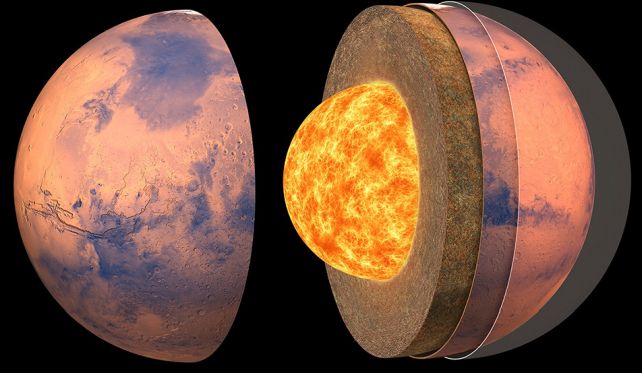
"Explaining a roughly 14-kilometer [8.7-mile] thick ultramafic zone at the base of the crust required a much larger magmatic system than we had initially expected," Mackay-Champion said.
One of the biggest limitations of InSight is that it was not mobile. Once it got into position in Mars's Elysium Planitia, that's where it stayed. In fact, it's still there today, inert and incommunicado since its retirement in 2022.
This means the researchers could only directly constrain the crust beneath the landing site. But they believe that the geological processes are unlikely to be unique to that location.
A similar seismic boundary has previously been identified thousands of kilometers from the InSight lander. In addition, mineral evidence from around the planet provides further support for evolved magmatism.
"Taken together, these observations suggest that the crustal differentiation processes identified beneath InSight may have operated across broad regions of Mars," Mackay-Champion said.
The idea of widespread magmatic activity on Mars could also change how we think about habitability on other worlds.
Earth's tectonic system is thought to be a key ingredient in creating and maintaining the conditions needed for life. If Mars were able to build a complex crust through a different geological process, that assumption may need to be revisited.
"Our study suggests that key processes associated with habitability – including crustal differentiation, long-lived magmatism, volatile cycling, sustained heat transfer, and the generation of chemically diverse environments – can occur without Earth-like plate tectonics," Mackay-Champion explained.
"That broadens the kinds of planets that could sustain habitable environments, including those previously dismissed based on size or their apparent lack of tectonic activity."
This doesn't mean Mars is or even was habitable. But it does suggest the kinds of geological processes associated with habitable worlds may be more common than once thought.
"Habitability may be achievable in a wider range of planetary settings than we once assumed," Mackay-Champion said.

Although there is no confirmed evidence of ongoing volcanism on the surface of Mars today, the planet may yet have surprises in store. InSight's observations of the Martian interior suggest a mantle plume may be surging upward beneath the Elysium Planitia.
More recently, gravity observations suggest a similar plume may be active beneath the Tharsis region.
This new result suggests that, far from being a dead planet, Mars may have a powerful history of activity that runs deeper and longer than we once imagined.
Related: Perseverance Finds Complex Organic Compounds in Strange Mars Rocks
"The biggest change is that Mars no longer looks like a planet shaped mainly by simple basaltic volcanism and stagnant-lid cooling," Mackay-Champion said.
"The most exciting part is that it offers a universal mechanism for building evolved crust on hot rocky planets without plate tectonics and broadens the kinds of planets that could sustain habitable environments.
"In that sense, Mars becomes an example of a much broader planetary process."
The research has been published in Nature Astronomy.