We may be one step closer to answering the most tantalizing cosmic question: Are we alone?
Our loyal robotic explorers have been scouring Mars for evidence of life since the 1970s, when the Viking landers may have found and even destroyed it, according to one hypothesis.
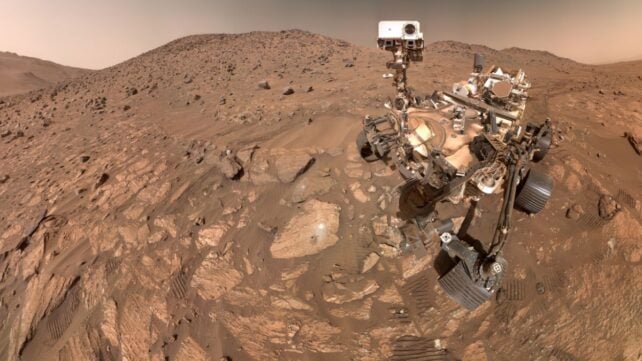
Since 2021, NASA's most recent red-planet rover, Perseverance, has been faithfully traversing the site of an ancient lake: Jezero Crater.
Gouged out of the Martian landscape by a meteorite impact, Jezero held a vast body of water and river delta around 3.7 billion years ago, when our rusty, dusty neighbor may have been a blue, watery world like Earth.
It's thought this lake may have existed for many millions of years, potentially allowing for various molecules, including those supplied via magma flows from Mars' enriched interior, to form the chemical precursors for life.
Now, researchers describe in a new study how they used Perseverance's SHERLOC instrument to examine some intriguingly complex carbon compounds locked away in Jezero's resident rocks.
What they found is striking.
"The detection of macromolecular carbon on the dust-cleared, but otherwise unprepared surface of the 'Cheyava Falls' rock represents the shallowest detection of organic matter on the surface of Mars," Kyle Uckert, an astrobiologist and instrument scientist at NASA's Jet Propulsion Lab, told ScienceAlert via email.
"It suggests that these organics may have been relatively recently exposed, or may have been shielded by minerals with photoprotective properties."
The researchers detected this macromolecular carbon (MMC) in two rocks in the Bright Angel outcrop of Neretva Vallis, a river channel that fed Jezero Crater's western delta.
One of these rocks was the Cheyava Falls mudstone, which contains the intriguing leopard-like spots that sparked debates over their possible biological origin.
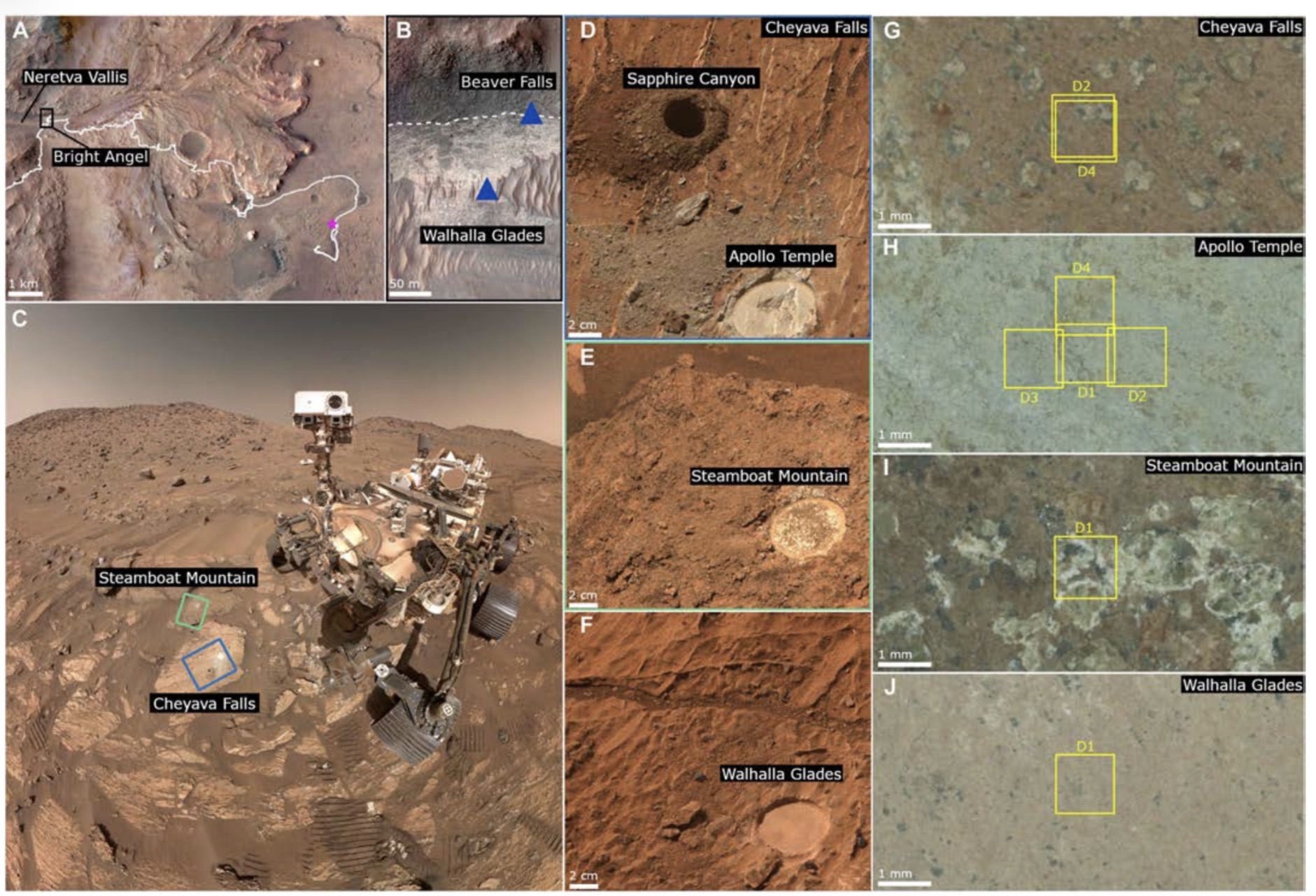
This MMC supplements other intriguing compounds in the rocks, including the carbonates, sulfates, and phosphates that can provide essential ingredients for the building blocks of life as we know it.
Finding organic-bearing mudstones more than 3,500 kilometers (2,200 miles) away from the ones Curiosity detected in Gale Crater suggests that both the conditions and materials needed for life may have been widespread on Mars, billions of years ago.

Additionally, the MMC analyzed in this work appears to be generally more complex than other organic molecules found on Mars, such as the alkanes recently discovered in Cumberland mudstone.
The researchers also compared the sample's spectral properties, obtained through Raman mapping, with those of other known compounds, including meteorite and terrestrial samples.
"Using the MMC's Raman G-band parameters, we determined that it is amorphous carbon," Ashley Murphy, a geologist at the Planetary Science Institute in the US, told ScienceAlert.
"The G-band peak position and bandwidth [are] similar to various amorphous carbon types, including biotic (e.g., microbial mats and coals) and abiotic (e.g., meteorites and hydrothermal rocks) sources."
Those similarities certainly are intriguing. On Earth, bituminous coal, chert, and microbialites are associated with biological processes.
However, Murphy noted that due to the methods used and overlapping spectra of the reference samples, "we cannot use the G-band to attribute the MMC detected by SHERLOC to any unique carbon source or setting."
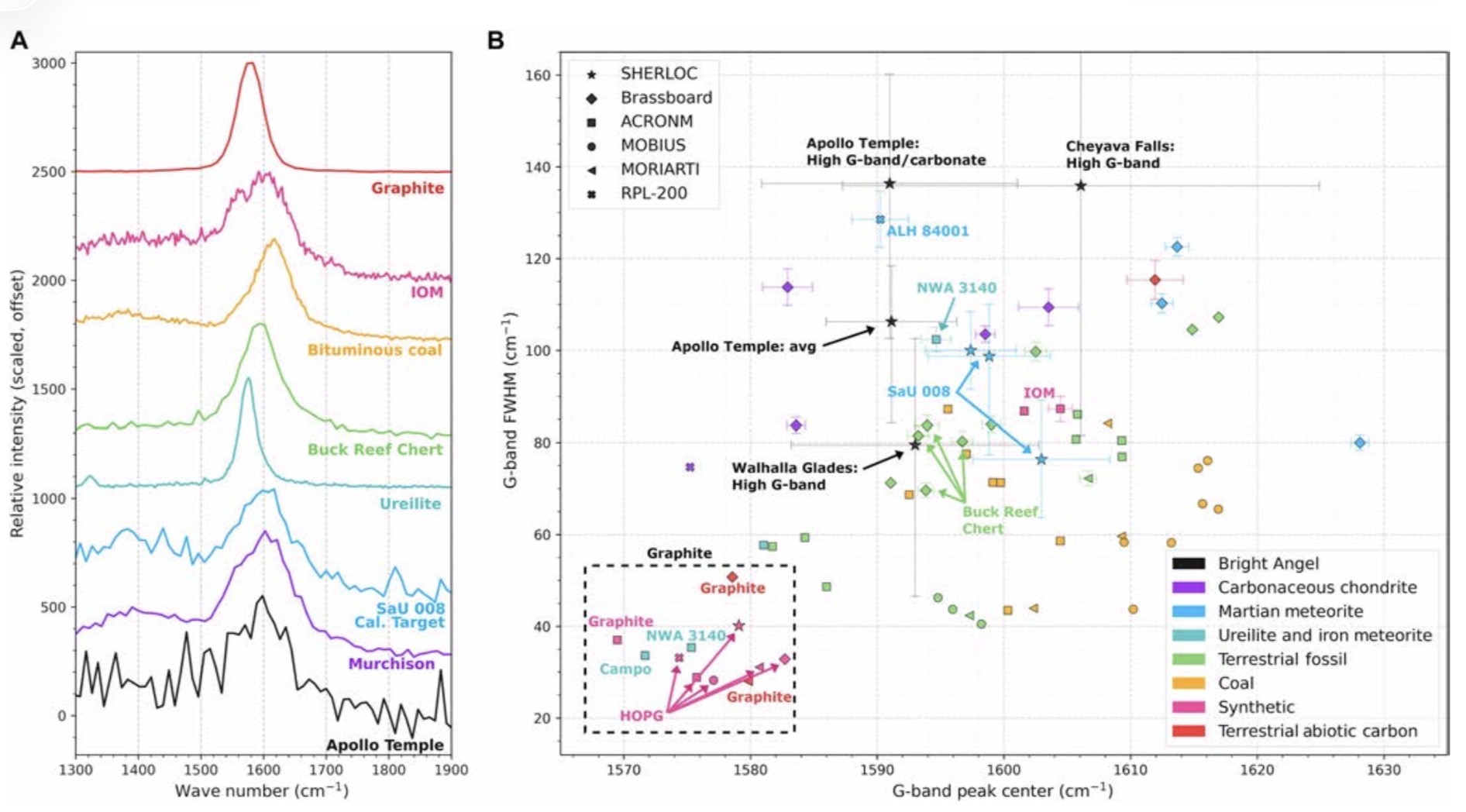
In other words, the researchers don't know where the Martian MMCs came from, and they're also not saying they signify Martian life.
"The presence of organic matter on Mars does not necessarily imply biologic processes," Uckert explained.
"The Perseverance Rover payload is not able to evaluate whether organic compounds are derived from biologic or abiologic processes. We cannot state that biology played any role in the organic carbon described in this study."
Although the MMC reported here cannot be attributed to any specific formation mechanism, the researchers presented several possible origins.
It may have been transported to Mars on interplanetary dust particles or within meteorites.
On the other hand, it may be made in situ through abiotic processes, such as volcanic, electrochemical, or hydrothermal forces acting on rocks.
Of course, this also means that the current work cannot rule out the most existentially exciting possibility: in situ biological synthesis.
Constraining the source of these interesting organics will require high-sensitivity analysis that can only be performed on Earth, so orchestrating a Mars sample return mission will be vital.
Related: Scientists Cracked Open a Mars Meteorite And Found a Big Surprise
Therefore, the glut of Martian organics presents a cliffhanger of universal proportion.
If we can eventually say that life existed on (at least) two planets in our little corner of the cosmos, then perhaps it could have emerged elsewhere in the Universe.
But in a Universe so vast and varied, who knows what those signatures of life might possibly look like – or if we'll be alive to see them.
This research is published in Science Advances.