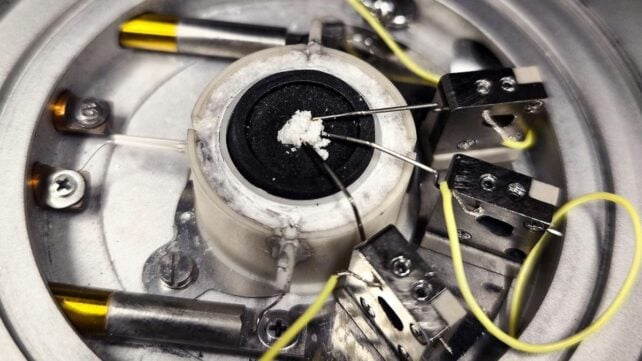
Wouldn't it be great if we could make a material we need for batteries by pulling carbon dioxide right out of the air?
It almost sounds too good to be true, but chemists have found a way.
Molten salt electrolysis involves poking extreme-heated salts with electrodes.
This careful assembly of molecules and electricity literally pulls carbon dioxide out of the air, rearranging the bonds between the carbon and oxygen atoms, and locking the carbon into a solid state, such as graphite.
For decades, scientists have wondered what exactly is going on at the molecular level during this 500-degree Celsius (932-degree Fahrenheit) reaction.
Now, for the first time, they've been able to see for themselves.
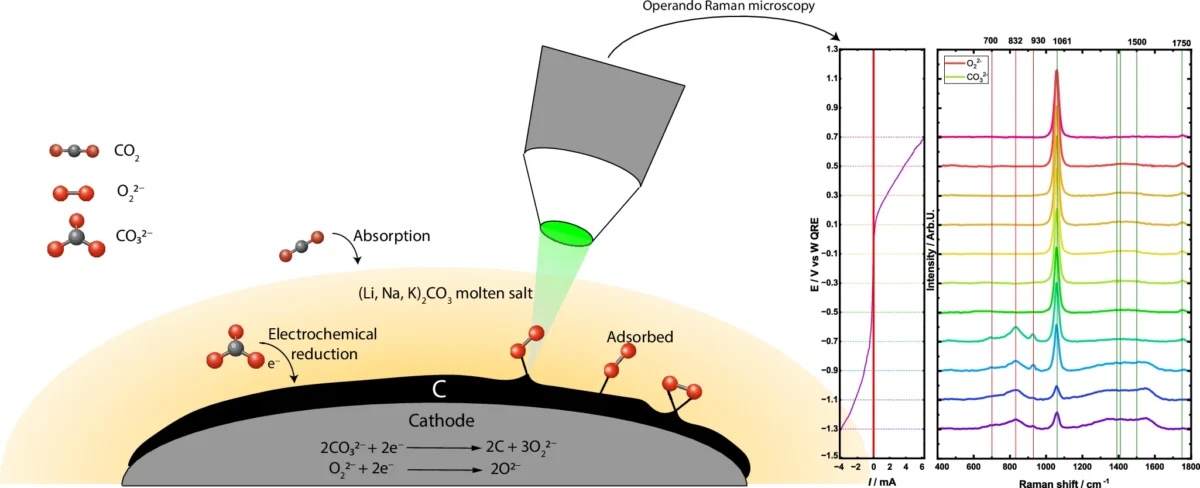
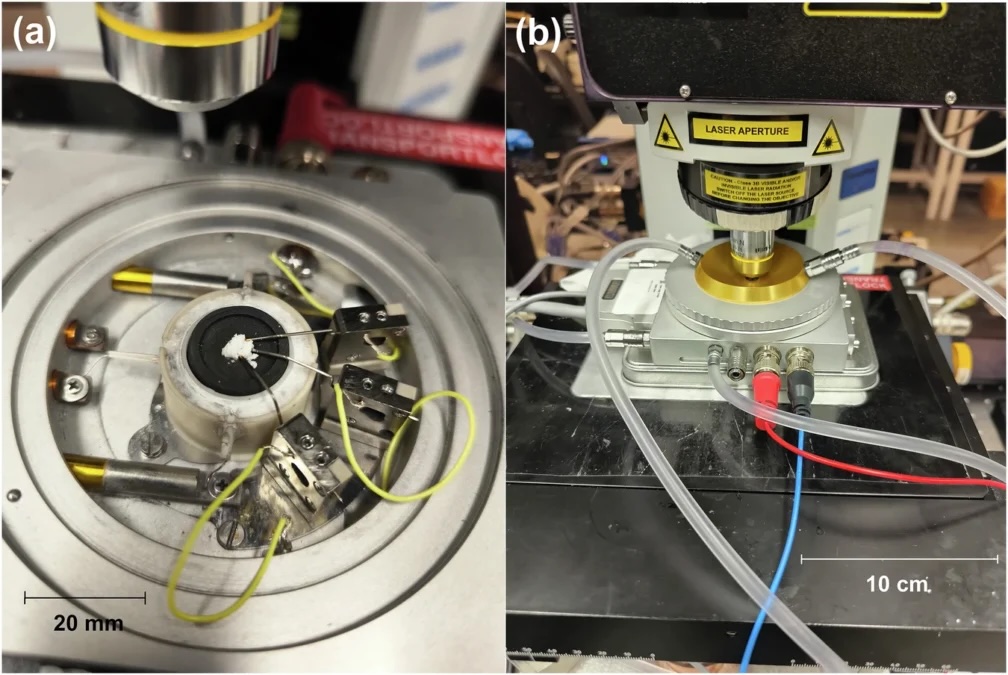
In a paper published in Nature Communications, a team, led by chemical physicist Sander Ratso of University of California, Berkeley, describes a process that allowed them to monitor, in real-time, the transformation of materials, while also detecting the vibrational modes of bonds within the molecules.
"Very simply put, when before we were cooking with a closed oven, we put a window in it," Ratso told ScienceAlert.
"Understanding how this reaction proceeds and how the structure of the carbon evolves over time is the first step in controlling, and eventually designing the structure that comes out of the electrolysis."
"This is a major win in a larger effort of synthesizing critical materials and battery materials using molten salts," says Mike Whittaker, an Earth geoscientist at Lawrence Berkeley National Laboratory.
This approach provided unprecedented detail on the evolution of carbon and intermediate species during CO2 electrolysis, revealing a two-step reaction pathway.
Using Raman spectroscopy to observe the electrolysis in action, the researchers noticed bands of light indicating the appearance of carbon-adsorbed peroxide as carbon was gradually deposited.
Scientists actually proposed peroxide might be an intermediate part of the process back in 1999.
"The peroxide band… emerges reproducibly and increases concurrently with carbon deposition, providing direct evidence that [peroxide] is the mechanistic intermediate driving the CO2-to-carbon pathway under our conditions," Ratso and team write in their published paper.
Different kinds of deposited carbons emerged depending on which cathodes the researchers used, though the essential reaction held.
On a pure nickel cathode, they found carbon in the form of nanotubes and platelet-like shapes.
A cathode made of the alloy Inconel 600 almost exclusively produced platelets.
And on an electrode made of gold, the carbon was deposited in what could only be described as 'amorphous' clumps.
A tungsten cathode resulted in more amorphous carbon, along with the delightful addition of 'carbon nano-onions'.

These observations could help scientists to tailor the process depending on what form of carbon is needed – for instance, the kind used in batteries, smartphones and industrial equipment.
"If you could run this process at low temperatures with really cheap salts, you could have it in a lot of places, and you could generate enough graphite that you could feed into battery supply chains," Whittaker says.
A few companies are already using this technology on an industrial scale, producing kilograms to tons of carbon products. Ratso is a co-founder of one of them.
"However, all these companies (as far as I know) focus on specific products, for which the synthesis conditions have been inferred from ex situ trial-and-error measurements," Ratso explained.
"Basically, you synthesize a material, check its structure, then change a synthesis variable and check what comes out of the reactor again. This has made any improvements in the carbon materials' properties time-consuming and expensive, and has limited the range and quality of the materials available."
The insights from operando Raman spectroscopy could make the process much more efficient.
Related: Plastic Waste Has Been Turned Directly Into Hydrogen Fuel – No Sorting Required
The current methods for producing the carbons used in batteries and fuel cells come with enormous CO2 equivalents (kilograms of CO2 emitted per kilogram of material produced).
As such, sourcing graphite from carbon dioxide in the atmosphere is a very appealing concept – not only could it reduce future emissions, but actively remove some of that which has already been emitted.
In theory, anyway. Experts agree that carbon capture, utilization, and storage will not be enough to solve our climate problems on their own. However, Ratso believes this technique for producing graphite has its part to play.
"The molten salt electolysis method can make these materials with negative CO2 equivalents when coupled with wind, solar, or nuclear power," Ratso said.
"I firmly believe that this is among the most important technologies that could have a real impact on the levels of CO2 in the environment."
The research was published in Nature Communications.
This article was fact-checked by Michael Irving and edited by Michael Irving. While we pride ourselves on our process, we are only human. If you spot a mistake, please let us know.