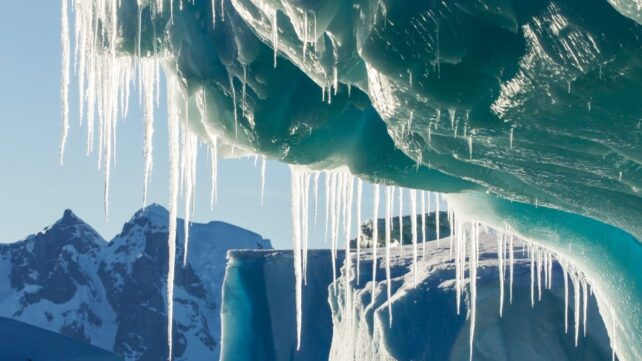
Across the last 200 years, Antarctica has been copping a whole lot of mercury pollution, despite humanity's best efforts to keep the frozen continent relatively untouched.
Mercury is released into the environment naturally by volcanoes and geological weathering, but ever since humans started to burn fossil fuels and intensify mining, environmental levels of mercury have seriously ramped up.
Meanwhile, Antarctica has been functioning as a kind of mercury 'sink', locking away large amounts of pollution in its layers of ice.
That's probably been helping reduce the amount of mercury getting into marine food chains (and our seafood).
Unfortunately, those heavy industries that are releasing mercury into the environment are also releasing the greenhouse gases into the atmosphere that are causing Antarctica's ice to melt.
And as Antarctica melts, it's leaking all that 'legacy' mercury into the ocean, too.
A team led by environmental scientist Chengzhen Zhou from Peking University in China has just published a study in Proceedings of the National Academy of Sciences describing the situation.
Using sediment cores collected across the Antarctic Peninsula (the continent's fastest-melting region), the researchers revealed a concerning pattern.
Although it seems worlds away from any sources of industrial mercury emissions, the Antarctic Peninsula shelf accumulates mercury at twice the rate of the global shelf average.
The rate at which mercury is accumulating on the Antarctic Peninsula has risen by 160 percent since the start of industrialization in the mid-1800s.
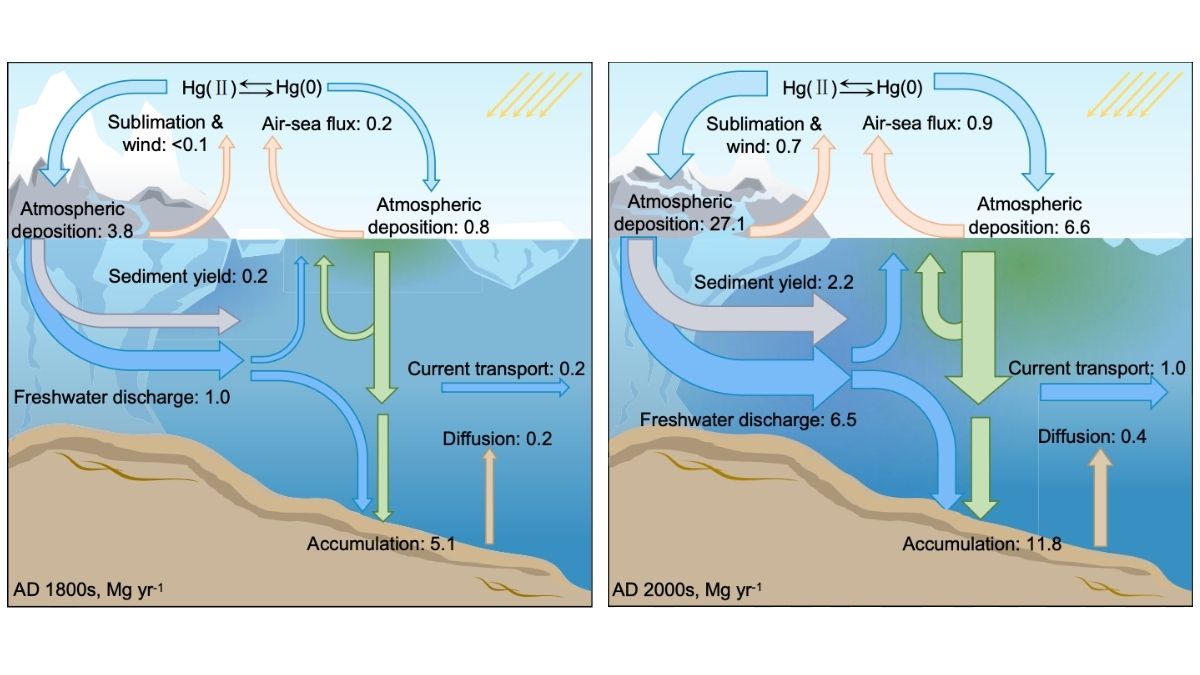
One of the main routes by which mercury reaches Antarctica from afar is via the atmosphere, from which it can eventually be absorbed by seawater, from which it can be released back into the atmosphere. This is called the 'atmosphere-ocean loop.'
But research shows some of the mercury acceleration on Antarctica is also coming from deep within the continent itself. Ice melt and erosion activate what the researchers call the less-snappy 'atmosphere-glacier-land-ocean loop', pictured below.
It's this loop that is re-mobilizing mercury that has been locked away in the ice.
"The coupling of these two loops has increased ice melt-driven terrestrial mercury release by 550 percent and air–sea exchange by 350 percent," Zhou and team report in their paper.
"Thus, climate warming is turning the large historical mercury reservoir in Antarctica into an active secondary pollution source, amplifying polar mercury pollution risk."
The World Health Organization now ranks mercury among the top 10 chemicals of major public health concern, because even at low levels it is toxic.
An older study based on data collected in 2012 found bacteria in Antarctic sea ice capable of converting mercury into the potent neurotoxin, methylmercury, a form in which the element accumulates in marine creatures.
It's this form of mercury that makes the new findings especially concerning.
"Accelerated mercury enrichment and cycling in Antarctica may increase risks to Antarctic ecosystems," Zhou and team write.
"The Southern Ocean food chain from diatoms to krill to fish to higher predators is highly sensitive to methylmercury. Recent observations have shown that mercury levels in Antarctic species such as Antarctic toothfish, marlin, and sharks frequently exceed previous records and food safety limits."
And it's not just Antarctica's waters that this could affect.

Mercury export from the Antarctic Peninsula into the open ocean via currents has surged by 400 percent, suggesting this mercury contamination could spread further afield.
"If other marginal seas of the Southern Ocean have experienced postindustrial mercury enrichment comparable to that observed on the Antarctic Peninsula shelf, the potential threat of mercury contamination to ecosystems and fisheries could be further amplified," the authors add.
Related: Scientists Reveal What Antarctica Would Look Like With No Ice
It's a grim picture. But because it's clearly linked to human activities, we have an opportunity to do something about it.
All we need to do is stop burning fossil fuels. Easy, right?
The research was published in PNAS.
This article was fact-checked by Michael Irving and edited by Michael Irving. While we pride ourselves on our process, we are only human. If you spot a mistake, please let us know.