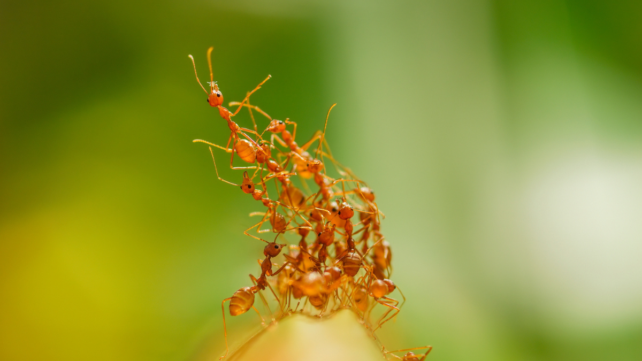
An ant nest can appear to be a jumble of tiny bodies moving independently.
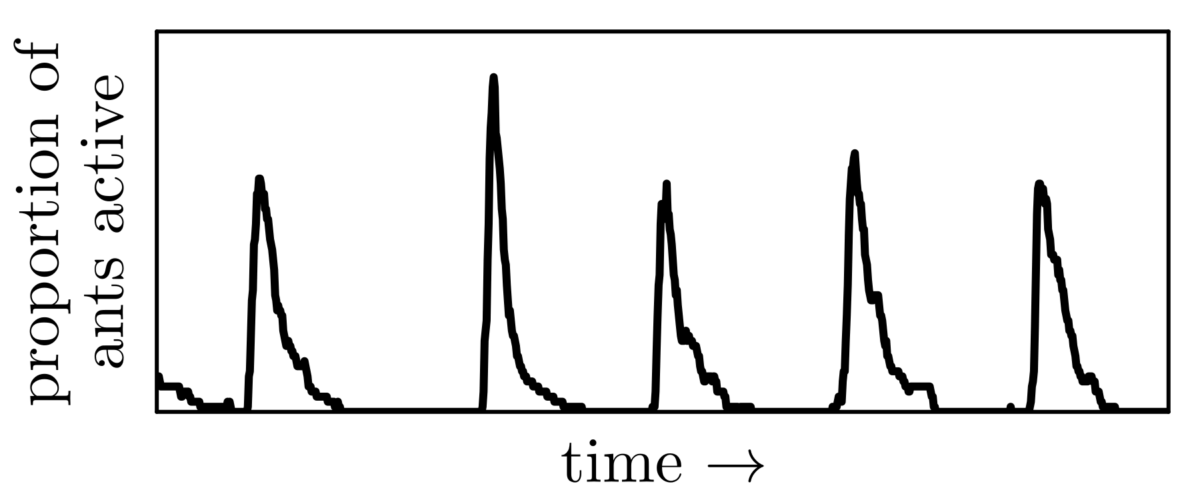
But every so often, something remarkable happens: much of the colony springs into action almost at once.
These sudden flurries, known as activity bursts, are followed by stretches of relative calm.
Scientists compare these bursts to phase transitions of physical systems and have observed them for decades, but how so many ants synchronize without a leader remains unclear.
A new mathematical model, described in a study published in PRX Life, suggests that ant colonies suddenly become synchronized after reaching a critical point.
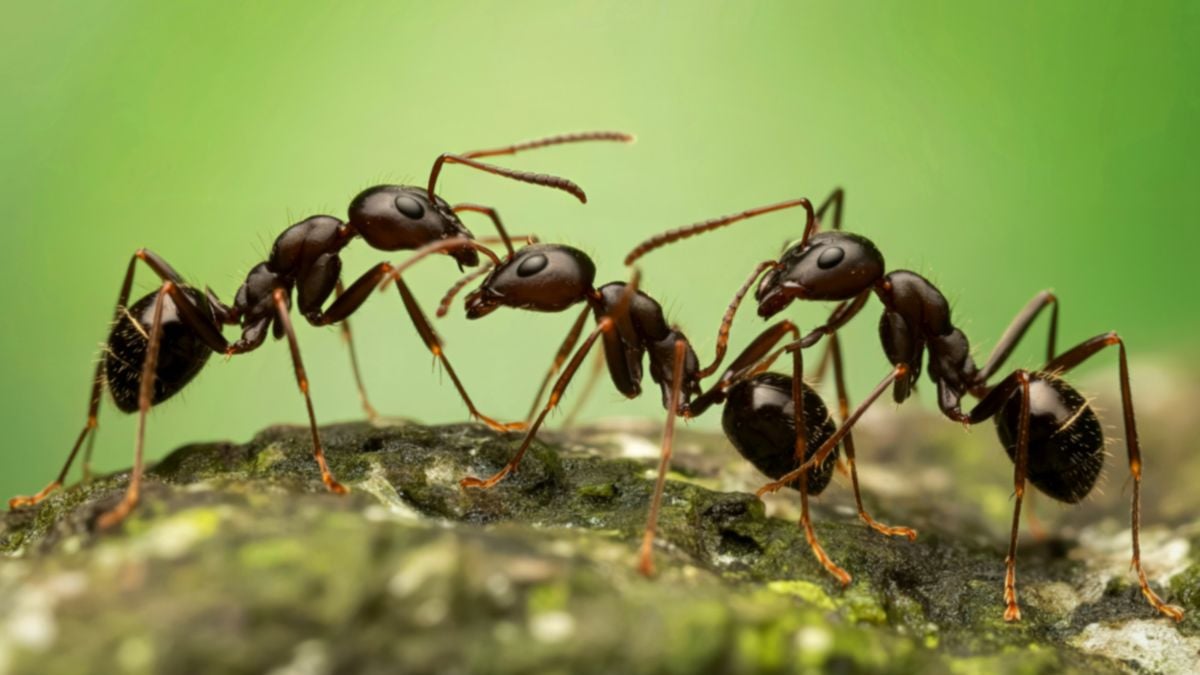
Before this point, ants move independently. But once the colony crosses it, a single ant can trigger a wave of activity throughout the nest.
"Synchronization does not depend on any specific individual; any ant can serve as the first mover," New Jersey Institute of Technology biologist Simon Garnier says in an article published by the American Physical Society.
New York University mechanical engineer Michael Napoli and urban systems engineer Maurizio Porfiri developed the model with Garnier.
"The emergence of activity rhythms in our model is closely dependent on two key ingredients: the colony must be responsive to the activity of a single individual – sensitive to social contagion – and this individual must spread the activity much faster than the timescale of the activity bursts," Napoli told ScienceAlert.
"This insight provides a perspective on other complex systems where burst-like behavior may emerge, but does not persist, whereby the lack of one of these two ingredients ruins the synchronization."
Ant colonies contain surprisingly large numbers of inactive workers, but an encounter with a moving nestmate can prompt one to start moving.
Earlier models represented this social activation as a probability. The new model also accounts for the physical encounters required for activity to spread.
In the model, ants switch among three states: active, inactive, and refractory.
Active ants move and can activate nearby nestmates. Inactive ants remain still but can be prompted into action. Refractory ants are stationary and temporarily unable to reactivate, preventing bursts from continuing indefinitely.
Model parameters were based on earlier measurements.
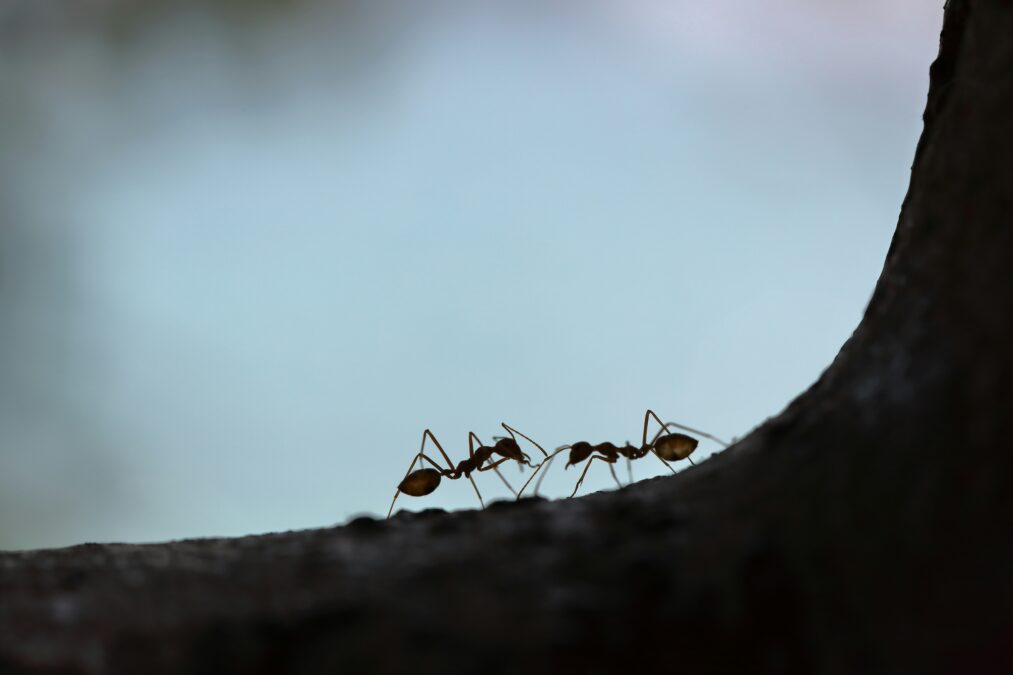
In simulations, activity faded before spreading when ants moved too slowly or encountered one another too infrequently.
But when speed, density, or interaction range crossed a critical threshold, encounters became frequent enough for one ant's activity to cascade through the colony.
Napoli compares the effect with a physical phase transition, such as water freezing, but stresses a key limit.
"The transition decides whether the burst is present, not if a burst will occur over the next time period," he said.
The model therefore cannot predict exactly when a quiet colony will spring into action. It determines whether the colony is in a state capable of producing synchronized bursts.
How, then, can one ant's activity spread through an entire nest before dying out?
"This is, perhaps, the most interesting result in the paper," Napoli said.
Earlier research has found that ant colonies can behave like neural networks when making collective decisions, and coordinate as a "superorganism" when responding to threats.
"We find that the bursts in the model emerge due to the dramatic difference in time scale between the motion of the ants – which spreads the activity – and the cycle between the behavioral transitions – which determines the burst period," Napoli said.
"This separation of time scales creates the proper conditions for the bursts to persist, and is comparable to many decision-making cascading phenomena in biological systems."
In other words, interactions spread activity much faster than the colony passes through its broader cycle of activity and rest. This allows movement initiated by one ant to travel from nestmate to nestmate without a commander.

The simulated bursts were broadly consistent with observations reported in earlier studies. However, the new study was mathematical rather than experimental, and tests with living ants are underway.
"Presently, experiments are being conducted and analyzed to validate the model against real ant data," Napoli told ScienceAlert.
"We are specifically interested in gauging the proximity of the colony to the transition threshold, whereby the activity bursts may serve as a platform for the colony to spread information extremely rapidly through the nest."
The results could show how closely living colonies operate to this threshold and whether bursts help information travel efficiently. Any evolutionary advantage remains unknown.
Related: Cockroaches Have a 'Collective Memory' That Emerges From Their Social Networks
A 2023 modeling study suggested synchronized movement could improve access within crowded nests by reducing obstacles created by inactive ants.
Yet a 2017 study found that short-term activity cycles can impede information transmission when synchronized inactivity interrupts chains of physical contact among workers.
Activity bursts may therefore involve trade-offs among movement, communication, energy use, and the organization of work.
The study was published in PRX Life.
This article was fact-checked by Clare Watson and edited by Clare Watson. While we pride ourselves on our process, we are only human. If you spot a mistake, please let us know.