The Universe is expanding, and that expansion is accelerating, according to the best data we have.
The problem for scientists is explaining what drives that acceleration – and whether the simplest explanation still fits every new measurement.
Dark energy is one explanation that's been put forward: It's more a name for the unknown component behind the Universe's accelerating expansion than a solution to it.
In the standard cosmological model, dark energy accounts for roughly 68 percent of the Universe's energy density. However, the numbers still don't really tally with quantum field theory.
In a new paper published in Physical Review D, physicist Savvas Koushiappas from Brown University in the US proposes that some of the behavior usually attributed to dark energy could instead emerge from a quantum modification to the geometry of the Universe itself.
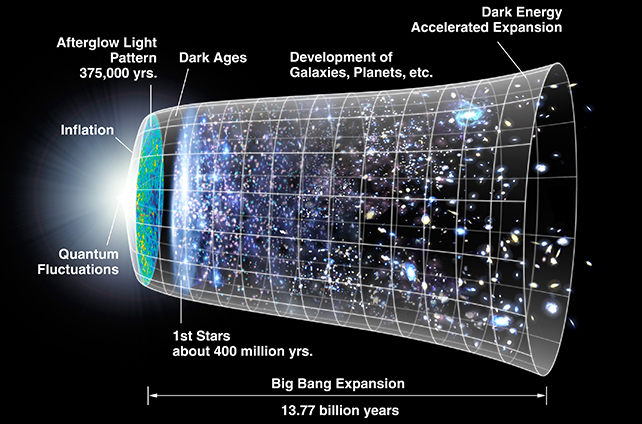

Koushiappas proposes that this accelerating expansion is being driven by the way the Universe is put together – we've just been seeing it wrong.
In his model, the size and expansion rate of the Universe can't both be precisely specified at the same time. That proposed uncertainty changes the equations cosmologists use to describe expansion, changing how the expansion rate evolves over time.
"In this picture, the accelerated expansion of the late Universe may be the macroscopic imprint of an irreducible quantum uncertainty in simultaneously knowing the size and expansion rate of the Universe," writes Koushiappas in his published paper.
Koushiappas then turns to quantum gravity to get everything to fit together in a satisfactory way.

Quantum gravity is a field theoretical physicists have been exploring to make the general theory of relativity play nicely with quantum mechanics.
General relativity describes gravity and the large-scale structure of spacetime extremely well, while quantum mechanics describes the behavior of matter and light, typically at microscopic scales.
Combining the two consistently remains one of the major unsolved problems in physics.
The uncertainty over knowing the size and expansion rate of the Universe simultaneously is effectively a classic quantum rule – but here Koushiappas proposes applying it at the scale of everything that exists.
"Within this framework, cosmic acceleration emerges as the macroscopic imprint of quantum gravity at the cosmological horizon," writes Koushiappas.
In other words, the speeding up of the Universe's expansion could carry a signature of quantum-gravitational physics, rather than requiring all observed behavior to come from dark energy.
Crucially, Koushiappas argues that the relevant quantum scale could extend to the edge of the Universe from which we can observe light (the cosmological horizon).

If the model is right, it could give astronomers an observable signature of quantum-gravitational physics in the expansion history of the Universe, rather than an abstract concept.
It could change what physicists mean by dark energy, shifting part of the explanation from an unknown material component to modified cosmic geometry.
Koushiappas also outlines an alternative configuration of his model, one that resolves some of the areas around the Big Bang where general relativity rules break down. Under the new proposal, our Universe wouldn't start from a point of infinite density, but rather from a rebound of an earlier, contracting Universe.
In the paper's simplest version, however, these outcomes require different choices of the model's key exponent: Positive values alter the late-time expansion in a way that behaves like evolving dark energy, while sufficiently negative values can replace the Big Bang singularity with a bounce.
These are hefty solutions to hefty problems, but Koushiappas admits that this new approach doesn't tie up everything neatly either. Inconsistencies and open questions remain.
Related: Dark Matter May Have a Secret, Extra Force That Doesn't Work The Way We Expect
Further calculations, and particularly further observations of deep space, should help to put these new ideas to the test. Surveys from DESI, Euclid, and the Vera C. Rubin Observatory could tighten measurements of the expansion history enough to learn more.
This and other observations have certainly raised intriguing questions about whether the simplest standard cosmological model captures the full expansion history.
"It seems that the expansion history we are now measuring is inconsistent with the simplest theory we have," writes Koushiappas.
The research has been published in Physical Review D.
This article was fact-checked by Rebecca Dyer and edited by Rebecca Dyer. While we pride ourselves on our process, we are only human. If you spot a mistake, please let us know.