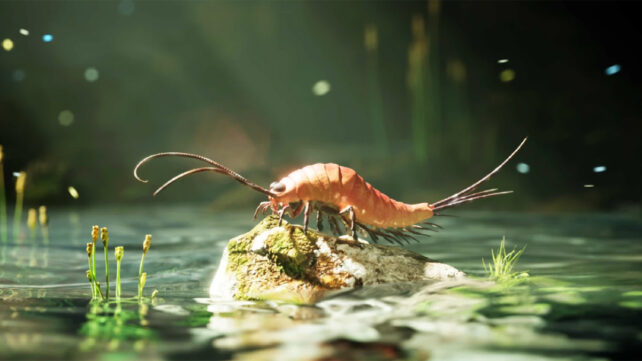
As strange cases of mistaken identity go, this story is a difficult one to beat.
A fossil dating back some 324 million years has turned out to be a completely new species of insect, rather than a juvenile crustacean, as was assumed for decades.
The story starts in 1985, when fossils of an ancient creature in a rock formation in western Texas were discovered for the first time.
Within a few years, experts had classified the specimen as a young example of Tesnusocaris goldichi, a many-segmented aquatic creature related to shrimps and crabs.
Fast forward to 2026, and a new study published in Nature.
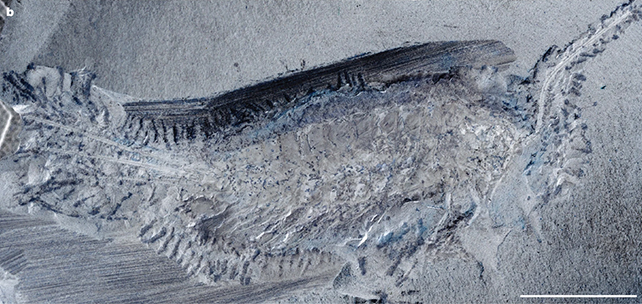
In the study, a team of international scientists identified the fossil as an entirely new insect species, a distinctive 24-legged creature that they're calling Chosha praecursor.
Not only does the reclassification correctly identify this ancient organism as part of the hexapod clade, but it also provides some clues towards solving a long-standing biological mystery around how insect evolution carried these species from the sea to land hundreds of millions of years ago.
What C. praecursor suggests, together with other related fossil specimens the researchers took a look at, is that this transition is more gradual than scientists might have thought – as evidenced by the unconventional characteristics of these critters.
"Our phylogenetic reconstruction recovers C. praecursor as a hexapod, strongly favoring its placement as an early-diverging insect," write the researchers in their published paper.
"A revision of three other enigmatic hexapod fossils, the Devonian period Leverhulmia and two undescribed Carboniferous fossils from the Mazon Creek Lagerstätte, demonstrates diverse body organization in Palaeozoic wingless insects."
The original case of mistaken identity regarding C. praecursor is understandable: The source fossil was found in a bed with other Tesnusocaris species and amounts to a dark imprint on dark rock. The details are incredibly difficult to see.
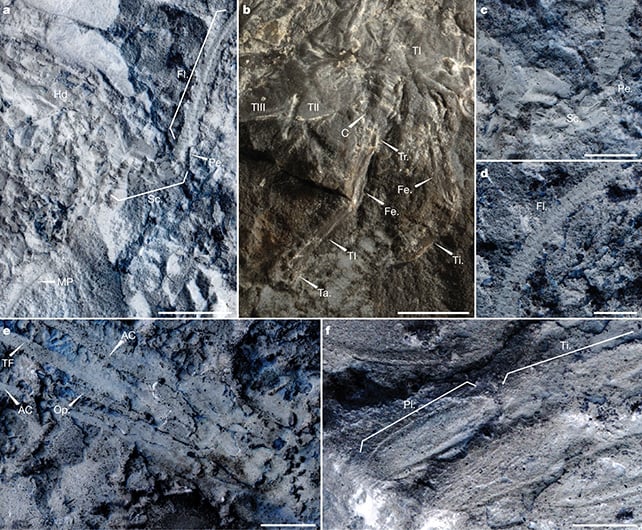
But suspicions were raised that this wasn't, in fact, a crustacean, which led the researchers behind the latest study to analyze it again using cross-polarized light imaging, which reduced glare and made the finer parts of the fossil more visible.
Together with references to evolutionary models, the new species was classified.
While it has some conventional insect characteristics, C. praecursor stands out for several reasons, including the dozens of paddle-like legs, instead of the standard six, and the crustacean-like abdomen they're attached to.

"The unusual abdominal gill-like appendages of Chosha suggest a semiaquatic mode of life in at least some stem-insects and revise our understanding of the assembly of insect morphological organization," write the researchers.
Alongside the other specimens the researchers analyzed – taken from different sites, but related hexapods that paleontologists have questions about – the indications are that some early insects may have been amphibious, able to live on land and sea.
This has been challenging to establish for experts, because of the 'hexapod gap': An 80-million-year blank spot in the fossil record of hexapods (including insects), causing discrepancies with genetic family trees measured partly by molecular clocks.
"Together, these stem-group fossils represent the earliest uncontested insects and partly reconcile the incongruence between molecular clock estimates and the fossil record," write the researchers.
It also means the history of the earliest insects as we know them today gets pushed back, while giving us evidence of the physical adaptations that connect crustaceans and the insects that diverged from them across millions of years.
The research raises the possibility that some of the earliest insects thrived along the shoreline and in wetland environments, eating dead plants and laying some of the foundations for animal life on land.
Related: An Ancient Shark Graveyard Has Been Found in The Egyptian Desert
"Recognized as stem-group Ectognatha, these fossils represent the oldest insects," write the researchers.
"They thus help to close the gap in the early fossil record of insects and provide a valuable calibration point for studies of arthropod terrestrialization."
The research has been published in Nature.
This article was fact-checked by Rachel Garner and edited by Peter Dockrill. While we pride ourselves on our process, we are only human. If you spot a mistake, please let us know.