It's difficult to avoid the discussions around AI at the moment – and how useful or otherwise it can be.
Science and healthcare are two of the areas where the tech promises to be transformative.
We're already seeing AI used extensively in terms of analyzing scans, designing drugs, and predicting the future, but researchers led by a team from the Beijing Visual Science and Translational Eye Research Institute (BERI) in China wanted to take the deployment of AI further – by letting it run an eye clinic (still with oversight).
The clinic was called the AI-TEC (AI-Agent Augmented Tsinghua Eye Clinic), and while human doctors were still involved, it was designed from the ground up to maximize AI use rather than having these tools bolted on top of existing systems and practices.
As reported in Nature Medicine, that meant AI was used in everything from pre-consultation to patient follow-up, including the all-important eye scans themselves.
"We provide early implementation lessons in moving AI beyond algorithm performance toward clinical workflow transformation and system-level integration, where clinical value is ultimately created," write the researchers in their published paper.
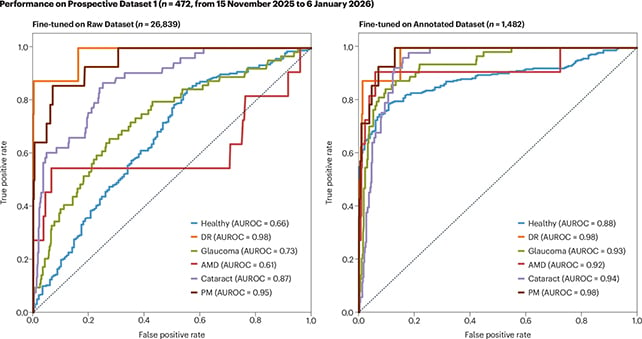
Several interesting findings came out of the AI-TEC trial. Firstly, the AI started off with a relatively low success rate at identifying diseases in eye scans – diseases like glaucoma and age-related macular degeneration.
However, the accuracy levels increased significantly when expert ophthalmologists fed the AI with 1,426 high-quality eye scan images correctly labeled with the relevant conditions.
This fresh data worked better than the original training data of almost 27,000 images that were of lesser quality and less comprehensively labeled.

Using a standardized diagnostic metric called AUROC, the AI was able to reach an accuracy of over 0.93 using the updated training data – roughly on a par with other state-of-the-art scanning systems.
Something else the researchers found was that clinical usage of the AI tools started off high and then dipped. In a snapshot taken after five months, only 41 of 1,113 examinations (3.8 percent) in the month used the AI-TEC processes available.
This climbed back to 259 of 1,126 examinations (23 percent) the following month, after the researchers made the system faster and easier to use, with fewer clicks and less manual input required from staff.
"Our early experience showed that implementing an AI-native healthcare is fundamentally an ecosystem challenge," write the researchers.
"Its effectiveness did not depend on any individual algorithmic performance but instead depended on data quality, workflow interaction, clinician engagement, adequate governance and monitoring, and measurable clinical value."
Another observation from the researchers: regular feedback from clinicians needs to happen quickly in order for the AI to improve, rather than it being supplied weeks later.
Those are the three big takeaways: the need for quality data, the need for optimized operation, and the need for regular, rapid feedback.

"We emphasize the need for close on-site engagement and collaboration between clinicians and AI researchers," write the researchers.
It's early days for this kind of AI-first clinic, but the results of this small-scale trial show they can be successful when the right ingredients are combined.
Plenty of challenges remain, however, including resolving the way that AI focuses on results first (does patient A have an eye disease or not), whereas doctors focus on symptoms first (patient A reports blurry vision).
In other words, having an AI that's accurate at analyzing scan images doesn't necessarily translate into something that improves patient care. In fact, future tests of this kind may be better off not focusing on raw performance scores alone, the study suggests.
Related: Scientists Find a Subtle Clue to ADHD Hidden in The Eyes
"The success of 'AI-native' healthcare system should ultimately be measured by whether clinical workflow is transformed and whether AI improves health outcomes, rather than by whether AI achieves superior benchmark performance," write the researchers.
The research has been published in Nature Medicine.
This article was fact-checked by Fiona MacDonald and edited by Fiona MacDonald. While we pride ourselves on our process, we are only human. If you spot a mistake, please let us know.