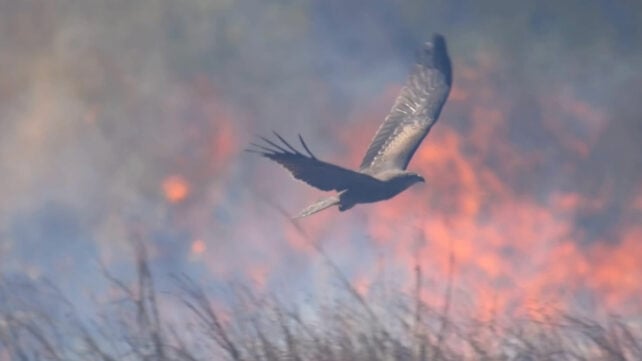
When faced with fire, most animals flee.
But some audacious raptors in Australia's northern savanna see the glint of opportunity in the flames and instead head towards them.
A team of scientists has reported this strange phenomenon in a paper uploaded to the preprint server bioRxiv.
Their research is yet to be peer-reviewed, but it offers us an early glimpse at a fascinating adaptation to an element most animals fear.
Humans have been using fire deliberately to maintain the landscape in the country now known as Australia for at least 11,000 years.
Rangers from the Mimal Land Management Aboriginal Corporation in central Arnhem Land continue this practice today, lighting small patches of relatively cool fires throughout the landscape early in the dry season.

It was around these prescribed burns that cognitive zoologist Ivo Jacobs and team made their observations, in collaboration with the Mimal rangers.
Humans are not alone in using fire to their advantage in this landscape.
"Fires appear to attract raptors by increasing prey detectability and catchability," Jacobs and team report.
"Pyrophilic [fire-loving] birds can detect fire from great distances, likely through visual cues such as smoke plumes, although this has not yet been examined in detail."
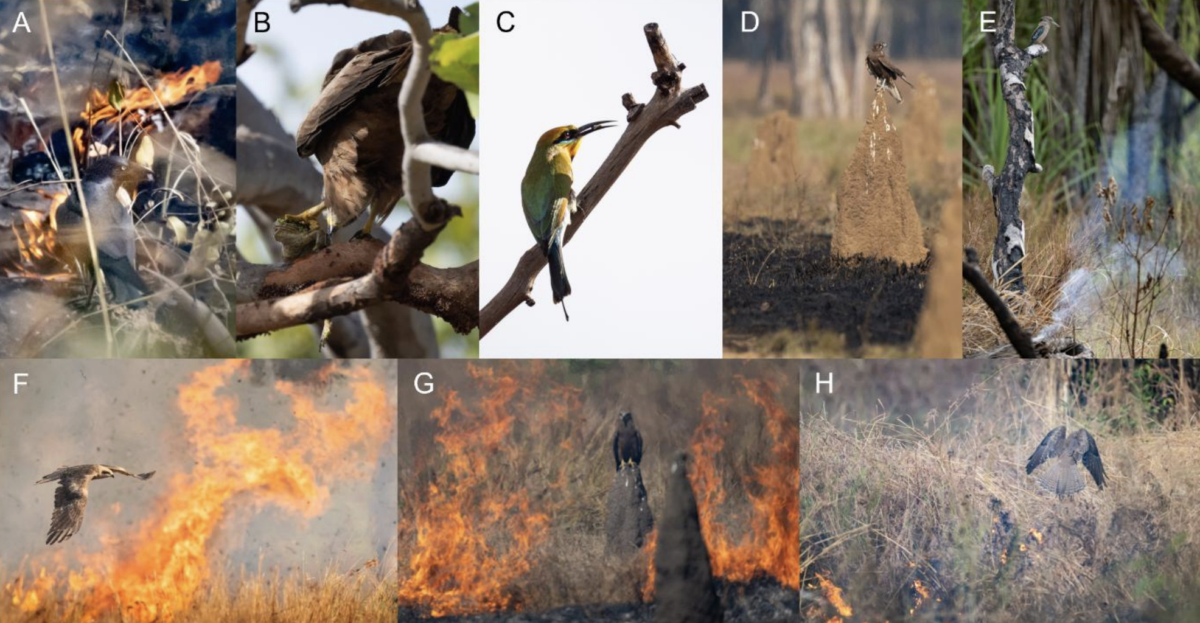
Black kites (Milvus migrans) and white-breasted woodswallows (Artamus leucorynchus) were the species seemingly most drawn to the flames, being 23 and 20 times more abundant when fire was around than when it wasn't.
The researchers also noticed that raptors caught prey at, on average, ten times the rate when they took advantage of a prescribed burn than when there was no fire.
Most of the prey the birds caught were insects (especially grasshoppers), though some black kites caught toads and a snake, and a nankeen kestrel got a lizard.
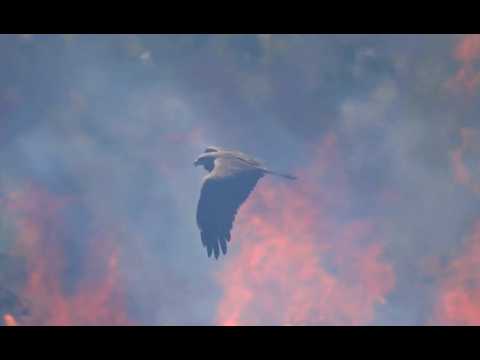
"Raptors seemed to forage mostly over unburned ground in front of the advancing fire, where more prey is likely flushed," the team writes.
"Black kites, the most pyrophilic birds observed, were more numerous during larger fires and foraged more efficiently on the ground than in the air."
Previous research describes reports of how some 'firehawk raptors' – black kites among them – carry burning sticks from one site to another, apparently to spread fire.

"Most of the data that we've worked with is collaborative with Aboriginal peoples… They've known this for probably 40,000 years or more," geographer Mark Bonta from Penn State Altoona told National Geographic when that research was published.
Jacobs and team didn't spot any firehawk behavior during their recent fieldwork, but their observations add further detail to a picture of the birds' clever and complex relationship with the fires that have been part of their habitats for millennia.
It also adds further evidence to why the firehawks would risk carrying flaming sticks through the sky.
Wildfires in Australia are occurring more frequently and at greater intensity as time passes, largely due to climate change.
These uncontrolled fires are very different from the ones the raptors seem drawn to.
Related: These Birds of Prey Are Deliberately Setting Forests on Fire
What this changing climate means for the fire-loving birds is unknown.
"Similar observations should be performed at natural wildfires, which differ in many respects from prescribed fires," the researchers suggest.
The research was uploaded to the preprint server bioRxiv.
This article was fact-checked by Peter Dockrill and edited by Peter Dockrill. While we pride ourselves on our process, we are only human. If you spot a mistake, please let us know.