The weekend can be different from weekdays in all kinds of ways – sleeping patterns, work schedules, socializing – and a new study looks at the possible health effects of shifting eating habits at the weekend, described as 'eating jet lag'.
Published in Communications Medicine, the study follows up on what we know about so-called social jet lag: that irregular sleep patterns, caused in part by the differences in weekend routines, can be detrimental to health.
Researchers from France and Spain analyzed data on 104,806 adults registered with an ongoing health study, cross-referencing eating habits against cardiovascular disease (CVD), over an average follow-up period of 8.1 years.
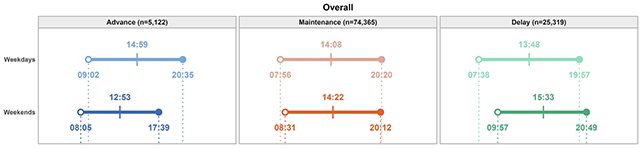
While there were no clear correlations in the data for women, when it came to the male participants, a greater variation in meal times between the weekend and the rest of the week was associated with higher rates of heart disease – even after accounting for several other factors, including social jet lag.
"Our results suggest a role for meal timing regularity between weekends and weekdays in CVD etiology, independently of sleep duration and diet quality, specifically in males," write the researchers in their published paper.
"If confirmed in other studies, meal timing regularity could be a strategy to mitigate cardiovascular disease risk."
To measure eating timings, the researchers found the average mid-point between when participants first ate or drank something on a weekday, and when they last ate or drank something. The same was then done for the weekends.
The bigger the gap between the weekday and weekend mid-points, the higher the CVD risk. For the men, an extra hour of eating jet lag was associated with a 14 percent higher rate of CVD overall, and a 21 percent higher rate of coronary heart disease (including heart attacks) specifically.
Having meals earlier at the weekend was less common in the study cohort, but was linked with a greater risk level.
"These associations are independent of diet quality and remain significant after adjustment for bedtime, total sleep time, and social jet lag," write the researchers.
The data gathered here isn't enough to prove direct cause and effect, as there may be other contributing factors that both increase CVD risk and make eating jet lag discrepancies more likely.
Further research will be needed to identify the reasons for these associations, but the study team suggests that disruptions and irregularities to our natural biological clocks might be putting extra stress on the body – including the heart.
As for the lack of any associations for women, the researchers point to differences in hormones and metabolism as possible explanations. CVD risk is also known to be higher in men to begin with.
"In many industrialized societies, irregular eating patterns, such as skipping breakfast and late-night eating, are becoming more frequent," write the researchers.
"Rest days (usually Saturday and Sunday) generally allow individuals to align their sleep and meal patterns more closely with their biological clock.
"This inconsistency in sleep and food intake timing may disrupt circadian rhythms – the internal clocks that coordinate homeostasis and metabolism and run on [a] ~24-hour cycle (the circadian clock)."
We have several of these circadian clocks ticking away inside us, and studies have repeatedly found that when our daily rhythms shift – whether it's sleeping, eating, or another habit – there can be health complications.
The next steps could involve looking at more diverse groups of people, and a greater range of work habits – it was assumed for this study that all the participants had Saturday and Sunday as a weekend – as well as testing how attempts to correct eating jet lag might improve heart health over time.
"If our results are confirmed in other studies, meal timing and regularity could be an important focus for interventions to reduce chronic disease risk and alleviate the associated public health burdens," write the researchers.
The research has been published in Communications Medicine.
This article was fact-checked by Rachel Garner and edited by Peter Dockrill. While we pride ourselves on our process, we are only human. If you spot a mistake, please let us know.