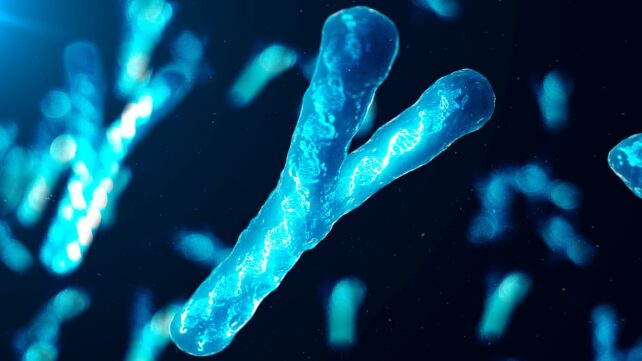
Cancer may come with a trace beyond the tissue that looks cancerous.
In men, that trace may be a missing Y chromosome in cells that still look perfectly normal, new research shows.
That was the surprise in a study of tissue from men with and without cancer.
Cells immediately beside tumors showed more Y chromosome loss than normal tissue from men without cancer, while the tumors showed even more.
"What surprised us most was that Y chromosome loss was not confined to the cancer itself," Dan Theodorescu, director of the University of Arizona Cancer Center and senior author of the study, told ScienceAlert.
Most cells in a man's body carry one X and one Y chromosome. Occasionally, when a cell divides, a descendant loses the Y.
As those cells multiply, they form pockets of tissue in which some cells carry the chromosome and others do not. Researchers call this mosaic loss of Y.
To find out where those pockets occur, Theodorescu and his colleagues examined 1,000 archived tissue samples from 405 males, covering 11 major organs.
Their fluorescence in situ hybridization (FISH) test made X and Y chromosomes visible in more than 4.3 million cell nuclei. Comparing the two signals allowed the researchers to estimate how much Y chromosome loss was present in each sample.

The researchers turned the signal ratio into a score for each sample. The score describes a tissue sample, which may contain epithelial, immune and stromal cells.
It does not mean every cell in a low-scoring sample has lost its Y chromosome. They checked the approach against measurements of Y-linked gene activity in 25 metastatic prostate cancer samples.
The result was a gradient. Normal tissue from men without cancer retained the strongest Y signal. Normal-looking tissue right beside a tumor had a weaker signal.
The tumor itself had the weakest signal. The amount of loss varied between cancer types, with colorectal tumors showing the most.
The researchers had both tumor and neighboring normal-looking tissue from the same organ in 49 men: 33 with bladder cancer, eight with prostate cancer and eight with other cancers. In these men, the tumors showed greater Y chromosome loss than their surroundings.
Tissue from organs away from a man's cancer did not, overall, show a significant difference from normal tissue in men without cancer. The extra loss was concentrated in the apparently normal tissue beside tumors. This does not mean the normal-looking cells will necessarily become cancerous.
"Many of the cells surrounding tumors looked completely normal under the microscope. Yet by the FISH test, they had already begun to show evidence of Y chromosome loss," Theodorescu said.
In a reanalysis of existing bladder data, activity of Y-linked genes tended to decline from precancerous tissue toward invasive cancer. In a separate set of bladders, the difference between precancerous lesions and invasive tumors in five individuals fell just short of the conventional threshold for statistical significance.
These were different tissue samples examined at one point, not the same cells followed as cancer developed.
In blood cells, Y chromosome loss becomes more common with age. In this study, older age was associated with more loss in normal tissue from men with cancer, including in organs away from tumors, but not in tissue from cancer-free men or in tumors.
Theodorescu says that aging alone does not readily explain why the change was especially evident next to tumors.
Does losing the chromosome help start cancer, or do cancer-related conditions favor cells that have already lost it? This study cannot distinguish those possibilities.
"Our study suggests an association between Y chromosome loss and cancer development, but it does not by itself prove cause and effect," Theodorescu said.
He says researchers would need to show that deliberately causing Y chromosome loss in cells makes them more likely to turn cancerous, or that preventing the loss reduces cancer formation. Those experiments would speak to causation in a way these tissue comparisons cannot.
The potential medical use lies in the normal-looking tissue beside tumors. If a biopsy misses a small tumor but collects some neighboring tissue, Y chromosome loss might eventually alert doctors to investigate.
"Potentially, yes, although that remains a future possibility rather than a current clinical application," Theodorescu said. The study did not test whether such a biopsy strategy works.
That would require studies following patients over time. Those studies would also need to establish how accurately the marker identifies cancer.
The current work used small archived samples; only 1,000 of 2,917 assembled samples passed its image-quality checks. Just 10 men provided normal tissue from an organ away from their cancer.
Whether Y chromosome loss can eventually help find cancers earlier is the question researchers can now test.
The research has been published in JCI Insight.
This article was fact-checked by Peter Dockrill and edited by Peter Dockrill. While we pride ourselves on our process, we are only human. If you spot a mistake, please let us know.