Physicists, it seems, can't seem to stop 'feeding' Schrödinger's cat.
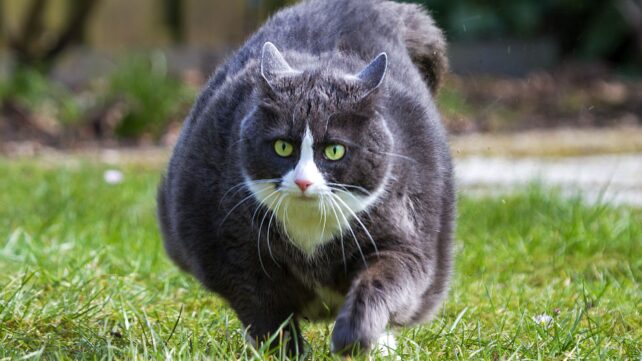
The theoretical feline has gone from a Slinky Malinki to a Butterball Brown – and just keeps on growing bigger.
Not literally, of course. Rather, physicists have been trying to push the quantum states in a superposition farther and farther apart, trying to discover just how close they can get to the realm of classical physics before the cat is no longer Schrödinger's.
Now, scientists in Germany have created a record-breaking optical version of the famous thought experiment – using some of the strangest atoms known to physics.
By exploiting a super-puffy type of atom known as the Rydberg atom, a team led by physicist Hendrik Hegels of the Max Planck Institute of Quantum Optics has created Schrödinger's chonkers – optical cat states at what the researchers describe as "world-record sizes".
And the bigger the cat gets, the more closely physicists can interrogate one of quantum mechanics' most enduring mysteries: Where, exactly, does the quantum world end and ours begin?

It's a deeply vexing problem.
Quantum mechanics is extraordinarily accurate at describing the behavior of the subatomic realm. Classical physics does an equally superb job for the larger realm we live in every day. But try to apply the rules of one to the other, and things get messy.
Somewhere, there's a boundary where the strange maybes of the quantum domain turn into the certainties of the classical – but how and why that happens is currently a giant question mark.
Schrödinger's cat entered the picture in 1935 – but it was never really about the cat.
Austrian physicist Erwin Schrödinger devised the thought experiment to illustrate what happens when the bizarre quantum concept of superposition is extended into the everyday world.
In his hypothetical example, a cat is sealed inside a box with a mechanism triggered by a random quantum event that may or may not kill it.
Until the box is opened and the outcome is observed, quantum mechanics describes the system as a superposition of both possibilities; the cat is simultaneously alive and dead. That's an example of a 'strange maybe'.
In the quantum realm, superposition is not an abstract absurdity involving domestic pets, but a real phenomenon that can be created and measured.
Scientists can even create superpositions of states that are quite different from one another. The greater the difference, the "bigger" the resulting Schrödinger cat state is said to be – picture one possibility being a fossilized skeleton and the other a cat tap-dancing, rather than merely dead and alive.
The farther apart the states become, the more vulnerable their delicate quantum relationship is to disruption by the surrounding environment, a process known as decoherence.

And now it's the Rydberg atom's turn to shine.
In a normal atom, you have a nucleus surrounded by its tiny swarm of electrons. Add energy, and an electron can jump into a higher-energy state, farther from the nucleus, expanding the atom just a teensy bit.
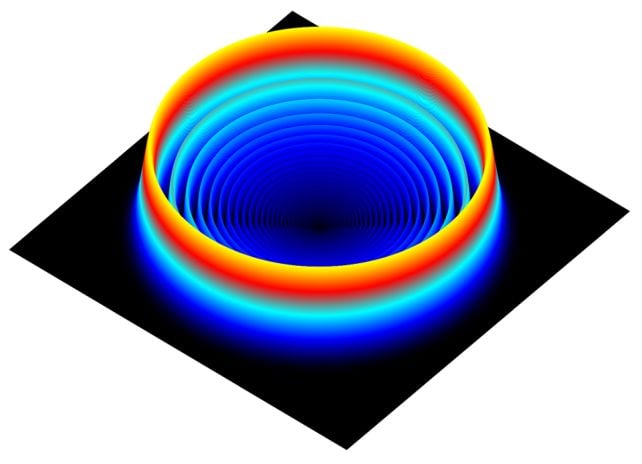
A Rydberg atom is what you get when you give one of those electrons a lot of energy under conditions that allow it to remain bound to the atom. Its orbit can extend surprisingly far from the nucleus, making the atom enormous (by atomic standards), with the excited electron about as loosely bound as it can get without flying off.
Because they're so loosey-goosey, Rydberg atoms behave in an exaggerated way, which makes them useful for conducting experiments.
For Hegels and his colleagues, those properties offered a way to tackle the problem they'd set for themselves – creating an optical Schrödinger cat with two states farther apart than had previously been possible while preserving the delicate quantum coherence.
In particular, one of those exaggerated behaviors is how strongly Rydberg atoms interact with each other. Excite one atom into a Rydberg state, and its influence can prevent nearby atoms from being similarly excited – a phenomenon known as the Rydberg blockade.
The researchers used this blockade to make particles of light – photons – influence one another indirectly.
They started with a cloud of atoms trapped between two mirrors, which could be excited into Rydberg states. The mirrors repeatedly bounced light through the cloud, increasing the interaction between the light and atoms. This arrangement is known as an optical cavity.
Into this setup, the researchers sent two pulses of light, one after the other. The first was the "control", which essentially determined what would happen to the second, the "target".
Here's where things get quantum.
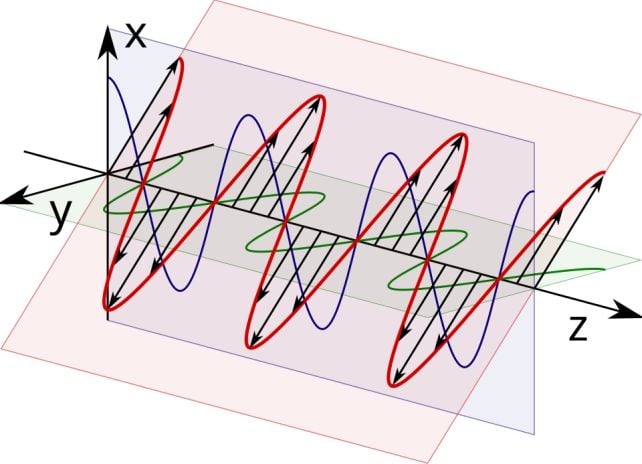

Light can be polarized, meaning its electromagnetic waves can be oriented in different directions. The control light was prepared in a superposition of two polarizations – rather than definitely being one or the other, it was quantum mechanically both.
The apparatus separated those two possibilities onto different paths. One simply traveled around the atomic cloud. The other interacted with the atoms, temporarily leaving its quantum information behind as a Rydberg excitation – an electron boosted into the high-energy state described earlier.
So, in superposition, the atomic cloud both did and did not contain that Rydberg excitation.
Then the researchers sent in the target light.
This is where the Rydberg blockade comes into play. The target light interacted differently with the cloud depending on whether the stored excitation was present. In one possibility, it came back from the cavity with its wave shifted relative to the other.
Because the stored excitation was in a superposition of being present and absent, the target light experienced both possibilities. It ended up in a superposition of two states, each linked to one of the control's two states.
Boom. There's kitty.
In this case, the two possibilities weren't alive and dead, or fossilized and tap-dancing, but two states of light whose waves differed in phase. The farther apart the researchers could push those two states while keeping them quantum mechanically linked, the bigger their optical cat became.
And this one got pretty chonky. For these optical cats, their size can be expressed using a quantity called alpha squared (α²). Hegels and his colleagues reached 2.4, sailing past the previous record of 1.4 for this specific kind of optical cat state.
But simply producing two different states of light isn't enough – the researchers also had to show that quantum coherence had been maintained.
This is the key difference between a Schrödinger cat and two states of light just hanging out, unrelated to each other.

By taking many measurements of the light, the researchers found a telltale signature of quantum behavior in all six cat states they created – confirming that, even as the cats grew bigger, they hadn't lost their essential quantum wackiness.
Bigger cats aren't just useful for poking the boundary between quantum and classical physics. Making their two states more distinct while preserving their quantum connection could also make them more useful for storing and processing quantum information.
And the researchers say their work leaves room for cat dessert. Several parts of the experiment could still be improved, which could allow even bigger cats to be created in the future.
Somewhere between the quantum and classical realms, there's a point at which Schrödinger's cat has to stop growing. Puffing up its fur may be one way to find it.
The paper, which is yet to be peer-reviewed, is available on the preprint server arXiv.
This article was fact-checked by Peter Dockrill and edited by Peter Dockrill. While we pride ourselves on our process, we are only human. If you spot a mistake, please let us know.