Human languages are complex and versatile. They reflect our intelligence, our cultures, our need to understand and be understood.
Our languages tend to follow specific patterns. Little chunks of grammatical sense can sit within the larger structures of sentences to form complex layers of syntax.
We've long thought those nested patterns of language – known as supra-regular recursive grammar – distinguished us from any other animal on Earth.
But there's growing evidence that at least some of our terrestrial neighbors may be using similar grammatical strategies to communicate with each other.
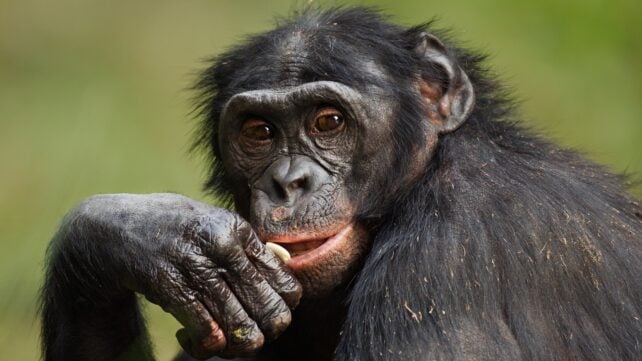
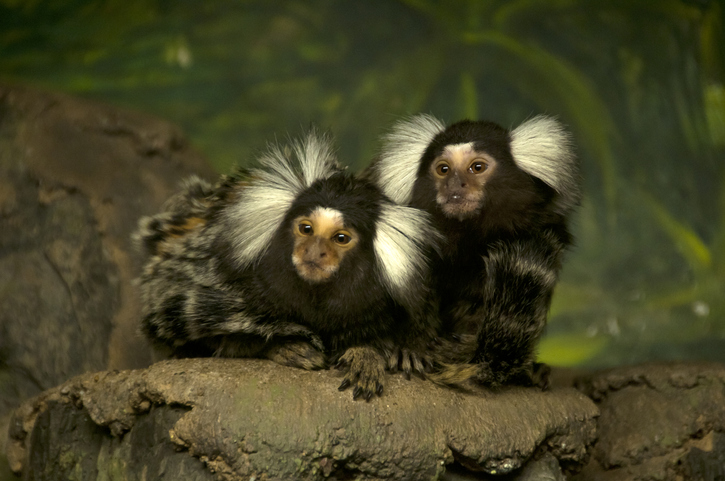
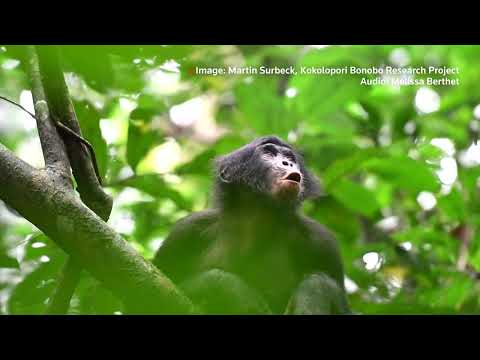
A new study suggests three non-human primate species may sometimes use supra-regular recursive grammar when calling to each other: the common marmoset (Callithrix jacchus), the olive colobus monkey (Procolobus verus), and the bonobo (Pan paniscus).
"We show for the first time that animals generate call sequences that can be captured by supra-regular recursive grammars and hence share more similarities with human language than previously thought," writes University of Zurich linguist Remo Nitschke and his colleagues.
The study has been made available on the preprint server bioRxiv, and it hasn't yet been peer-reviewed, but it gives us a preview into their work.
Since we don't know what the components of primate speech actually mean and how they fit together, the researchers used some tricky math to analyze the call sequences.
They created two different mathematical models to analyze audio recordings of human speech and sounds, and primates' calls. Each model was used to predict which call sequences would come next, drawing on different assumptions to make that prediction.
One of these models was designed to predict how a call sequence would progress based on the assumption that the sequence of sounds is linear (also known as probabilistic regular grammar).
The other was designed to factor in nested hierarchies, where the position of smaller chunks of sound within the call sequence is also factored in to predicting what comes next (also known as probabilistic context-free grammar).
These two models represent some of the key differences between regular grammar (which we know some animals are capable of) and supra-regular grammar (which is supposedly unique to humans).
The researchers tested their approach using recordings of humans first, which, the authors say, confirmed the models' reliability, at least for the sake of this study.
When they turned the models on primate calls, it appeared the calls of all three species contained elements of supra-regular grammar.
"These findings challenge syntax as the major transition in hominid evolution and opens up prospects for alternative evolutionary scenarios," the authors write.
But we're still a way off from being able to say, for sure, that these primates do actually use supra-regular grammar when communicating.
The study's results are based on probabilities, using models to decipher the structures of communication sequences we don't actually understand. That means it's likely that the calls contained supra-regular grammar, but not certain.
"Yet another possibility is that the groupings reflect a purely formal structure, similar to the syntax of music in humans or song in animals," the authors note. "Disentangling these possibilities requires much further research."
The datasets were also quite small, so further studies would be needed to see if the observed patterns hold up consistently across wider sets of calls from these primates.
"Despite these limitations, it is clear that the traditional view needs to be revised: some parts of call sequences of nonhuman primates are in fact most likely generated by supra-regular grammars," the authors add.
This could mean there's less separating us, language-wise, from our primate relatives than we thought.
"The absence of a supra-regular capacity has long been held to be the single-most important demarcation line in hominin evolution," Nitschke and team conclude.
"Our findings reset the agenda for research on the evolution of language: if not syntax, what is the critical step that enabled the evolution of language from a primate-like communication system?"
This preprint is available at bioRxiv.
This article was fact-checked by Fiona MacDonald and edited by Fiona MacDonald. While we pride ourselves on our process, we are only human. If you spot a mistake, please let us know.