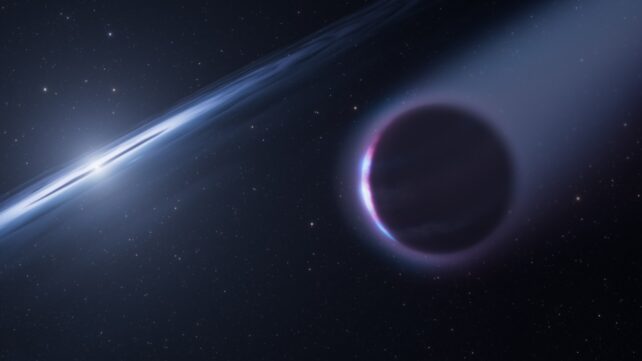
After being born of mostly just hydrogen and helium, a scant 14-ish billion years later the Universe is full of weird planets of wildly varying makes, shapes, and sizes.
Well, maybe not shapes, because they're all pretty rotund – it's in the definition of planet.
Yet some are truly alien, including oddballs as dense as iron and teeny-tiny 'next door neighbors' that make our modest Venus seem like a giant.
Upping the alien ante, astronomers have just announced a suspected exoplanet like no other entity, either in astronomy or in legend: a "phoenix planet" that arose not from its own ashes, but from those of its burned-out mother star.
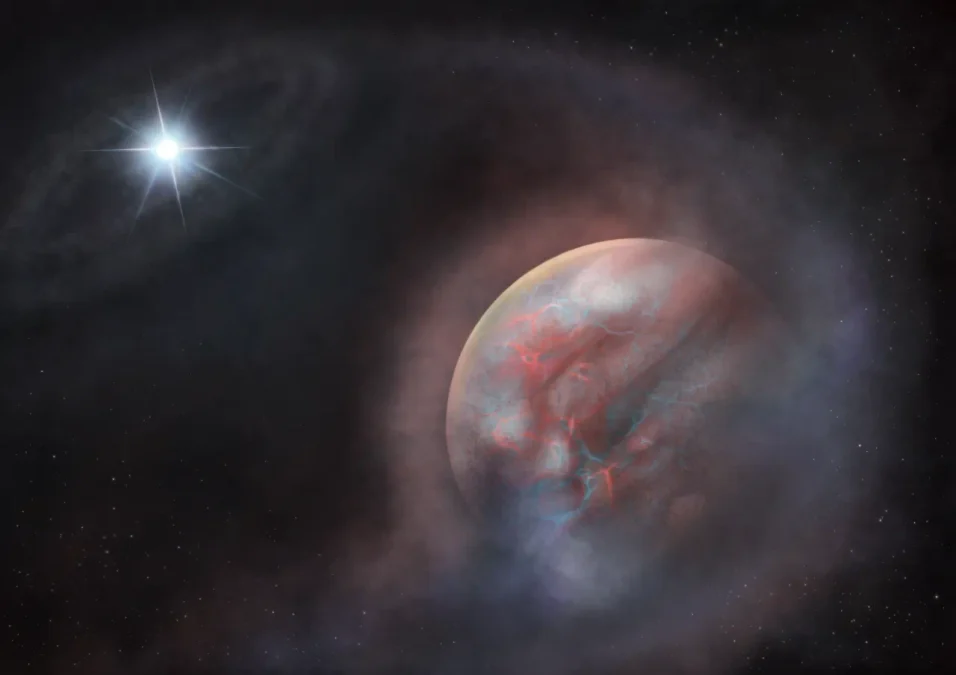
After nearly three decades of uncertainty, a team led by researchers from the University of Warwick has finally characterized what may be the first second-generation planet ever detected around a white dwarf, one named HS 0209+0832 and located only 270 light-years away.
White dwarfs are the cooling cores of formerly Sun-like stars that have exhausted their nuclear fuel. Before they die, they puff up like popcorn and shed their outer layers into space.
In an exceedingly rare stroke of cosmic fate, these layers appear to have been gravitationally trapped and squashed down into a new planet.
A second-generation planet hatched from stellar senescence, rather than first-generation planets like ours, born from the natal cloud that birthed the Sun.
As a reminder of how long Hubble has been faithfully serving us, it first observed this dead star last century, in 1999, revealing approximately 100 spectral lines (a light-based fingerprint) that astronomers could not identify.
A modern reexamination revealed a chemical fingerprint including zinc, copper, and a standout element: niobium, at levels more than 1,000 times greater than in our Sun.
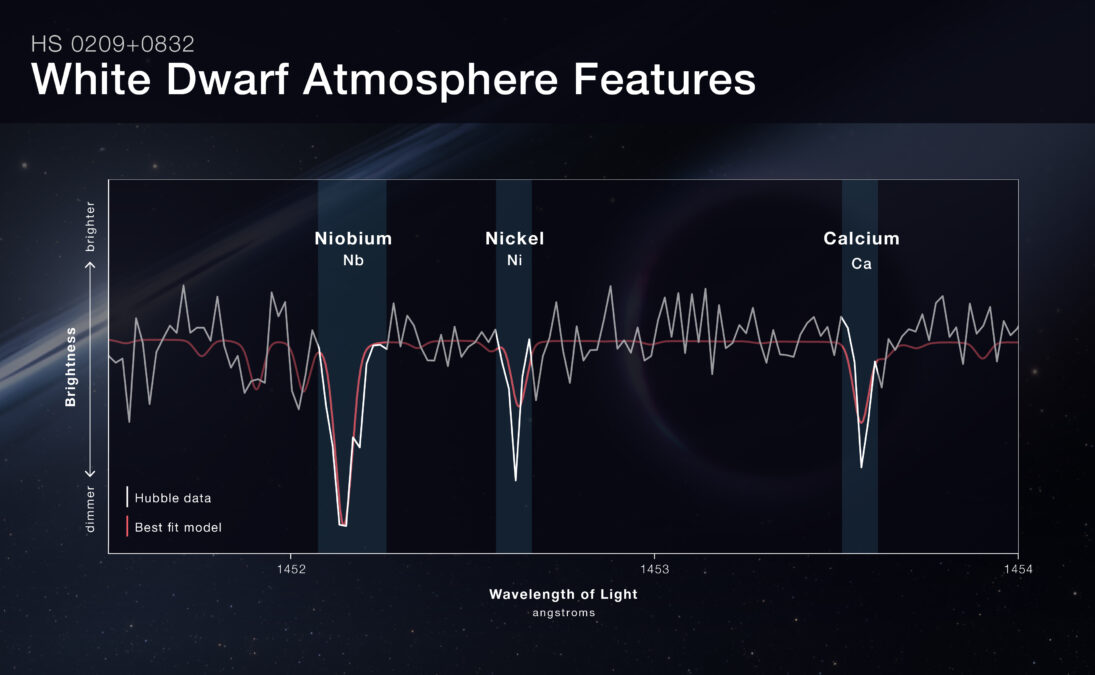
This niobium – with Earthly applications in jewelry and medical imaging devices – was the mysterious spectral feature that helped crack the decades-old "cold case," representing an astronomical milestone:
"When [lead author] Jamie asked me about niobium in relation to this study I was truly gobsmacked, as that element had not been reported in any other white dwarf analyzed to date," says Boris Gänsicke, professor in the Department of Physics at the University of Warwick, and study co-author.
"Once we realized it was there, everything fell into place."
It's grimly akin to an astronomical autopsy report.
"This pattern of elements is a telltale sign of the 's-process,' a nuclear reaction that builds heavy elements inside dying stars during their bloated red giant phase," explains Nicholas Stone, a theoretical astrophysicist at the University of Wisconsin-Madison and study co-author.
"It's a chemical signature no ordinary, 'first-generation' planet should carry, which told us that this new planet was something different."
The researchers explored the system's properties using various ground-and-space-based observatories, including NASA's Transiting Exoplanet Survey Satellite (TESS).
The wavelike brightness variations by the parent white dwarf suggest that the suspected phoenix planet may be a Jupiter-sized gas giant that swings around its 'dead' star every 4.4 days.
This tight orbit, 25 times tighter than Earth's around the Sun, may have led to tidal locking so one side of the planet always faces the white dwarf while the other side basks in never-ending night.
Defying its designation as 'dead,' the white dwarf is incredibly hot, with an effective temperature of roughly 35,000 degrees Celsius (63,000 degrees Fahrenheit). At only 5 million years old, this youthful stellar cinder has not yet cooled.
So it's basically blow-drying its companion, which may be losing around a billion kilograms of mass per second, perhaps as a comet-like tail that accretes onto the white dwarf.
Of course, this is the same material that was created and cast off by the white dwarf's death throes, completing an astrophysical, Lion-King-like Circle of Life scenario.
Though the system itself is unique, the process is not. As Sun-like stars fizzle, they may shred and engulf their planets, as per a gruesome mythological motif that may foretell the fate of Earth.
A white dwarf's atmosphere can thus preserve the chemical evidence of its pulverized planets, mirroring the meals found in the fossilized bellies of dinosaurs.
"What's remarkable about the planet around HS 0209+0832 is that this isn't a planet from somewhere else, or a survivor from the system's birth," explains Gänsicke.
"It looks like it was built from the very material its own star cast off as it died. In a sense, this system has given birth to a new world using the foundations of the old one."
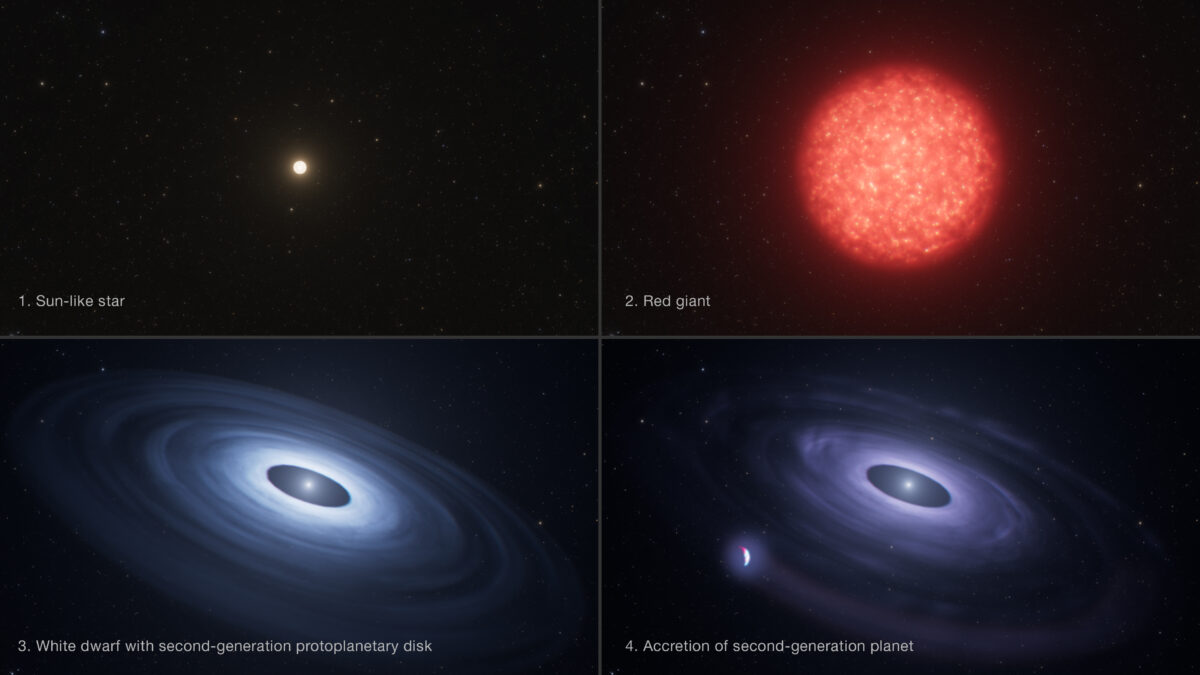
It may be considered classically poetic that the white dwarf is eating a planet built from its nuclear ashes. Especially since it may have previously consumed a companion star that helped the phoenix planet form in the first place.
In the perspective of the aforementioned mythological motif, even the power-mad, paranoiac Kronos only devoured the first generation of his children.
But there's good news.
"If the second-generation planet is there, I think it is likely to survive. Eventually the white dwarf will cool and then maintain a consistent temperature, with the planet in its stable habitable zone for millions of years," forecasts Jamie Williams, an astronomer at Warwick and the study's lead author.
Finally, this work informs the search for future bodies that may share a secondary birth, suggesting that the death of a star presents a prologue rather than an epilogue – and placing our own solar mortality in reincarnate terms, as Gänsicke concludes:
"Finding this one example raises the question of how many more might be out there and might our own Solar System host a second-generation planet formed from the ashes of our Sun."
The research has been published in Nature Astronomy.
This article was fact-checked by Fiona MacDonald and edited by Fiona MacDonald. While we pride ourselves on our process, we are only human. If you spot a mistake, please let us know.