
The time-keeping offered by your watch or phone may be good enough for day-to-day life, but scientists are much more ambitious in terms of precision, and use atomic clocks to measure slices of time as accurately as possible.
These clocks are based on 'ticks' of light waves or microwave signals, tuned by electrons swapping energy levels as they are excited by the external energy source. As those swaps happen at a specific, known frequency for each type of element, a single atom of it can be used to make sure the ticks are precise.
Now we have a new atomic clock that claims to beat all previous records when it comes to accuracy. It's based on the element lutetium, and measures a second with an uncertainty level of under a ten-billion-billionth of a second, around four times better than anything previously recorded.
In other words, it should be out by less than a second if it was left running for 300 billion years (which is roughly ten billion-billion seconds). The researchers behind the clock, from the National University of Singapore, have published their work in Nature.
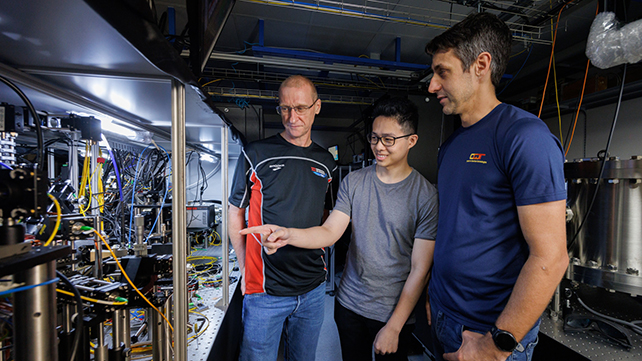
"I am confident that what we have now is the most accurate clock in the world," says physicist Murray Barrett. "In the future, I just don't see how this clock can be beat."
Atomic clocks have traditionally used cesium as their reference element, but in recent years other elements have been tested too, including strontium. These elements oscillate faster than cesium, meaning more ticks per second.
The researchers have been exploring the possibility of using lutetium for a decade at this point, and are so far the only team to realize its time-keeping potential.
Where the element really excels is in its stability. Its atomic structure means it's incredibly well protected against heat, magnetism, and motion, which would act as disturbances to electron energy state shifting.
"The good properties mean that high accuracy can be achieved even in a wide range of environments," says Barrett.
"The lutetium clock would be stable even if you went from the hottest place recorded on Earth in Death Valley to the coldest place in the Antarctic plateau."
To verify the accuracy of their atomic clock, the researchers built a second one, also based on lutetium. With adjustments for Einstein's theory of general relativity (the clocks weren't in exactly the same place), the two units were compared against each other.
Across 200 hours of measurements, taking 12 days in total, the differences between the two clocks were so small that they were effectively zero.
"There is a humorous saying that 'a man with a watch knows what time it is, a man with two watches is never sure'," says physicist Kyle Arnold.
"It basically tells you that the only way to test the accuracy of a standard is to compare clocks and demonstrate reproducibility."
Besides just being a really, really good reference point for what time it is, these super-precise timepieces are invaluable for some of the most fundamental, large-scale investigations in physics – measuring how gravity changes across Earth, for example.
To advance the atomic clock technology further, the team wants to reduce it in size (it currently takes up an entire lab), so that it can be moved from place to place. This means it can be tested for accuracy in a greater number of locations, and can be used for practical applications (like underground magma monitoring).
Again, lutetium has properties that can help. The element uses off-the-shelf lasers that don't take up an inordinate amount of space, and works at room temperature without any need for bulky cooling systems.
"The next step is to take the lab-scale clock and miniaturize it into a transportable system," says physicist Michael Lee.
The research has been published in Nature.
This article was fact-checked by Rachel Garner and edited by Fiona MacDonald. While we pride ourselves on our process, we are only human. If you spot a mistake, please let us know.