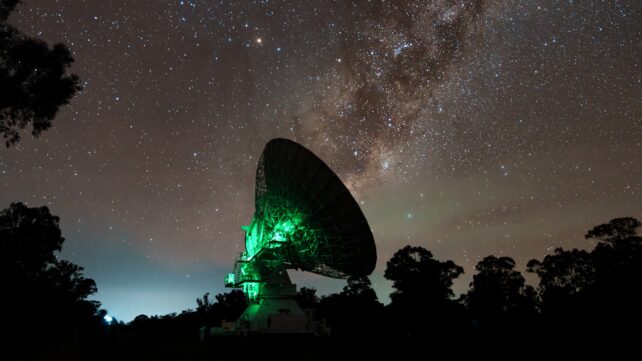
Sometimes we receive strange, ghostly radio signals from outer space, which astronomers have yet to conclusively explain.
Partially because they disappear almost as soon as they arrive.
The ephemera known as fast radio bursts (FRBs) are among the Universe's most mysterious occurrences, even more eerie than the supposed little green aliens with a penchant for physical probes.
If they were related, that would neatly solve two major mysteries.
But FRBs are bursts of radio waves from the distant cosmos, generally lasting for tiny fractions of a second (i.e., fast).
Their transience, and the fact that they randomly appear across the sky, have made it difficult to pin down their origins for nearly two decades since their discovery in 2007.
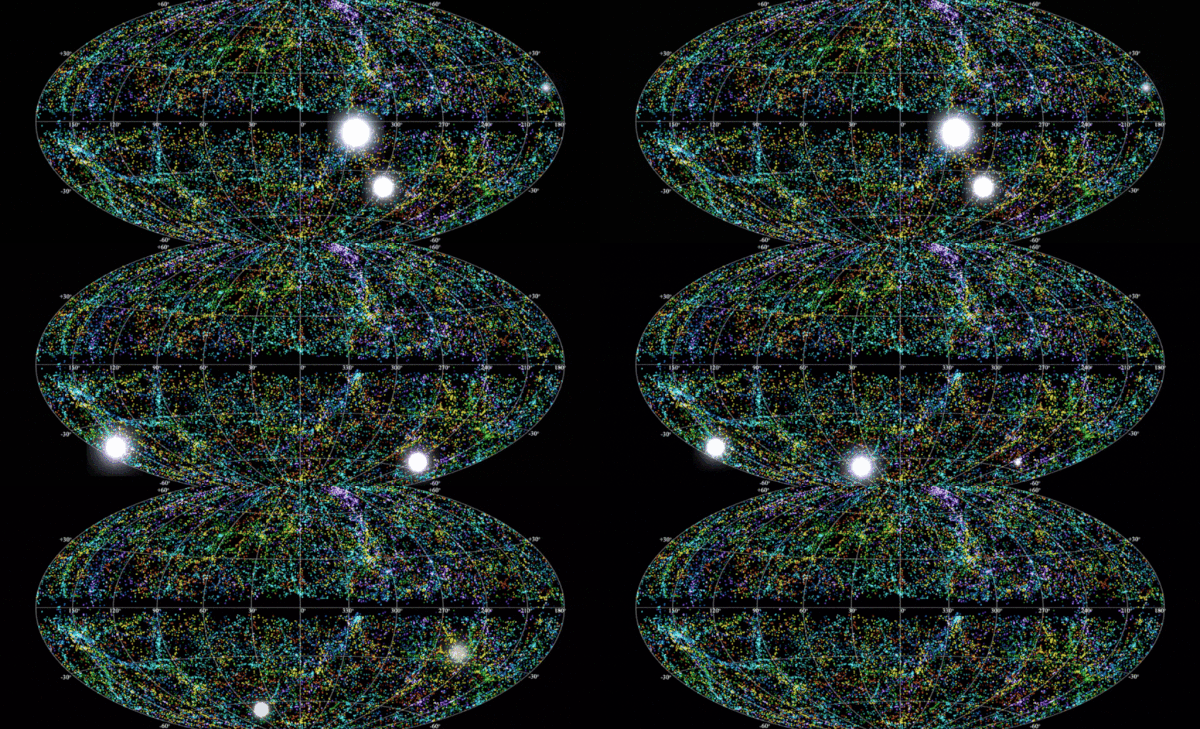
But we just got a huge clue: Astronomers have reported the most distant FRB yet, designated FRB 20240304B, a burst of ancient energy that was emitted in one-thousandth of a second and has traveled through 80 percent of the Universe's history to meet us.
"What makes fast radio bursts interesting is that we don't know what generates them," explains lead author Manisha Caleb, a radio astronomer and astrophysicist at the University of Sydney.
"We have theories for what objects produce them, but we don't have conclusive proof."
So, who's the cosmic culprit in this specific case? Possibly a magnetar: a type of neutron star on steroids that packs the most powerful magnetic fields in the Universe and squeezes the mass of a whole Sun into a magnetic marble the size of San Francisco Bay.
Yet here's another conundrum: despite their incomprehensibly intense origins, and their ability to release 500 million Suns' worth of energy in thousandths of a second, they may be light(er)weights compared to other stellar outbursts, which has led to a sampler platter of possibilities and added to the difficulty of their conclusive identification:
"We observationalists can only kill models, never prove them. So, when you have 100 to kill, it takes a fair bit of time." – astronomer and astrophysicist J. Xavier Prochaska
"Fundamentally, it is because the energies involved are modest. They are extreme for radio wave emission, but nothing like the energy in a supernova or gamma-ray burst," J. Xavier Prochaska, an astronomer and astrophysicist at the University of California, Santa Cruz, told ScienceAlert.
"As such, theorists have devised nearly 100 models to generate them.
"We observationalists can only kill models, never prove them. So, when you have 100 to kill, it takes a fair bit of time."
In the study, published in the journal Science, a massive, international collaboration of astronomers used multiple observatories to explore this mysterious FRB emanating from 'cosmic noon,' an era only 3 billion years after the Big Bang when Universal star formation was at its peak.
The astronomers identified the FRB in March 2024 using MeerKAT, a 64-antenna radio telescope in South Africa's Meerkat National Park.
They then pointed two ultra-sensitive ground telescopes at the corresponding patch of sky to see its host galaxy and discovered… darkness.
They looked as deep as they could "but there was simply nothing to see," Prochaska says.
So they called in the heavy orbital artillery (just a metaphor, for now), the JWST and its exceptional infrared sensitivity.
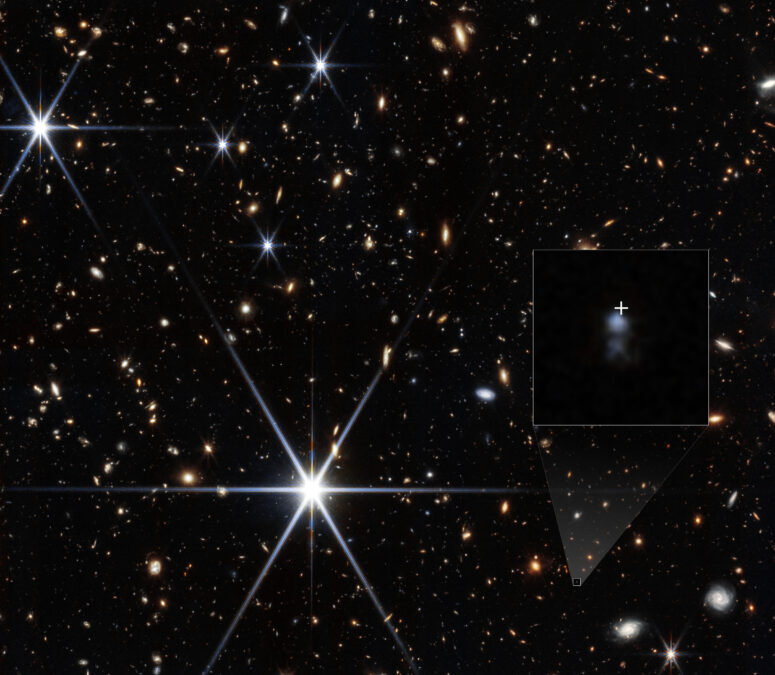
And if the researchers suspected a monster, they found a mouse:
"We thought it would be a big, nicely formed galaxy with lots of stars, and instead it was a little dwarf galaxy, although it was actively forming stars," says Caleb.
Altogether, this dwarf galaxy is 1,000 times less massive than expected.
It's also exceedingly young, with 90 percent of its stellar mass having formed in the past 30 million years.
This helped the astronomers favor a magnetar as the potential source of the historic FRB.
Another prominent FRB scenario involves the collision of two neutron stars, a cataclysmic crash that yields a black hole or an extra-heavy neutron star, plus a bunch of literal gold.
Yet neutron stars dance around each other for billions of years before colliding, like a still-shy couple on a second date, so it wouldn't make sense in a young galaxy.
Magnetars, however, can form and release their magnetic energy in just millions of years. Especially in a metal-poor galaxy like this that breeds massive stars.
Also, like good guests, FRBs come bearing gifts of the astrophysical kind.
Even though light travels at the speed of itself, the ultimate breakneck physical limit, it only does so in a vacuum.
And as this FRB passed through the cold, ionized (electrically charged) gas that permeates the cosmos, its lower-frequency waves were slowed more than its higher ones, so they arrived later.
Turbulent gas, most likely in its home galaxy, also scattered the signal, smearing it out over several milliseconds
FRBs thus act as an astronomical flashlight, and this particular one has had its signal warped by two cosmic-scale structures as it traversed most of the Universe to meet us.
In doing so, it helped illuminate an unknown galaxy group along the way, located about 3.5 billion light-years away, while also bearing the ionic imprint of the Virgo Cluster, the nearest such structure to Earth, only around 54 million light-years distant.
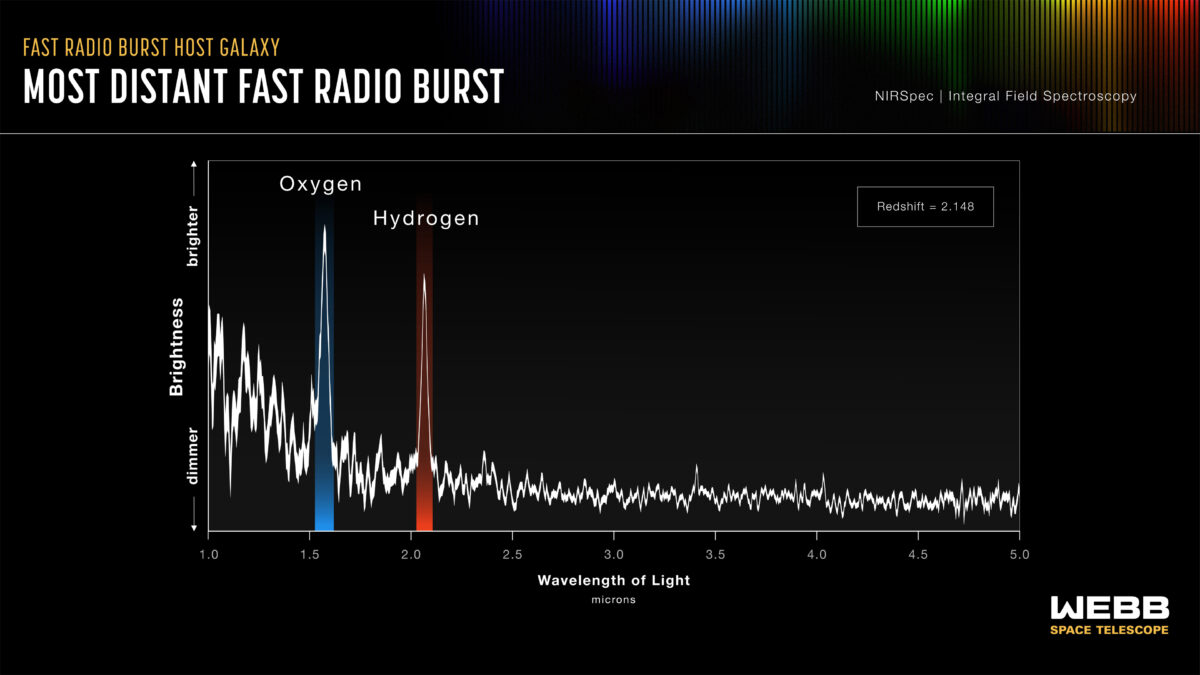
Finally, since we only know of about 100 FRBs whose host galaxies have been confirmed, the researchers note, and most are billions of light-years more local, this wasn't just the cherry atop the celestial sundae, but a whole other sundae on top of the sundae.
"Because we have scant understanding of what generates FRBs, we could only hope that they might exist at such early times," Prochaska told ScienceAlert.
"Now, we have proven it and this will drive new, dedicated studies to find others – and search even greater distances!"
The research has been published in Science.
This article was fact-checked by Rebecca Dyer and edited by Rebecca Dyer. While we pride ourselves on our process, we are only human. If you spot a mistake, please let us know.