Time travel is a dream shared by pretty much all of us.
But the dearth of visitors from the future – and the dismal turnout at the famed time traveler party – is alarming for hopefuls.
Still, hypothetical time travel ideas abound, including traversable wormholes propped open by undiscovered exotic states of matter, and a rocket ship skirting billions of light-years around a spinning Universe to end up back in its past.
But a new study presents a surprisingly simple numerical basis for ruling out closed time loops in a wide class of possible universes, based on a single mathematical proof.
In yet-to-be peer-reviewed research, posted to the preprint repository arXiv, physicist Hongsheng Zhang from the University of Jinan in China repurposed a long-standing equation to offer a new numerical prohibition against time travel – further dashing our hopes of a history-bending romp as promised by Bill & Ted's Excellent Adventure.
The research used the "null eikonal equation," an old tool for exploring how light propagates, to surprising effect.
"The first is how little the theorem needs. The proof runs to three lines and uses exactly one fact about directions: a light-like direction can never be perpendicular to a traveller's direction in time," Zhang told ScienceAlert.
"From that alone it follows that a certain function must grow along every possible journey, so no journey can return to its starting event."
So a light beam can never be at a 90-degree angle (orthogonal) to the path of any entity moving through time – like a particle or a time traveler with a notepad full of winning lottery numbers – which means a certain quantity always increases along their journey, so they can never loop back.
In other words, in such universes only forward movement is possible. As if driving down an endless one-way street with no service roads, turnarounds, or even an extended shoulder where one could pull over to enact a sneaky (illegal) U-turn.
And, really, this is the basis of time travel, which has much different definitions depending on whether one is talking science or science fiction:
"People expect a result about time travel to need heavy machinery, energy conditions, quantum effects, maybe a singularity. It needs none of that. The whole content is bookkeeping about directions," Zhang adds.
The equational model used in this work offers a fourth family of criteria to prohibit closed time loops, supplementing the following three families:
First, the time function criteria state that time loops are ruled out if a universal clock can be defined that always ticks forward along every possible path.
Second, the energy condition criteria mandate that energy and gravity work in non-negative ways, disallowing time travel because it would require negative energy or "exotic matter".
Third, topological criteria deal with the shape and connectivity of spacetime, linking time loops to the structure of the boundary where a time-travel region would begin.
Fortunately, this work adds an extra tool to theorists' time-traveling toolkit, allowing a relatively easy algebraic way to rule out numerical time-travel scenarios without messy mathematics that account for the greater Universe and its chaos.
Another unexpected revelation is that one needs to find a way to turn part of the Universe into a churro to create a closed, time-traveling loop.
"So the surprise is that a question about the causal structure of an entire universe collapses into one scalar equation, and that the culprit is not spin. It is twist."
Indeed, this is one of two escape routes that would allow time loops to exist, because a "sufficient condition is useful only if we know how it can fail."
As hinted, both escapes basically rely on spacetime folding back on itself to create a loop. This could happen locally, such as around a massive spinning black hole that turns spacetime into a pretzel, or if the layout of the Universe somehow doubles back on itself topologically.
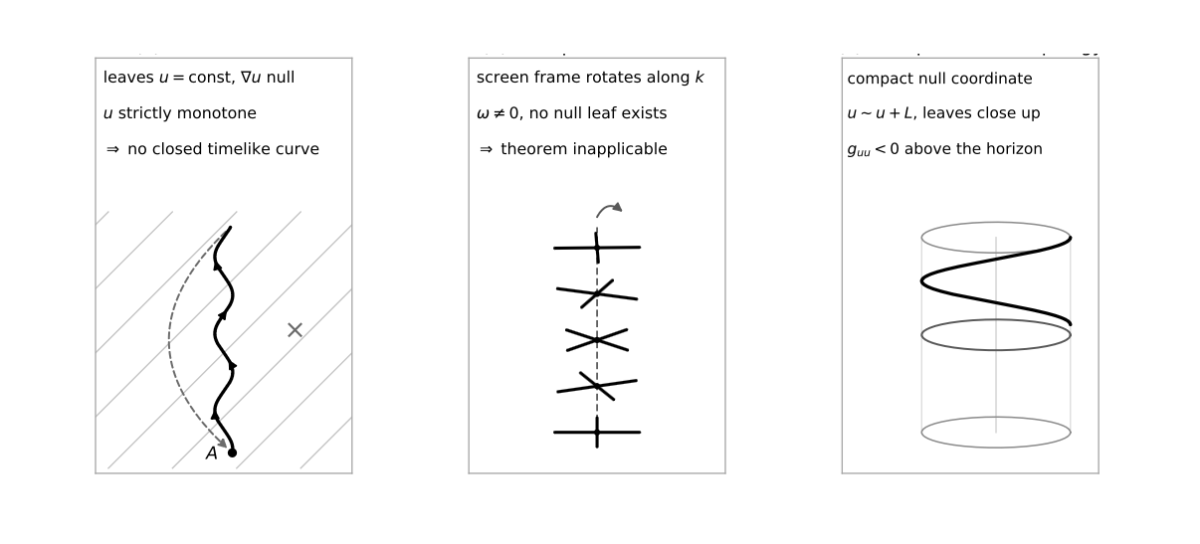
Overall, this work splits the Universe based on light, rather than by moments of spacetime, which sidesteps our understanding of time.
"It is accurate to say we slice spacetime by light rather than by space. But the slices are not the paths of light; they are surfaces that light itself can inhabit."
"Why does this help? An ordinary slice of space requires you to choose a moment, a moment requires a clock, and a clock requires an observer. A slice of light requires none of these. It is fixed by the geometry alone," Zhang explains.
Finally, this offers a thought-and-math experiment of the type that has been influential throughout scientific history, allowing us to explore the abstruse principles that define our existence and possibilities.
But the Universe, as always, has the final say, Zhang concludes:
"What it does not do is tell us whether nature permits any of this. That remains open, and it is the question I would most like to see answered."
But we are a step closer: "If you want a time machine, you now know exactly what you must break."
The research has not yet been peer-reviewed, but a preprint is available on arXiv.
This article was fact-checked by Rebecca Dyer and edited by Rebecca Dyer. While we pride ourselves on our process, we are only human. If you spot a mistake, please let us know.