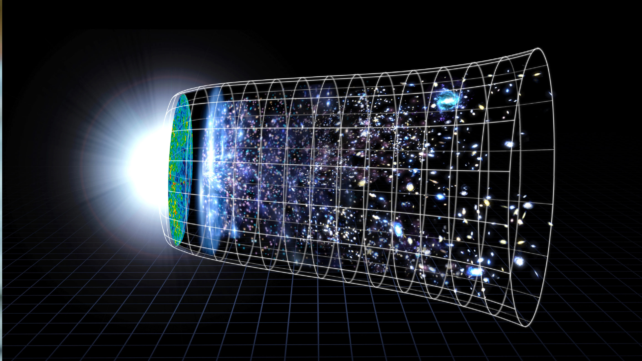
Over one hundred years ago, a pioneering thinker changed how we understand space and time.
He told us that they're both intertwined in a fabric that permeates the cosmos, comprising three dimensions of space and one dimension of time.
This now-famous visionary's name? The mustachioed Hermann Minkowski, of course – Albert Einstein's math teacher.
And no, he did not flunk Einstein, who then added gravity to the flat "Minkowski spacetime" and 'birthed' a curved spacetime.
In fact, one can say that Einstein flunked Hermann, as Einstein deemed Hermann's way of thinking "superfluous learnedness." At first, anyway.
But why does the Universe have three spatial dimensions and one temporal dimension? A weird new mathematical theory offers a surprising possibility:
It's all due to the invisible building blocks, like puzzle pieces or LEGOs (or even K'NEX) that form the cosmos.
In a preprint paper posted to arXiv, which has not yet been peer-reviewed, a trio of physicists from the University of Belgrade, in Serbia, simulated different cosmic geometries, out of virtual four-dimensional triangles, to see if they could give rise to our familiar mix of three dimensions of space and one of time.
The answer is yes, absolutely. Kind of.
The authors used a toy model of quantum gravity – which is itself mysterious and debated – to probe some complex cosmic mechanics without the messy real-Universe complications, like the laws of physics.
This framework modeled what one may consider an immensely miniature Universe, decreasing from four to zero dimensions, like a hierarchical house of cards.
It began with the four-dimensional 4-simplices, which are made of three-dimensional tetrahedra, which are made of two-dimensional triangles, which are made of one-dimensional edges, which join together at zero-dimensional vertices.
Like a famous quote about world-supporting turtles, it's simplices all the way down!
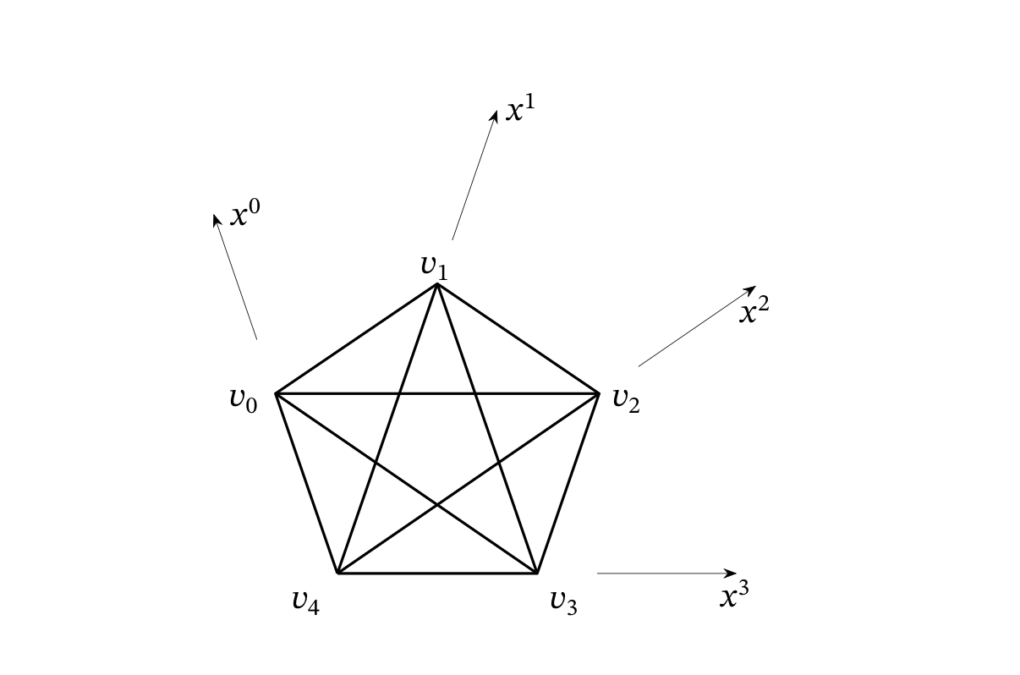
The researchers then randomized the edge lengths for these pieces, setting the minimum at the Planck length, a scale of 10-35 meters that represents the breakdown of our physical understanding.
The upper bound of this scale is the point at which the Universe stops behaving like a smooth continuum and starts acting like a jagged jigsaw puzzle. Observations from the Large Hadron Collider and the LIGO-Virgo gravitational wave network help set the size range: from the size of the whole Universe, around 1026 meters, down to a scale of 10-20 meters.
So any jaggedness would only appear at a scale way lower than the size of an atom, which is not even close to visible.
The researchers also considered three different topologies, or cosmic landscapes, made of approximately 100,000 simplices in three configurations.
First, a four-dimensional ball with a boundary.
Second, a four-dimensional sphere without a boundary, because it loops back on itself.
And, thirdly, a disconnected set of four-dimensional simplices, like 100,000 scattered puzzle pieces used as a control.
Finally, the researchers treated all the edges of the pieces either as space-like – akin to physical distances, represented using real numbers – or as time-like – akin to time intervals, represented using imaginary numbers, or a combination of the two.
Altogether, their final data pool included over 20 billion evaluations of these various simplices-based simulations.
So, did a four-dimensional 'Universe' emerge?
Amazingly, yes. When you toss a bunch of randomized puzzle pieces in a mixer, strip away complex cosmic dynamics and forces, and let them assemble geometrically, up to about 85 percent of the time they organize into a spacetime with three spatial dimensions and one temporal dimension – according to mathematical signatures the researchers assigned to these dimensions.
Some other weird configurations also pop out. Around 6 percent of the trials give a Euclidean signature: a frozen Universe with four spatial dimensions and no time.
And, intriguingly, about 8 percent of the trials yielded a split Universe, with two dimensions of space and two dimensions of time.
However, this is only when you treat the edge lengths as space-like. Treating them as time-like, or as a mixture, yields signatures with two or even three dimensions of time, rather than the Minkowski-style Universe that we perceive as reality.
So this presented one of the major surprises: one would think that both space-like and time-like edges would be necessary. Yet in this model, space-like edges alone were enough: edges of mismatched lengths often can only fit together in a geometry that includes a time direction
Just as surprisingly, the topology didn't matter, making little difference whether the global shape of the Universe was a ball, sphere, or just a jumble of puzzle pieces, perhaps suggesting that the split between space and time is set locally. Or that the topological differences are invisible, or average out with enough puzzle pieces.
Future research can include other dynamics, like physical laws, and various shapes, to further test "whether the spacetime signature can ultimately be understood as an emergent property of quantum geometry," the researchers conclude.
The research is available as a preprint on arXiv and has not yet been peer-reviewed.
This article was fact-checked by Fiona MacDonald and edited by Fiona MacDonald. While we pride ourselves on our process, we are only human. If you spot a mistake, please let us know.