Much of our online security relies on a digital padlock system called RSA encryption, which protects our privacy as we doomscroll social media, get software updates, or do banking transactions to fund further doomscrolling.
The RSA-2048 encryption standard is easy to form but incredibly hard to break because it multiplies two large prime numbers to produce a modulus up to 617 decimal digits long – a virtual padlock that people can see and prod.
Cracking this requires a private key: those two initial primes, found by factorization.
Yet our collective privacy may be more fragile than we think, as quantum computing advances could threaten this encryption sooner rather than later, new research suggests.
In a preprint study (which is yet to undergo peer review) posted on the Cryptology ePrint Archive, a team led by researchers from the quantum computing firm Alice & Bob, headquartered in Paris, has performed a from-the-ground-up resource estimation of what's known as Shor's algorithm, using superconducting "cat" qubits.
Put simply, Shor's algorithm is a quantum computing algorithm designed by mathematician Peter Shor in 1994 to exponentially speed up this encryption-cracking factorization.
Cat qubits are a fundamentally intriguing alternative to the "transmon" qubits that power many quantum computers.
A cat qubit, named after Schrödinger's cat thought experiment, is composed of photons trapped in a tiny metal box, or oscillator.
Its more wave-like nature allows it to exponentially suppress one of two primary avenues for quantum errors, called bit-flip errors, while only linearly increasing the other type, called phase-flip errors.
A bit-flip error can be thought of as a light switch being flipped from on (1) to off (0), by things like outside electrical interference messing up the quantum system.
A phase-flip error is like the entire light switch installation being flipped on its head, without the switch itself changing its position between on and off.
Overall, resource estimates for Shor's algorithm have consistently decreased, from 20 million qubits in 2019 to below one million in 2025, according to Google Quantum AI's Craig Gidney and colleagues, the researchers mention in their blog.
Alice & Bob's cat-qubit estimates have similarly fallen since 2023, from 350,000 to just under 23,000 in their recent estimate.
This is around 40 times fewer qubits than the million previously estimated by Gidney, though this most recent Alice & Bob estimate uses its own specifics, including error rates and correction capabilities.
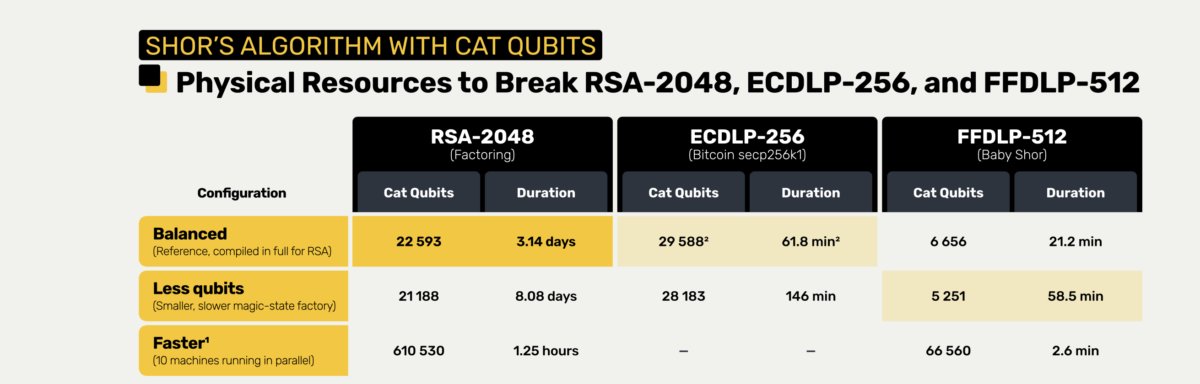
So, to factor an RSA-2048 encryption key, and shatter the digital lock protecting our thousand pictures of Mrs. Whiskers (and bank accounts), a framework of 22,593 cat qubits would only need 3.14 days.
"To our knowledge, no published architecture is smaller at this runtime, which puts us at the frontier of size and speed together," the researchers say in their blog post.
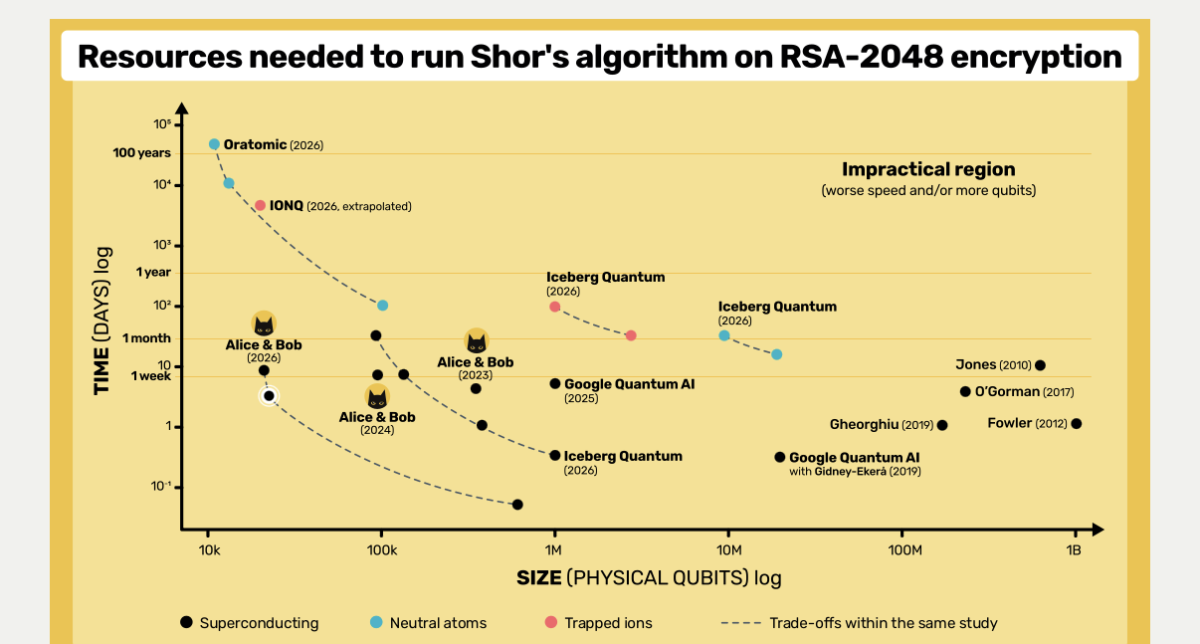
This balanced approach strikes a sweet spot between space and time requirements.
The qubit count dictates the size of the quantum computing machine and its hardware, including the cryogenics needed to cool quantum chips to fractions of a degree above absolute zero, significantly colder than outer space.
The other essential factor is runtime, or how long it would take to generate a useful computation.
"You can trade one for the other, but push too far either way and you end up with a machine that is too big to build, or too slow to matter," the blog post explains.
For an expedited effect, linking 10 quantum computing machines to yield 610,530 cat qubits could crack RSA-2048 in just 1.25 hours.
The researchers also estimated the resources needed to, in effect, bypass the elliptic curve digital padlocks that secure Bitcoin ownership. A system with 29,588 cat qubits could do so in 61.8 minutes.
However, Bitcoin transactions occur within a 10-minute block time, the researchers note, a time limit that would need to be met to steal this cryptocurrency in transit.
So any hackers wanting to reenact the famous Bitcoin Pizza Day are, as yet, out of luck.
Importantly, no one has a 23,000-qubit quantum computer. And it's not even close. The largest array, developed by Caltech engineers, features 6,100 qubits trapped by lasers – but this is an array rather than a functional 'computing' computer.
Multiple current quantum challenges must be surpassed, including temperature control, scalability, and stability, such as linking many chips and increasingly distant qubits. Still, some surmise that the RSA-2048 standard may be deprecated at the dawn of the next decade.
Additionally, the researchers' estimates assume that the cat qubits can avoid bit-flip errors for 100 years, but many proven qubits may only be stable for milliseconds.
Yet cat qubits become exponentially more stable by incorporating extra photons in the oscillator – just throw some more cats in the box (Schrödinger's litter).
In fact, Alice & Bob quantum physicists have recently achieved a milestone average bit-flip time of 44 minutes by stuffing 11 photons into their cat-box (cat qubit), improving standard stability by millions of times.
The study suggests that relaxing the bit-flip times to about one hour would require doubling the qubit count to around 45,000.
As the researchers note in their press release, the early 2030s may see the convergence of improved hardware and lower resource requirements.
As a result, the first machines could be built in a matter of years – though the timeline of actual threats is uncertain.
The research is available as a preprint on the Cryptology ePrint Archive.
This article was fact-checked by Rebecca Dyer and edited by Rebecca Dyer. While we pride ourselves on our process, we are only human. If you spot a mistake, please let us know.