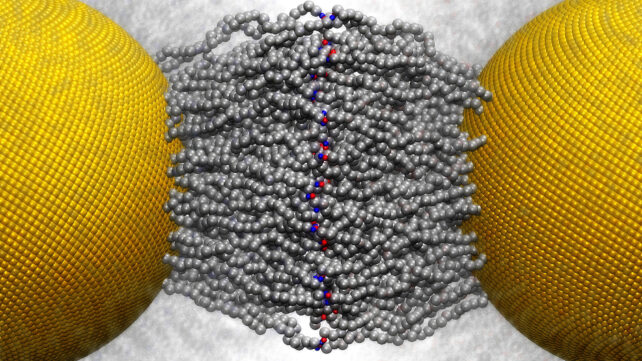
One of the key methods through which scientists develop and enhance new materials is by getting more control over their structure at the smallest scales, and microscopic nanoparticles can be incredibly useful for this kind of detail.
Now researchers led by a team from MIT have overturned the conventional thinking of the last couple of decades when it comes to how these nanoparticles are connected together.
Previously, the connectors – or ligands – between the nanoparticles have mostly been designed as rigid and fixed.
In a new study in Nature Materials, the researchers went for the opposite approach, building connector molecules that were floppy rather than rigid.
The nature of the links is determined by the nanoparticles themselves as they come together.
Crucially, the researchers found that this gave them better control over the number of links between the nanoparticles, and the direction of those links. And with better control, comes more possibilities for new materials.
"People are interested in nanoparticle superlattices because of the promise of building designer materials where you have more say in what types of structures they can actually build into," says materials scientist Rob Macfarlane, from MIT.
"This is a new approach in nanoparticle assembly that hasn't been investigated before. It's exciting to have a new tool that is so counterintuitive."
Materials made of nanoparticles are already widely used in a variety of fields, but they can be difficult to scale up. By default, they pack together tightly and have to be carefully engineered for each specific purpose.
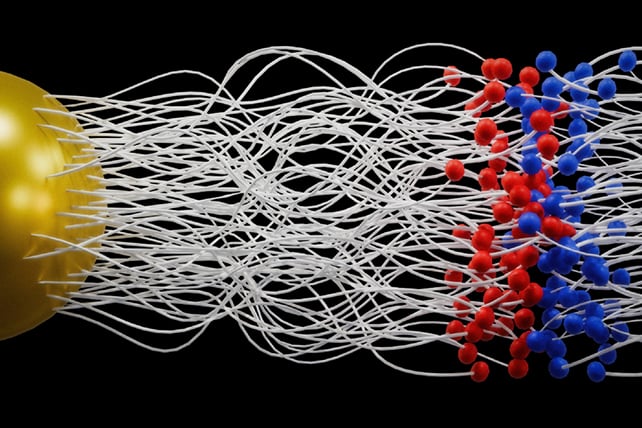
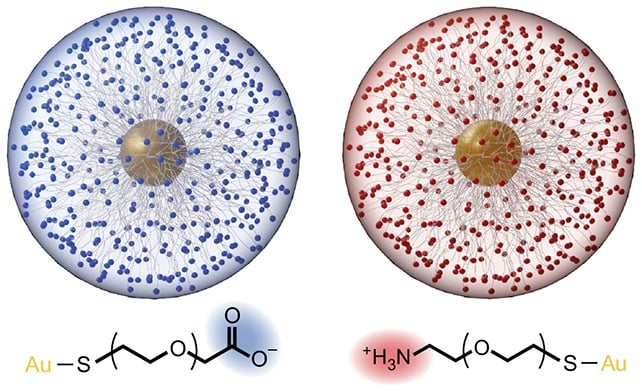
Here, the researchers used gold nanoparticles with ligands made from a common, floppy polymer called PEG, tipped with positive or negative charges to aid the connections. Computer simulations were also run to follow what the experiment was showing.
Without any rigidity, the ligands ended up bunching together where the particles touched, which in turn limited the number of connections that could be made – there were only so many particle-to-particle chains to go around.
"It's the exact opposite of what the dogma has been for 20 years: that you need to make connector ligands rigid, and any deviation causes assembly to fail," says Macfarlane.
"We showed if you just crank it all the way to the opposite extreme, it works just as well."
The connections can still be controlled to a large extent by changing the sizes of the nanoparticles and the lengths of the ligand chains. For example, the team found that smaller particles led to fewer links.
In tests, the team was able to create ordered crystal structures that haven't been seen before. The functionality of these materials still needs to be examined and tested, but the results of the experiment are promising.
"Without having to predesign where the particles connect or what their shapes are, we can control the number of bonds each particle has," says Macfarlane.
"The amount of flexibility of the polymer dictates how many bonds it has. It allows us to lower the number of bonds each particle has and make lattices we have never seen before."
Materials scientists have previously tried to fine-tune nanoparticle connections by precisely aligning them, or changing the shape of the particles themselves. It turns out that relinquishing some rigidity actually brings about more order.
According to the researchers, the new approach could lead to the development of high-performance materials in fields including photonics (technologies that control light), chemical catalysis, medicine, and agriculture.
Ultimately, nanoparticles that aren't packed as closely together mean a material that can be customized at scale more easily, and "that's where a lot of the interesting applications are," says Macfarlane.
The next steps will be to experiment with other particle materials and ligand combinations, and put the materials to the test in real scenarios.
"If you know what your building blocks are and how they're arranged, you can explain what properties materials have," says Macfarlane. "Controlling that is how you make materials that have new properties."
The research has been published in Nature Materials.
This article was fact-checked by Fiona MacDonald and edited by Fiona MacDonald. While we pride ourselves on our process, we are only human. If you spot a mistake, please let us know.