Since the very first particles fizzed into existence in the Big Bang, the Universe has been evolving.
From the humblest atom to the mightiest superstructures, nothing escapes the long, long fingers of change – but some things, it seems, can skip slightly to one side as those fingers graze past.
And a tiny galaxy in the distant Universe seems to have emerged largely unscathed from one of the biggest changes in the history of the cosmos.
As it existed just 1 billion years after the Big Bang, the galaxy, named AMORE6, contained gas so chemically pristine that astronomers think it could be home to the elusive first generation of stars – forged from the Universe's raw ingredients, unaltered by the ashes of stars that came before.
JWST has detected galaxies hundreds of millions of years earlier that bear the hallmarks of multiple generations of stars; the discovery suggests AMORE6 may have somehow escaped much of the chemical evolution taking place elsewhere in the Universe.
If the presence of primordial stars can be verified, AMORE6 will represent a time capsule that could tell us more about how the Universe started to assemble stars out of little more than the hydrogen soup at the dawn of time.
"Although we cannot exclude alternative sources of hard ionizing radiation, such as accreting black holes, these observations offer the first view of the extremely low metallicity environment where the Universe's first stars are predicted to be born," write astronomers led by Takahiro Morishita of Tohoku University in a preprint uploaded to arXiv.
The first stars in the Universe were also the catalysts of a vast chemical revolution.
In the first few minutes after the Big Bang, the Universe produced the atomic nuclei for just a few elements – predominantly hydrogen, a smaller proportion of helium, and scant traces of lithium. The rest of the periodic table wasn't even a twinkle in an atomic proton.
Then, somehow, enough of this primordial fog drew itself together densely enough to start forming the first stars – and everything changed.
We don't know for sure what they looked like, but simulations and models suggest they were giants – huge and hugely hot, the vast furnaces in their hearts forging hydrogen into heavier and heavier elements until, in many cases – BOOM – supernova explosions scattered these heavier atoms to the cosmic winds, while creating even heavier ones in the violent inferno.
The rest was history. Subsequent generations of stars started with these materials, taking them up during formation, then contributing their own fusion and supernova products.
This is why astronomers can roughly gauge a star's age based on the proportion of elements heavier than helium it contains. Younger stars have more; older stars have less.
To date, astronomers have yet to conclusively find those first stars, known as Population III.
But here's the fun thing about Pop III stars. They don't necessarily have to be the oldest stars in the Universe. They just have to have formed from pristine material that hasn't been touched by the chemical output of earlier stars.
And this is what Morishita and his colleagues think JWST has stumbled upon with AMORE6.
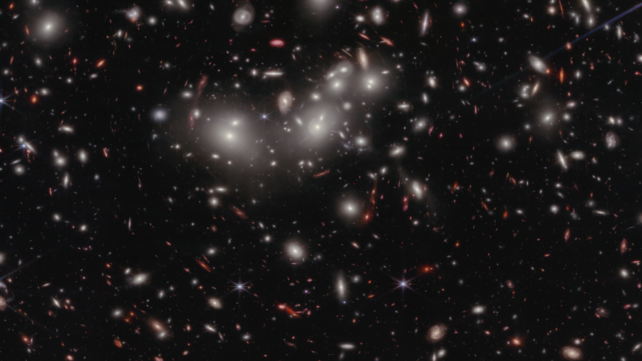
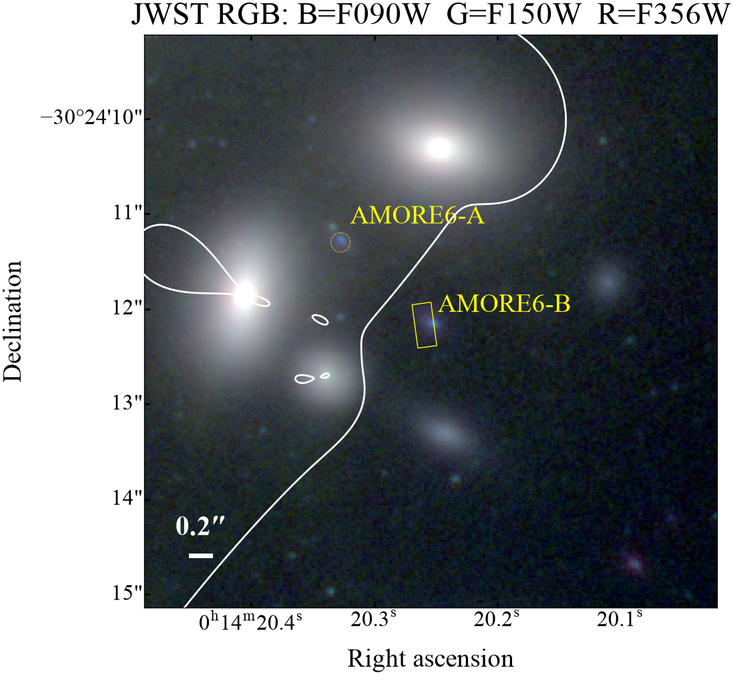
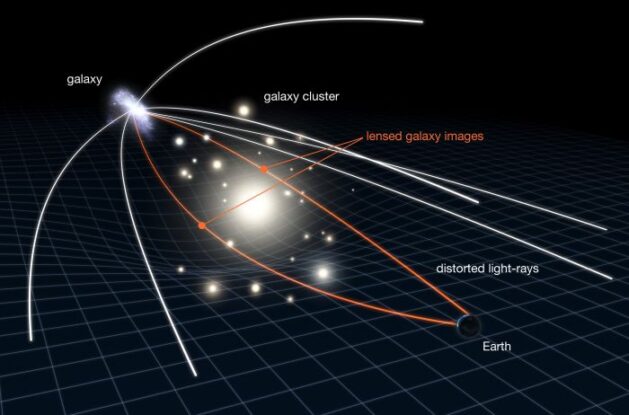
The galaxy itself, seen as it was around 12.8 billion years ago, is tiny – too faint to observe in such detail without the aid of Pandora's Cluster of galaxies, gravitationally warping spacetime to act as a giant magnifying glass.
The researchers calculated that AMORE6 has an effective radius of just 117 light-years.
But it's the stuff AMORE6 is made of that made the researchers really sit up and pay attention.
AMORE6 was identified in JWST observations reported in 2025, and initial spectroscopy revealed something peculiar: although the glow emitted by ionized hydrogen was clearly detectable, the telltale glow of oxygen that usually accompanies it was conspicuously absent.
That paper, also led by Morishita, found that the oxygen content of the galaxy's gas was estimated to be lower than 0.19 percent of the Sun's oxygen abundance. That made it a particularly promising place to look for pristine matter – including those elusive Pop III stars.
So, they booked time on JWST to take a much closer look – this time training the telescope's Near-Infrared Spectrograph (NIRSpec) instrument on the galaxy for a total of 45.2 hours.
Goodness gracious, the data it obtained.
This time, the researchers were able to detect the faint spectral signature of oxygen, as well as that of carbon. From the oxygen measurements, they calculated that the gas in AMORE6 had just 0.076 percent of the oxygen abundance of the Sun – remarkably low even for a galaxy so small.
But something else in the spectrum was particularly exciting: two emission lines produced by helium atoms stripped of both their electrons.
It takes extraordinarily energetic radiation to do this, of a kind that ordinary populations of stars struggle to produce in sufficient quantities.
Pop III stars, on the other hand, are not thought to be like ordinary stars.
This is because elements heavier than helium play an important role in allowing clouds of star-forming gas to cool as they collapse under gravity, enabling them to break up into smaller clumps to form individual stars.
Without these elements, the primordial gas would have remained much hotter. The gas would not have fragmented into smaller clumps in the same way, favoring the formation of much more massive stars.
And these stars are predicted to have been blisteringly hot, with surface temperatures reaching around 100,000 kelvin – more than twice those of typical massive stars today. Stars this hot would have been prodigious sources of precisely the sort of high-energy radiation needed to strip helium of both its electrons.
The strength of the helium emission in AMORE6 is consistent with predictions for a population of stars that formed from pristine gas.
It's not a smoking gun, though. A black hole actively slurping up material could also generate radiation of the requisite energies.
The researchers calculated that such a black hole would have a mass between 1,000 and 10,000 times that of the Sun. That would be a fascinating discovery in its own right – an elusive exemplar of the intermediate-mass class – if its existence could be confirmed.
And what of the oxygen and carbon? Well, actually, their presence doesn't necessarily mean that the stars in AMORE6 formed from gas that had already undergone chemical enrichment from earlier stars.
Pop III stars more than 100 times the mass of the Sun could forge and release detectable quantities of both elements in just a few million years.
Which means it's possible that JWST has caught the first stages of AMORE6's own chemical evolution.
Whatever it is we're looking at with AMORE6, the galaxy seems to have something very interesting to tell us – whether it's a black hole of unusual size, or a pocket of space that managed to remain isolated from chemistry occurring all around it to produce late-blooming Pop III stars, or even both.
As the researchers conclude, "AMORE6 is consistent with retaining conditions resembling those of primordial star formation almost one billion years after the Big Bang."
The research is available on preprint server arXiv.
This article was fact-checked by Fiona MacDonald and edited by Fiona MacDonald. While we pride ourselves on our process, we are only human. If you spot a mistake, please let us know.