
Non-physicists might hear of 'the Hall effect' and think it relates to the way time elongates when trying to get young children out of the front door, or the phenomenon where you always forget your keys or phone as you travel through the hallway.
However, the actual Hall effect concerns the way that electric currents and magnetic fields interact in certain scenarios – it's useful in a vast range of technologies where magnetism needs to be detected, including in flip covers on phones.
While the effect has been known about since physicist Edwin Hall discovered it in 1879, researchers led by a team from Carnegie Mellon University in the US have now found that it doesn't have to work in quite the way scientists have always thought.
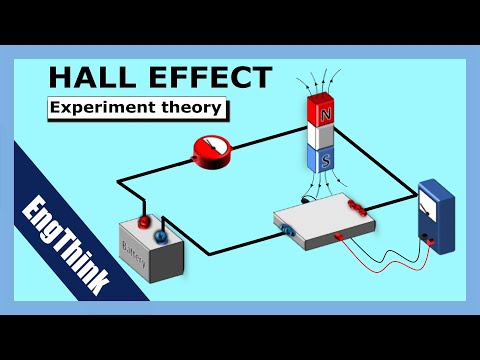
A magnetic version of the phenomenon, known as the anomalous Hall effect, can also be produced by a material's own magnetization.
A new study shows that this magnetization doesn't necessarily need to point in one specific direction – it's more versatile than that, as the research team reports in a study published in Nature Materials.
"For a long time, people thought the Hall effect only worked when the magnetic field was applied perpendicular to the plane of the film," says physicist Simranjeet Singh from Carnegie Mellon University.
"We've shown that that's not true – you can also get a response when the field is in-plane."
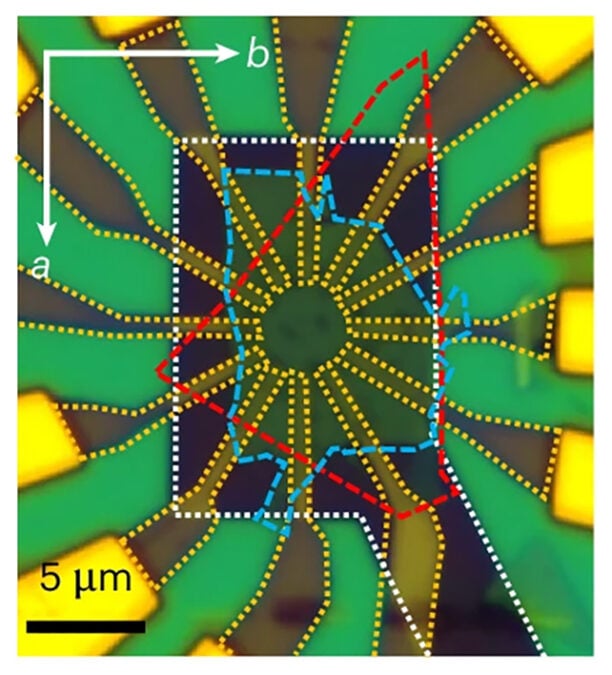
It's a shift in thinking that has been theorized before, but never demonstrated in a 2D system like the one the researchers constructed here.
Those theories were used as a basis for creating a custom atomic structure, made up of an ultra-thin layer of the material tantalum iridium telluride (TaIrTe4), paired with a magnetic layer of CGT (Cr2Ge2Te6).
The structural combination was enough to 'leak' magnetism into the non-magnetic layer, while also reducing some of the inherent material symmetry that would otherwise restrict how the Hall effect could be created.

"People proposed it and ideas were out there, but it's very difficult to make a magnetic material with the right symmetry to do it," says Singh.
"What we did was we found a material with the right symmetry and we made it magnetic."
It's a significant breakthrough for understanding a fundamental effect in physics. In more practical terms, the big win could be in magnetic sensors, where a single sensor could replace more complex setups.
Another way to think about it is that a single, ultra-thin device will potentially be able to detect magnetic fields along multiple axes, rather than just one.
"This truly demonstrates the power of building atomically precise heterostructures of emergent two-dimensional quantum materials to obtain on-demand electronic and magnetic properties," says physicist Jyoti Katoch from Carnegie Mellon University.
Some theoretical modeling was done as well, to go alongside the lab experiments and explain why the researchers got the results they saw.
The models showed that different electron effects – such as spin-orbit coupling (where an electron's motion is coupled to its spin) and magnetic exchange interactions – could account for the observed response, but further studies will be needed to know for sure.
There are broader implications too. All materials have a certain intrinsic symmetry, but the research shows that combining materials can break and modify those symmetries in useful ways – with quantum computers potentially being one field that could benefit.
However, for now this is a small-scale experiment run in very specific lab conditions – including cryogenic temperatures. The next steps for researchers will be to test the alternative Hall effect in a broader range of materials, closer to room temperature.
Related: Startling Exception Discovered to 200-Year-Old Law of Physics
"Our results reveal the potential for designing tunable Hall effects by controlling crystal symmetry and exchange interactions at interfaces," write the researchers in their published paper.
"Our work opens up possibilities for future investigations into other low-symmetry topological materials to engineer novel quantum transport phenomena for next-generation spintronic and electronic devices."
The research has been published in Nature Materials.
This article was fact-checked by Peter Dockrill and edited by Peter Dockrill. While we pride ourselves on our process, we are only human. If you spot a mistake, please let us know.