
The Fermi paradox asks: If there are other civilizations in the Universe besides ours, why haven't we yet made contact?
Researchers who study this paradox – also called the Great Silence – generally point to two explanations. First, maybe it's that intelligence is "intrinsically rare", writes Celia Blanco, who authored new research into this question.
The second is where Blanco and her colleagues have focused their work: "While intelligence may emerge, technological civilizations are typically short-lived, succumbing to self-destruction through ecological collapse, conflict, or other systemic instabilities."
Self-destruction might not mean complete annihilation, though.
Blanco and her team's idea is that the Universe could be full of technological civilizations that rise, collapse, rebuild, and rise again – spending long stretches in technological dormancy. If so, that could explain the cosmic silence we're currently experiencing

After all, humanity has only been able to communicate with others for maybe around a hundred years or so.
This isn't just a philosophical talking point. It comes out of a new model of Earth's possible technological future, which simulates ten different scenarios over the next 1,000 years. The scenarios vary in their governance, resource availability, and resilience, from a relatively stable, egalitarian "Golden Age" to societies under severe resource pressure or technological risk.
The scenarios are fascinating in-and-of themselves. As described by the researchers, the Golden Age is a stable, egalitarian society with abundant resources where tech growth occurs without collapse.
Out of Eden is a distributed society where humans and machines coexist harmoniously with nature, and the Ouroboros is a hierarchical civilization that keeps expanding, collapsing and regrowing (but that collapse and regrowth actually pushes the culture forward and makes it self-stabilizing).
Living with the Land is a low-impact culture constrained by ecological limits which has an initial tech-growth phase but then has frequent deep collapses and recoveries. There are six more examples in the full research paper.
The researchers ran 200 simulations for each scenario, allowing civilizations to grow until either their resources ran out or a randomly generated existential hazard–a catastrophic event such as an environmental disaster or technological failure–knocked them into collapse.
Afterward, some could recover, depending on how much technology and resources survived and how quickly society could rebuild.
The researchers call the proportion of time a civilization remains technologically active its duty cycle. The duty cycles varied dramatically across the simulated futures, from about 38 percent to 100 percent of the time.
Two scenarios – the "Golden Age" and "Out of Eden" – never collapsed during the simulations. But seven of the ten scenarios collapsed in every run.
"Living with the Land," for example, had a duty cycle of just 38 percent, while the "Ouroboros" scenario cycled through collapse and recovery while maintaining a much higher 87 percent duty cycle.
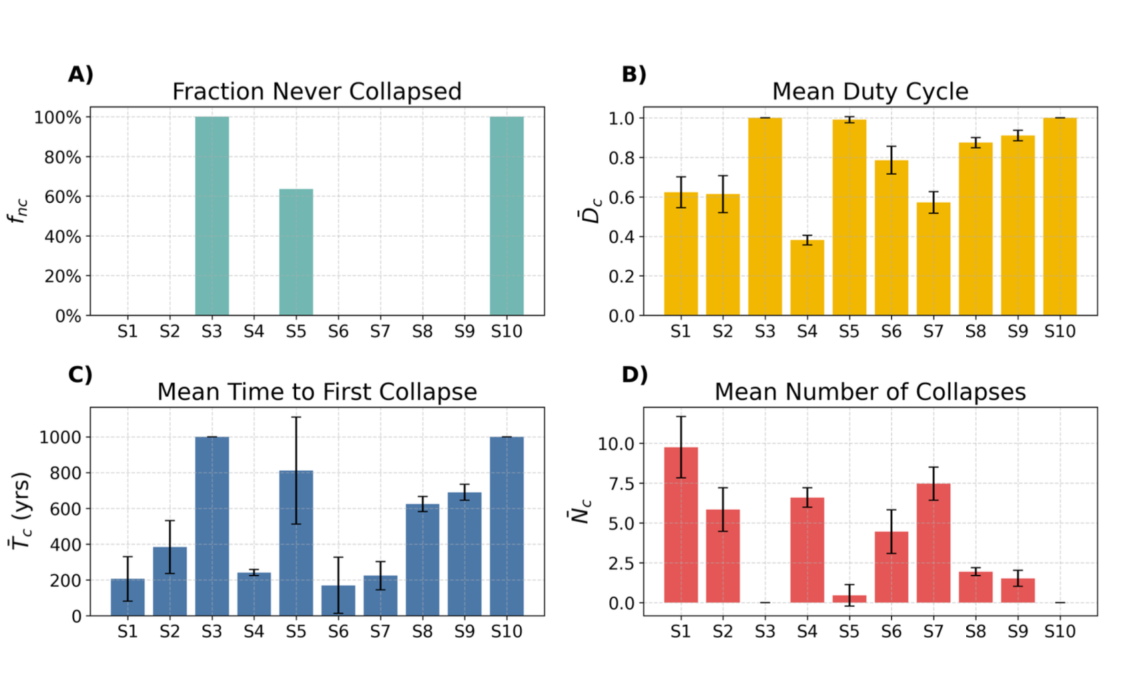
Distributions of key collapse and recovery metrics across scenarios (200 runs each). (Blanco, et al. arXiv, 2026.)
In other words, technological civilization doesn't necessarily have to be a one-way trip from Stone Age to spacefaring – or from technological sophistication straight to extinction. It could behave more like a waxing and waning flame.
That matters for the search for extraterrestrial intelligence, because astronomers need to catch a civilization while it is actually detectable.
The researchers then introduced a concept called effective detectability duration, which adjusts the familiar longevity term in the Drake equation (the famous framework for estimating how many detectable civilizations might exist in the Milky Way) to account for periods when a civilization is technologically inactive.
If a civilization spends only 40 percent of its time producing detectable technology, for example, its effective window for detection is much smaller than if it broadcasts continuously for the same overall lifespan.
And if two civilizations are intermittent, the chance of their active periods overlapping can become very small.
This could offer a new way to think about the Fermi paradox: the apparent absence of extraterrestrial signals despite the enormous age and size of the Universe.

The model also offers a less cosmic, more useful lesson for those of us here on Earth.
Of all the parameters tested, two consistently had the greatest effect on whether civilizations remained active: how quickly they consumed resources and how much of their resource base they could recover after a collapse. Small changes around certain thresholds could produce disproportionately large changes in long-term resilience.
That points toward some decidedly terrestrial interventions: reducing resource consumption, preserving knowledge and infrastructure, and making it easier for future generations to rebuild after catastrophe.
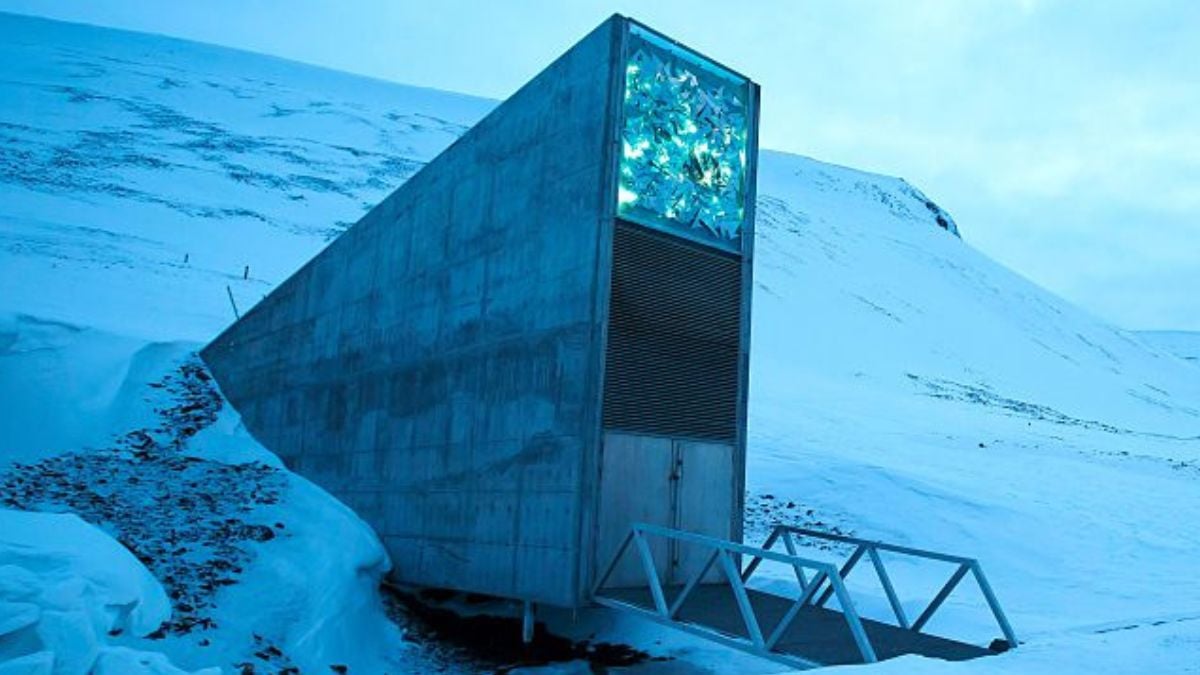
The authors suggest that solutions to this could include everything from distributed infrastructure to apocalypse "recovery kits" which are "curated repositories of essential knowledge designed to accelerate post-collapse rebuilding" containing specifics about agriculture, medicine, energy, and communications.
The authors point to the Svalbard Global Seed Vault as a great example of this.
There is, however, a very large caveat to this very large idea.
The simulations are based on scenarios imagined for Earth and make major simplifying assumptions, including linear technological growth and fixed resource-depletion rates.
This is all based on human organization and structures, but an alien civilization might organize more like a bee hive, or a dolphin pod for all we know. (And this is a preprint article, so be aware it hasn't been peer-reviewed yet.)
Related: We Surveyed Scientists About Aliens. Their Answers Were Revealing.
None of this is a prediction that humanity will collapse and reboot—nor is it evidence that extraterrestrials are hiding in the dark. It's just a particularly well-thought-out way of thinking about the question and trying to answer it with what we know now.
But it does give a little more wiggle room for why we have yet to make contact with an alien civilization that's rooted in some pretty comprehensible ideas.
The research has been published on arXiv.
This article was fact-checked by Fiona MacDonald and edited by Fiona MacDonald. While we pride ourselves on our process, we are only human. If you spot a mistake, please let us know.