There's something hinky about the amount of gravity in the Universe.
When all the normal matter and the gravity that should come with it have been totted up, a discrepancy emerges in the final numbers.
Not just a smidge, a little skimming off the top, a one here or a zero there: there's way more gravity than there is normal matter to make it.
We call the unknown source of the gravity excess dark matter, and scientists estimate there's roughly five times as much of it as there is normal matter in the Universe.
That means the mystery matter should be absolutely everywhere, and so it is, as far as physicists can tell. But we still don't know what it is, let alone how to make it.
Now, a theoretical paper has identified a new recipe we could try.
What if, ask theoretical physicists Stefan Evans and Ralf Schützhold of the Helmholtz-Zentrum Dresden-Rossendorf in Germany, we just took a bunch of atomic nuclei and gave them a good, hard shake?
OK, not literally – and obviously there's a good bit more to it than a nucleus maraca.
But the pair proposes that if nuclei are accelerated hard enough in a particle accelerator, they could disturb the quantum vacuum in just the right way to produce pairs of axions – hypothetical particles that could make up dark matter.
"Accelerated nuclei such as in ultraperipheral heavy-ion collisions can create entangled pairs of axions in analogy to the dynamical Casimir effect which can also be interpreted as signatures of the Unruh effect," they explain.
Well, duh. But let's elaborate a bit anyway.
We'll start with axions.
These hypothetical particles have been kicking around for nearly half a century, although dark matter wasn't the problem they were originally proposed to solve.
That problem lies in quantum chromodynamics, or QCD, the theory that describes the strong force binding quarks together to form protons and neutrons, which cluster together in atoms to form the nucleus.
QCD allows for a particular kind of symmetry violation that, for reasons physicists don't understand, simply doesn't seem to happen. That part isn't really relevant to this paper, so we won't go further into it.
What is relevant is that the axion emerged from a proposed solution to this puzzle. As an unexpected bonus, the properties of the hypothetical particle also made it a compelling dark-matter candidate.
Which gives the axion a foot in two worlds: QCD and dark matter.
It's the QCD foot that's pertinent here.
One of the many weird things about QCD is that even apparently empty space isn't truly empty. The quantum vacuum contains a background called the quark condensate, made up of quark-antiquark pairs.
Inside an atomic nucleus, however, that condensate is weaker – and that's important because the strength of the quark condensate helps determine the effective mass of an axion.
This means that if axions exist, they should be effectively lighter inside an atomic nucleus than outside it – making the nucleus a different kind of medium for axions, a little like water is a different medium for light than air.
This still makes a difference even when no axions are hanging around.
Quantum mechanics doesn't allow even completely empty space to be perfectly featureless and still. Instead, the fields that permeate space retain an irreducible background of quantum activity, known as vacuum fluctuations.
One strange consequence of those fluctuations is known as the Casimir effect. Place two objects extremely close together, and they can change which fluctuations are possible in the space between them compared with the space outside.
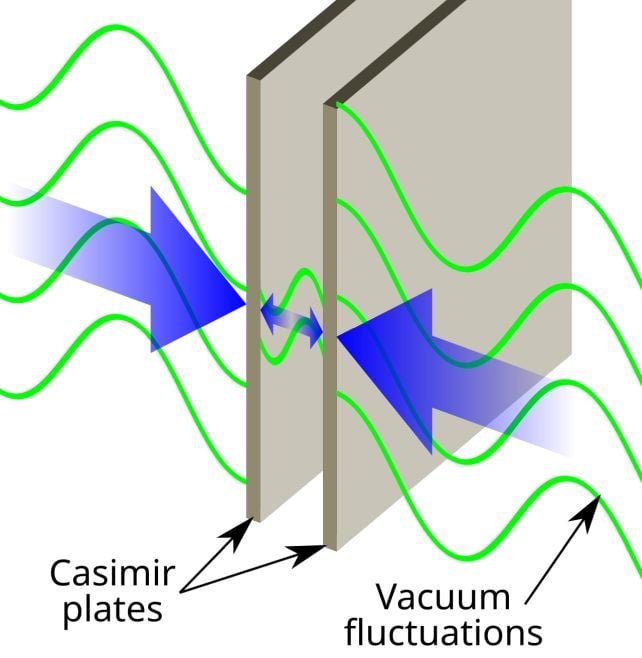

The resulting change in the field's vacuum energy can produce a measurable force between the objects.
In its best-known form, the Casimir effect involves the electromagnetic field and two closely spaced conducting plates – but the same underlying physics can, in principle, arise with other quantum fields, too.
Evans and Schützhold reasoned that something similar should happen with the axion field. Since a nucleus changes an axion's effective mass, it should also change the vacuum fluctuations of the axion field around it.
Their calculations suggest that if you put two nuclei close together, those altered fluctuations should generate an attractive Casimir-like force between them.
OK, so we have two nuclei sitting still, feeling a little attracted.
But the Casimir effect does something even weirder when stuff starts moving in just the right way.
If the thing disturbing a quantum field changes sufficiently rapidly, that disturbance can inject energy into the field, converting its vacuum fluctuations into pairs of real particles. That's the dynamical Casimir effect, and it's not just theory. Physicists have seen it produce real photons.
This is where our nucleus maraca comes back in.
A nucleus already changes the vacuum fluctuations of the axion field simply by existing. But if you accelerate that nucleus hard enough, the region of the altered axion field moves in just the right way to produce the dynamical version of the Casimir effect.
Some of the energy involved in rapidly accelerating the nucleus can then emerge as a pair of real, entangled axions.
Strangely, there's another way of understanding the same process.

According to the Unruh effect, an observer undergoing constant acceleration should experience what looks like empty space to an unaccelerated observer as a warm bath of particles. The harder the acceleration, the hotter that apparent bath becomes.
So, from the perspective of an accelerated nucleus, the empty vacuum would appear to contain a nice warm bath of axions. The nucleus could scatter an axion from that bath.
From our unaccelerated perspective, however, there is no axion bath – so we would instead see a hurtling nucleus appear to pop a pair of entangled axions out of the vacuum.
It sounds utterly demented, and utterly impossible – but we may, the researchers explained, already have the technology to put the idea to the test.
Evans and Schützhold propose ultraperipheral heavy-ion collisions as one possible setting. These are near-misses between atomic nuclei traveling at relativistic speeds, in which their powerful electromagnetic fields interact without the nuclei themselves colliding.
During such a close encounter, the nuclei undergo the abrupt change in motion the proposed mechanism requires.
It might not work. The estimated odds of producing an axion pair depend strongly on the axion's mass, and even if one is produced, detecting it is another challenge entirely.
You might need a sensitive liquid-xenon dark matter detector, for instance, and the axion would need to travel in the right direction to hit it. So it's likely to be very difficult.
Still, it might be worth a shot. After all, you can't make axion soup without breaking a few eggs.
The research has been published in Physical Review D.
This article was fact-checked by Peter Dockrill and edited by Peter Dockrill. While we pride ourselves on our process, we are only human. If you spot a mistake, please let us know.